PEO4YOU

Author: Sam Newland

  • When to Switch PEO Providers: 5 Warning Signs

    When to Switch PEO Providers: 5 Warning Signs

    You signed with a PEO to make HR easier. Instead, you’ve become the unofficial HR department — fielding benefits questions your PEO rep won’t answer, manually enrolling employees because the portal doesn’t work, and spending hours each week on tasks the PEO was supposed to handle.

    If this sounds familiar, you’re not alone. When to switch PEO providers is one of the most common questions we hear from employers who chose their PEO based on price alone and are now paying for it in operational headaches. The good news: switching is more straightforward than most PEOs want you to believe.

    Key Takeaways
    • A PEO that won’t speak directly with your employees is shifting its workload to you
    • Manual benefit enrollment in 2026 is a platform failure, not a “process difference”
    • Cancellation fees ($5,000-$10,000) typically pay for themselves within 4-6 months of switching
    • Month-to-month contracts with 30-day notice exist — long-term lock-ins aren’t necessary
    • The real cost of a bad PEO is measured in management hours, not just fees

    Warning Sign #1: Your PEO Won’t Talk to Your Employees

    This is the most telling red flag. A PEO’s core value proposition is that it handles HR, benefits, and payroll so your team doesn’t have to. When your PEO reps refuse to speak directly with employees — forcing managers to relay questions about claims, coverage, or enrollment — the entire model breaks.

    In our experience working with a financial services firm that was evaluating a switch, the operations manager had become a full-time benefits intermediary. Every employee question about insurance claims, prescription coverage, or enrollment changes went through him because the PEO’s reps wouldn’t take employee calls directly.

    The operational cost was staggering: an estimated 10+ hours per week of management time spent on tasks the PEO was being paid to handle. At a loaded management rate, that’s $30,000-$50,000 annually in hidden costs that never appear on the PEO invoice.

    A properly structured PEO provides a dedicated benefits coordinator who handles employee inquiries directly — freeing management to focus on revenue-generating activities. If your PEO can’t offer this, it’s time to explore PEO health insurance options for small businesses that include direct employee support.
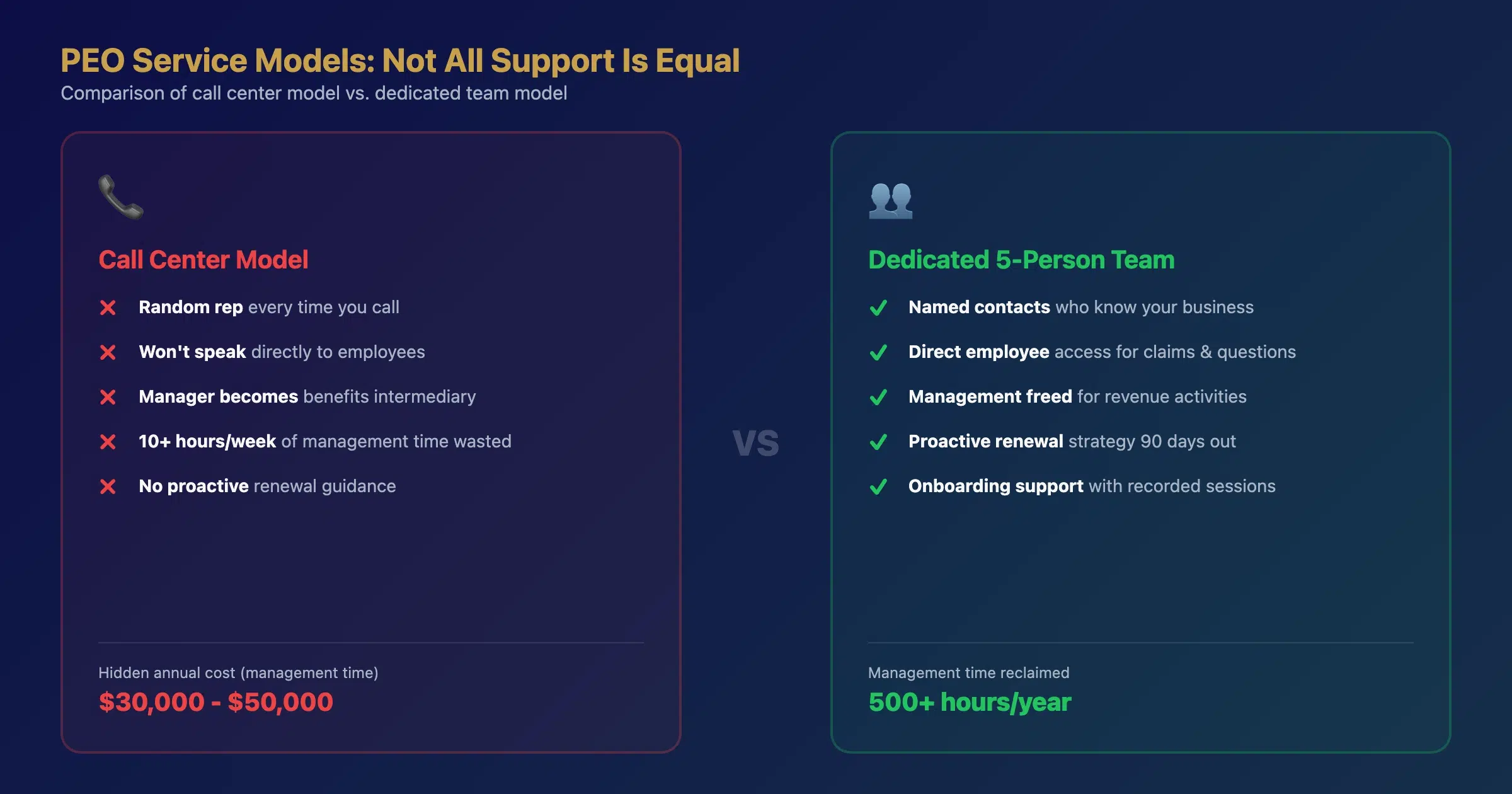
    PEO service model comparison between call center support and dedicated five-person team


    Warning Sign #2: Benefits Enrollment Is Still Manual

    In 2026, paper-based benefits enrollment is inexcusable. Yet we regularly encounter PEOs where employees must complete enrollment forms by hand, HR must manually enter I-9 documents, and benefits changes require phone calls and faxes.

    When to switch PEO providers often comes down to this: if the platform your employees interact with daily doesn’t work, nothing else matters. The financial services firm we worked with had a benefits portal that was technically “available” but functionally broken — employees couldn’t complete enrollment online, and the system didn’t mandate required document uploads during onboarding.

    A modern PEO platform should provide online self-service enrollment with mandatory document upload flows, automated onboarding workflows that track completion in real-time, a QuickBooks or accounting system integration that eliminates manual payroll data entry, and commission or variable pay import capabilities for complex compensation structures.

    Warning Sign #3: Your Admin Fees Keep Climbing Without Added Value

    PEO admin fees should reflect the value of services delivered. If your per-employee costs have increased 10-15% over two years without corresponding improvements in service, technology, or benefits, you’re subsidizing the PEO’s overhead — not paying for better outcomes.

    When we build benefits savings strategies for employers evaluating a switch, the admin fee comparison often reveals the largest opportunity. Here’s a real comparison we modeled:

    Cost Category Current PEO (% of payroll) Alternative PEO (flat fee) Impact
    Admin fees (15 employees) ~$7,200/year ($40/mo/ee) ~$13,260/year ($17/wk/ee) +$6,060 more
    Health insurance (15 employees) ~$66,600/year ~$44,000/year -$22,600 savings
    EPLI coverage Not included $2M included Risk reduction
    Dedicated support team Call center 5-person team Quality upgrade
    Net annual impact     ~$16,500 savings

    The higher admin fee purchased dramatically more value: lower insurance costs, EPLI protection (average defense costs run $75,000-$125,000 per claim according to industry data), and a dedicated five-person service team. What looked like a “cheap” PEO was actually the most expensive option when total cost of ownership was calculated.
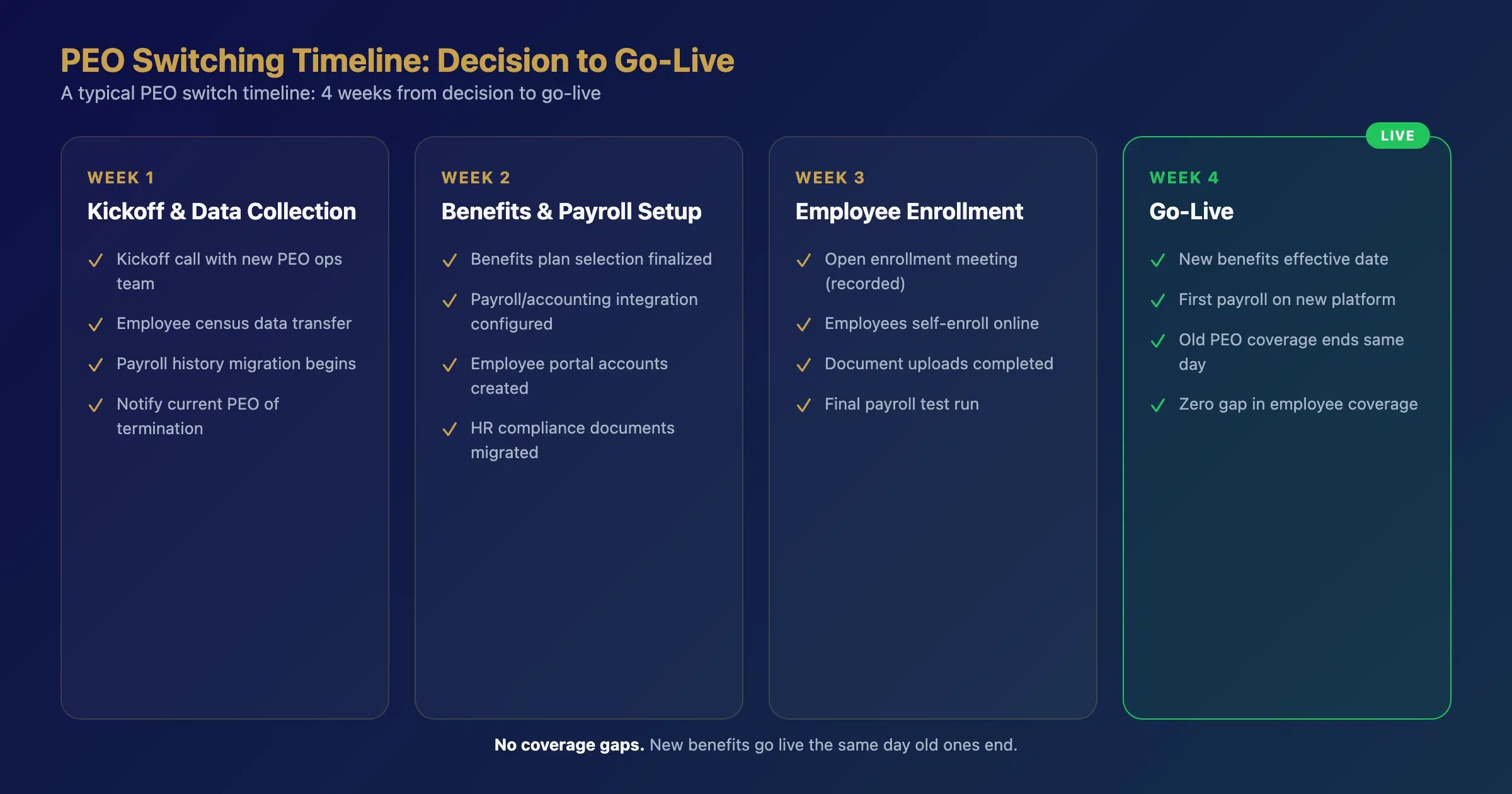
    Total cost comparison when switching PEO providers showing hidden costs of cheap PEO service


    Warning Sign #4: You’re Locked Into a Long-Term Contract

    Multi-year PEO contracts with substantial cancellation fees are a business model choice — they exist to create switching friction, not to serve your interests. If your PEO requires a 12-24 month commitment with a $5,000-$10,000 early termination penalty, ask why.

    The financial services firm we worked with faced a $7,500 cancellation fee from their current provider. The initial reaction was that the fee made switching unaffordable. But when we ran the full analysis, the projected savings from switching were approximately $48,000 annually — meaning the cancellation fee paid for itself in under 10 weeks.

    The right question isn’t “can I afford to leave?” It’s “can I afford to stay?”

    Month-to-month PEO contracts with 30-day notice periods exist. They signal that the PEO is confident enough in its service to earn your business every month, rather than trapping you contractually. If your PEO won’t offer this flexibility, consider how traditional group health insurance compares as an alternative structure.

    Warning Sign #5: Your Payroll Takes Too Long and Errors Are Common

    When running a payroll report takes 10 minutes of processing time, or when commission entries require manual data input that introduces errors every cycle, your PEO’s technology infrastructure isn’t meeting basic standards.

    Payroll should be fast, accurate, and integrated. Modern PEO platforms offer spreadsheet-based commission imports (eliminating manual entry errors), real-time payroll processing, and bi-directional accounting system sync. If your current PEO can’t deliver these fundamentals, it’s not a technology limitation — it’s a platform investment choice that tells you where you fall on their priority list.

    What Switching Actually Costs (and Saves)

    The fear of switching PEOs is almost always worse than the reality. Here’s what a typical transition timeline looks like:

    • Weeks 1-2: Kickoff calls for payroll/operations and benefits
    • Weeks 2-3: Open enrollment meeting for employees (recorded for those unavailable)
    • Week 4: Benefits effective date on the new platform

    The most common concern — “my employees will lose coverage during the transition” — is addressed through coordinated effective dates. Your new PEO’s benefits go live on the same day the old ones end.

    Use the Benefits ROI Calculator to model your total cost comparison before initiating conversations. Having clear numbers transforms the discussion from emotional to analytical.
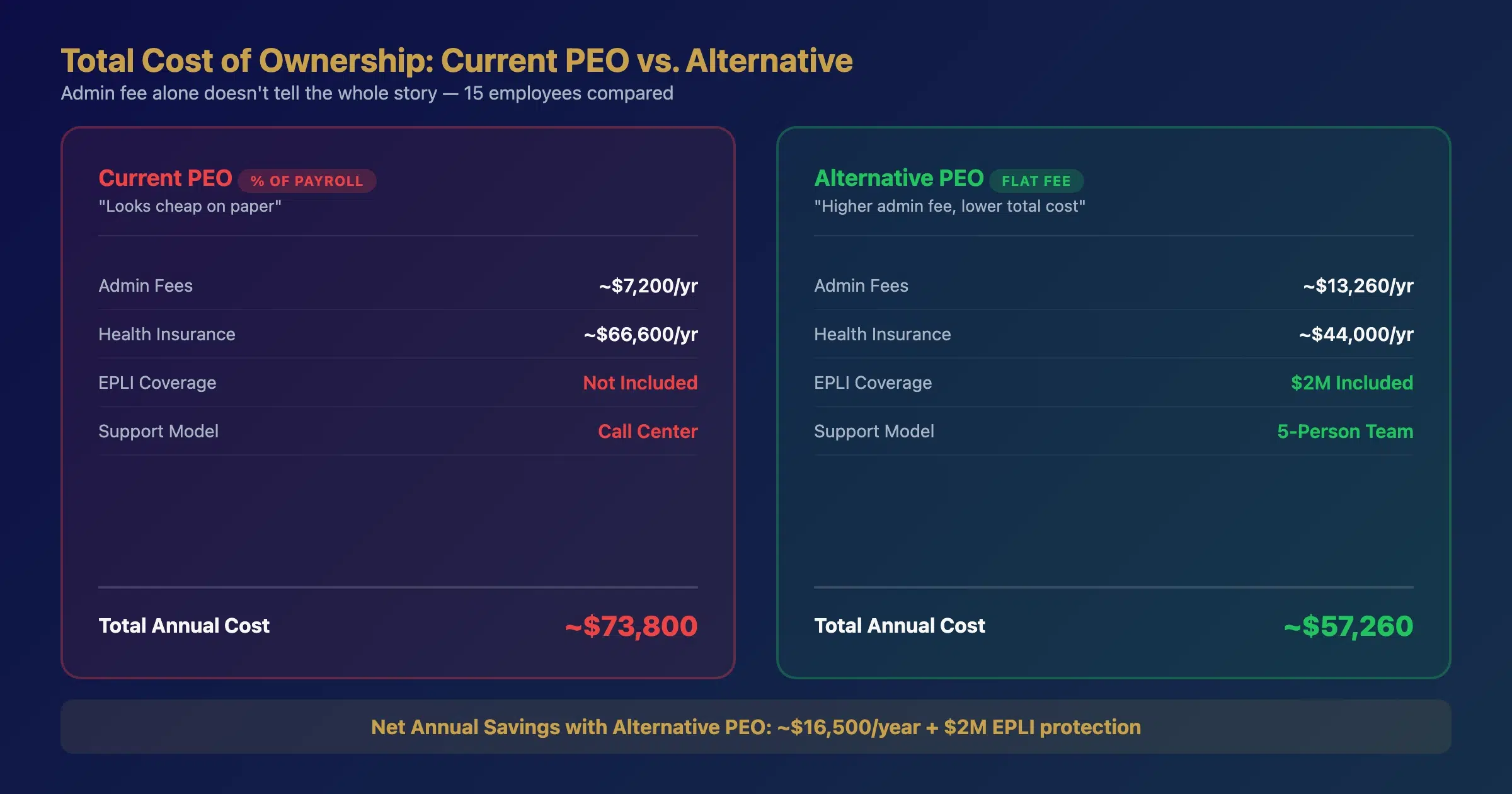
    Four-week PEO provider switching timeline from decision to benefits go-live

    If you’re spotting multiple warning signs in your current PEO relationship, the next step is understanding whether PEO honeymoon rates influenced your original decision — and how to avoid the same pattern in your next choice.


    Frequently Asked Questions

    How long does it take to switch PEO providers?

    A typical PEO transition takes 3-4 weeks from decision to go-live. This includes kickoff calls, data migration, employee enrollment, and benefits activation. Larger groups (50+ employees) may need 4-6 weeks. The key is coordinating effective dates so there’s no gap in coverage.

    Will my employees lose benefits during a PEO switch?

    No, when managed properly. The new PEO coordinates a benefits effective date that aligns with your current plan’s termination date. Employees experience a seamless transition — often with improved benefits and the same or better provider networks.

    What does a PEO cancellation fee typically cost?

    PEO cancellation fees range from $2,000 to $15,000 depending on company size and contract terms. However, most employers who switch to a better-fit PEO recover the cancellation fee in savings within 2-6 months. The fee should be evaluated against projected annual savings, not in isolation.

    Can I keep my current 401(k) provider when switching PEOs?

    In most cases, yes. Modern PEOs support integrations with major 401(k) providers through 180-degree or 360-degree APIs. During the evaluation process, confirm that the new PEO can integrate with your specific plan administrator to automate contribution tracking and reporting.

    What should I look for in a construction company benefits package when evaluating PEOs?

    For construction and trade businesses, prioritize workers’ comp integration (pay-as-you-go billing), E-Verify compliance support, multi-class benefits eligibility (different tiers for field vs. office staff), and a PEO with experience in your industry’s specific OSHA and DOL requirements.


    If you want to calculate whether switching makes financial sense for your business, the Benefits Savings Strategy Builder walks you through a comprehensive comparison — including cancellation fees, implementation costs, and projected savings.


    About the Author: Sam Newland, CFP®, has spent 13+ years in the employee benefits industry and founded Business Insurance Health and PEO4YOU to bring transparency to an industry that profits from complexity. His approach is simple: show employers the real numbers and let them decide.

  • PEO Honeymoon Rates: Spot Bait-and-Switch Pricing

    PEO Honeymoon Rates: Spot Bait-and-Switch Pricing

    Your PEO proposal just landed, and the numbers look fantastic. The admin fees are reasonable, the health insurance rates undercut your current plan by 15%, and the rep is already talking about an April 1st start date. Everything feels right.

    Until it doesn’t. Because what many employers don’t realize until year two is that the rates they celebrated were never meant to last. In the benefits industry, we call these PEO honeymoon rates — artificially low first-year pricing designed to win your business, lock you into the platform, and deliver the real cost later.

    Key Takeaways
    • PEO honeymoon rates are unsustainably low first-year quotes that spike 12-20%+ at renewal
    • A renewal increase projected within months of your start date is the clearest red flag
    • Percentage-of-payroll pricing models obscure true costs as your company grows
    • Always request 3-year rate history from the PEO’s existing clients before signing
    • Compare flat-fee vs. percentage-of-payroll models to understand your real long-term cost

    What Are PEO Honeymoon Rates and Why Do They Exist?

    PEO honeymoon rates are first-year insurance quotes priced below sustainable levels to make a PEO’s proposal look dramatically better than alternatives. The strategy is straightforward: offer an irresistible price, get the employer fully onboarded — payroll migrated, benefits enrolled, HR systems integrated — and then deliver the actual market-rate pricing at renewal when switching costs are highest.

    When we modeled this scenario for a mid-size law firm evaluating ADP TotalSource against an alternative PEO, the numbers told the story immediately. ADP’s proposal included health rates that looked competitive at first glance. But buried in the proposal was a projected 12% renewal increase effective just two months after the start date.

    That’s not a normal rate adjustment. A legitimate annual increase happens over a 12-month period. A double-digit spike within 60 days signals that the initial rates were never real — they were a door-opener priced below what the carrier would sustain.

    How to Identify PEO Bait-and-Switch Pricing

    The difference between a competitive quote and a honeymoon rate isn’t always obvious. Here’s what I’ve learned to look for after reviewing hundreds of PEO proposals across industries:

    1. The Renewal Timeline Doesn’t Match the Contract

    If a PEO quotes you an April 1 start date but projects a renewal increase in June, the math doesn’t work. Legitimate health insurance rates are set for a 12-month policy period. A rate increase within the first quarter means the initial rate was subsidized — and the subsidy is about to end.

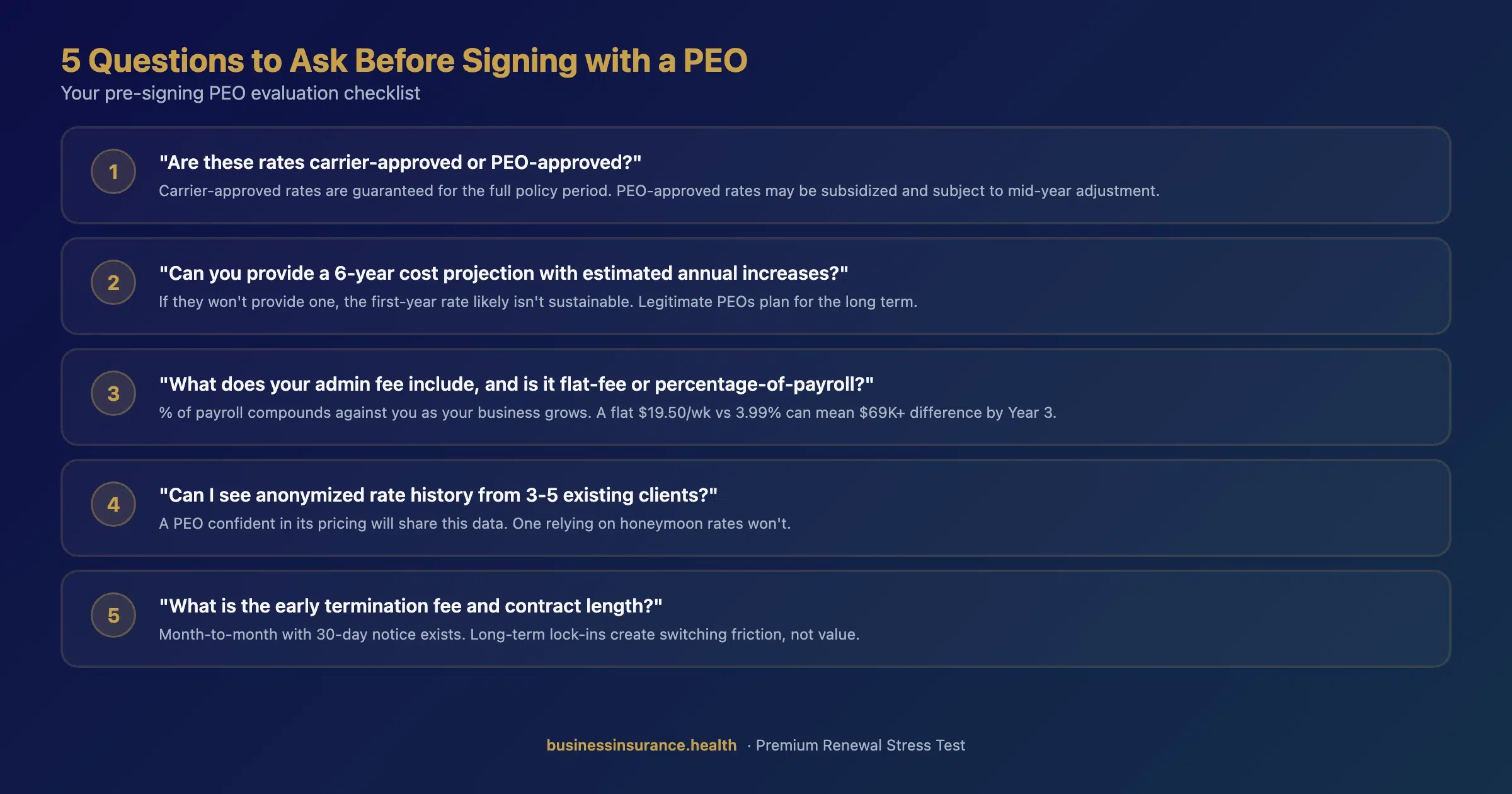
    What to ask: “Are these rates carrier-approved or PEO-approved?” Carrier-approved rates are underwritten and guaranteed for the full policy period. PEO-approved rates may be internally subsidized and subject to mid-year adjustment.

    2. The Admin Fee Structure Hides Escalating Costs

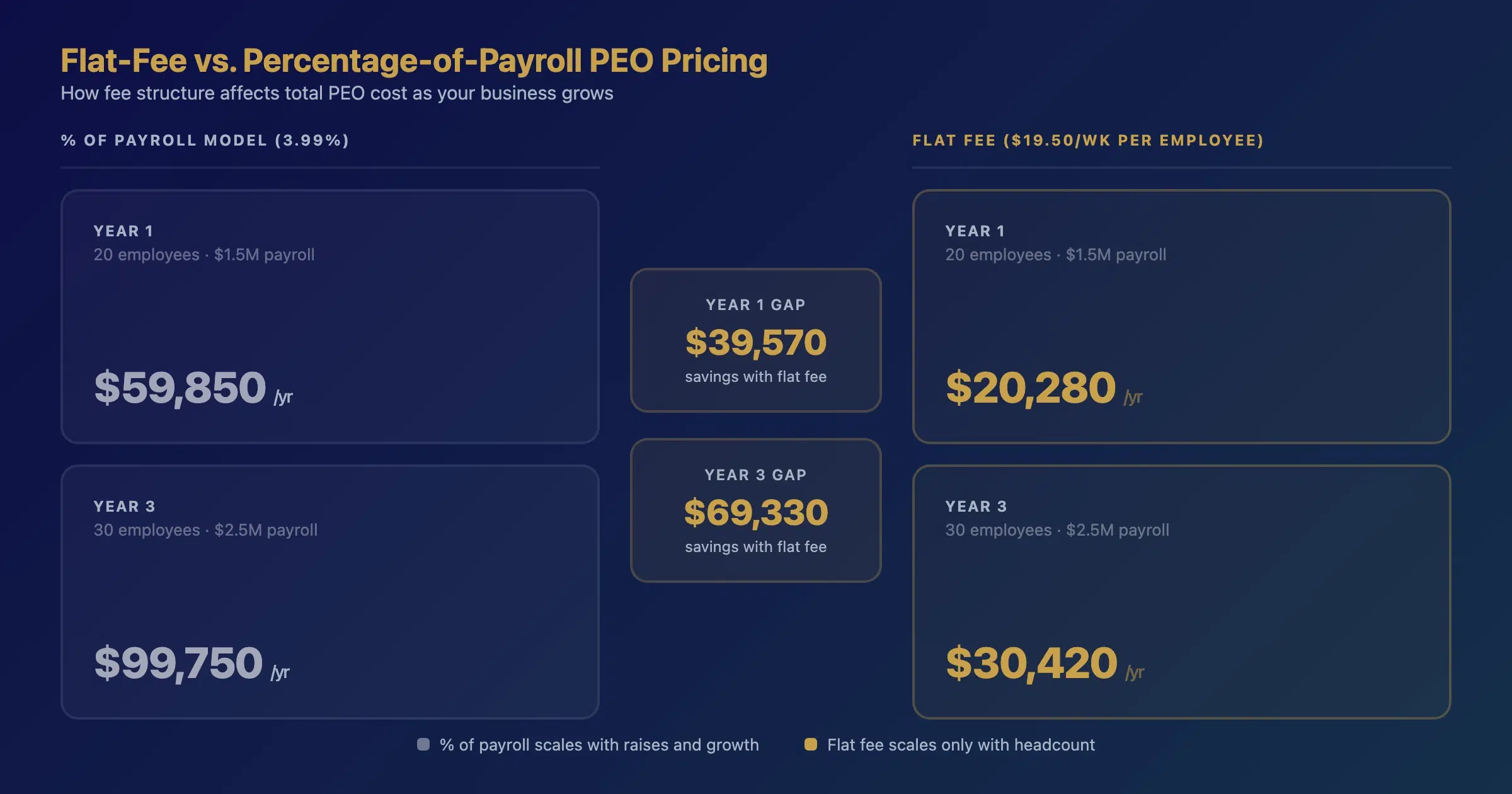
    Many large PEOs charge admin fees as a percentage of payroll — typically 2-12%. This sounds reasonable at first, but the math compounds against you:

    Fee Model Year 1 (20 employees, $1.5M payroll) Year 3 (30 employees, $2.5M payroll)
    3.99% of payroll $59,850/year $99,750/year
    Flat $19.50/week per employee $20,280/year $30,420/year
    Difference $39,570 $69,330
    Flat fee versus percentage of payroll PEO cost comparison over five years for growing small business

    In our analysis of the law firm’s proposal, the percentage-of-payroll model would have cost them an additional $22,000-$27,000 annually compared to a flat-fee PEO — and that gap widens every year as payroll grows. You can model your own renewal scenarios across funding strategies using the Premium Renewal Stress Test to see how different fee structures compound over time.

    3. The Benefits Package Is Suspiciously Rich for the Price

    When the health rates, dental maximums, and life insurance limits all outperform the market simultaneously, something is subsidizing the gap. Some PEOs absorb first-year costs through their marketing budget, effectively buying your business with the expectation that you’ll stay once switching becomes painful.

    The test: Compare the PEO’s health plan rates against direct-to-carrier quotes for the same network and plan design. If the PEO rate is more than 10% below the direct rate, ask how the discount is funded and whether it’s guaranteed for the full term.

    The Real Cost of Getting Trapped in PEO Honeymoon Rates

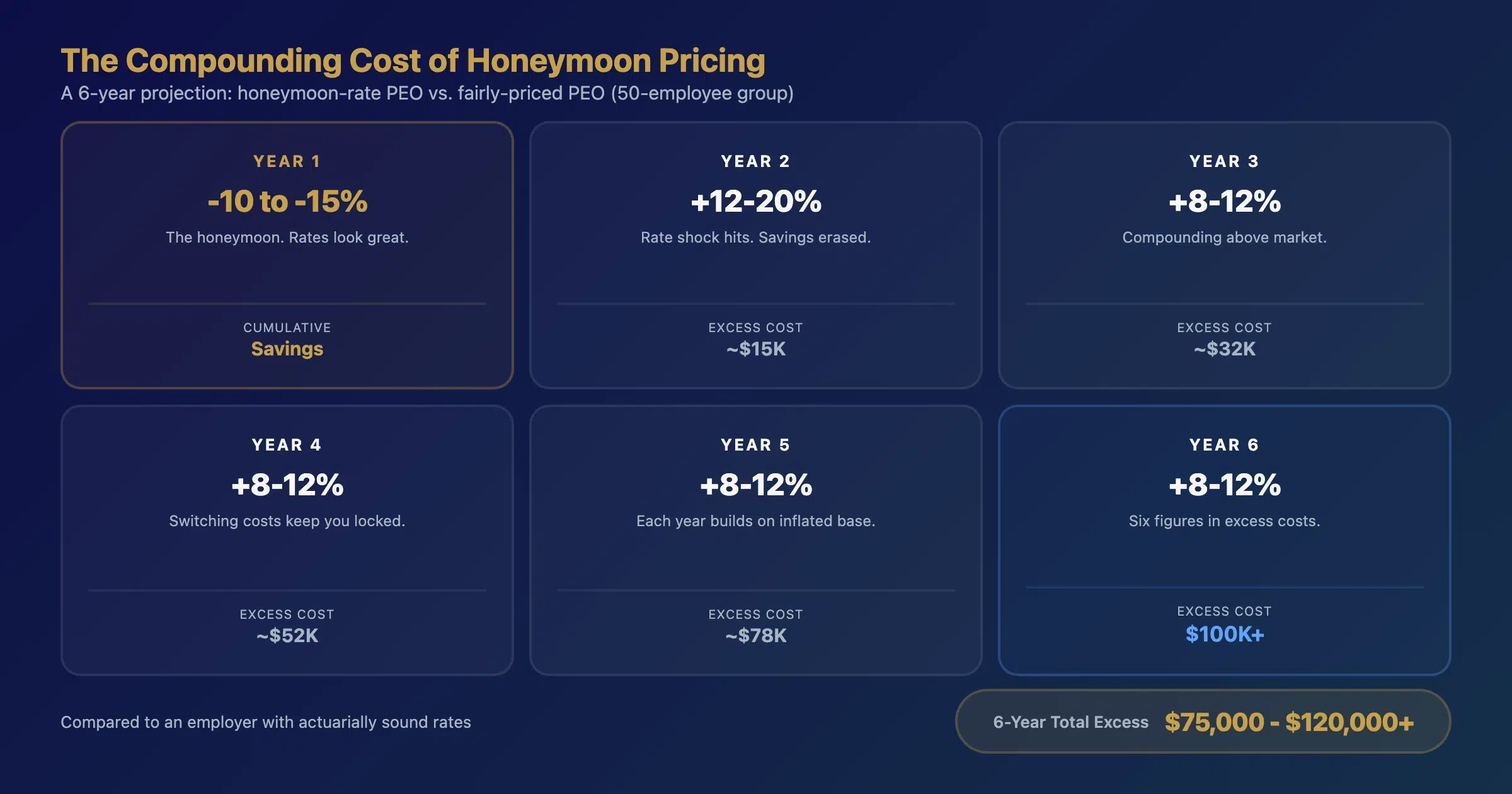
    The financial damage from honeymoon pricing isn’t just the rate increase itself — it’s the compounding effect of being locked in. When we calculated the true cost of PEO health insurance for employers who experienced year-two rate shock, the pattern was consistent:

    • Year 1: Savings of 10-15% vs. prior plan (the honeymoon)
    • Year 2: Increase of 12-20%, erasing all first-year savings
    • Years 3-6: Annual increases of 8-12%, compounding above market average

    Over a six-year period, what looked like a winning decision in month one turned into tens of thousands in cumulative excess costs compared to an employer who started with actuarially sound rates and experienced normal annual adjustments. For larger groups (50-100 employees), the compounding effect can reach six figures.

    The switching cost compounds the problem. By year two, your payroll, benefits, HR compliance, and 401(k) integrations are all running through the PEO platform. Migrating to a new provider means re-enrolling employees, transferring data, and often paying an early termination fee. That friction is exactly what the honeymoon rate was designed to create.

    Six-year cumulative cost comparison between PEO honeymoon rates and sustainable pricing


    How to Protect Your Business Before Signing

    Run a 6-Year Cost Projection

    Don’t evaluate a PEO on year-one pricing alone. Request a 6-year projection that includes estimated annual increases. If the PEO won’t provide one, that’s a red flag. You can calculate your benefits ROI across multiple scenarios using the Benefits ROI Calculator to compare how different PEO proposals perform over time.

    Ask for Client Rate History

    Request anonymized rate history from 3-5 existing clients in similar industries. What did their rates look like in year one versus year three? A PEO confident in its pricing will share this data. One relying on honeymoon rates won’t.

    Compare Fee Structures Apples-to-Apples

    Isolate admin fees from insurance costs. Some PEOs bundle “pass-through” charges (SUTA, FUTA, workers’ comp) into their admin percentage, making the true administrative cost harder to identify. Break every line item into its own category and compare.

    Verify Carrier vs. PEO Pricing

    Ask whether health insurance rates are carrier-underwritten (set by the insurance company based on your group’s demographics) or PEO-set (determined by the PEO’s internal pricing). Carrier-underwritten rates are inherently more stable because they’re based on actuarial data, not marketing strategy.

    If you’re evaluating a PEO switch and want to understand how your small business health insurance costs compare across models, running the numbers before signing is the single most important step you can take.

    Five critical questions to ask PEO providers about honeymoon rates before signing a contract


    Frequently Asked Questions

    What is a PEO honeymoon rate?

    A PEO honeymoon rate is an artificially low first-year insurance or admin fee quote designed to win your business. These rates are typically 10-20% below sustainable levels and increase significantly at renewal — often within the first 6-12 months. The strategy relies on high switching costs to keep employers locked in once real pricing takes effect.

    How much do PEO rates typically increase after year one?

    Based on what we’ve seen across hundreds of proposals, employers who received honeymoon rates experienced increases of 12-20% in year two. By contrast, employers on actuarially sound rates from day one typically see annual increases of 5-10%, which aligns with normal healthcare cost trends (the 2026 market median is running closer to 8-11%).

    Can I negotiate PEO renewal rates?

    Yes, but your leverage depends on timing and data. The best time to negotiate is 90-120 days before renewal, armed with competing quotes. PEOs are more willing to negotiate when you can demonstrate you’ve evaluated alternatives. The Premium Renewal Stress Test can help you model scenarios before entering negotiations.

    What’s the difference between flat-fee and percentage-of-payroll PEO pricing?

    Flat-fee PEOs charge a fixed dollar amount per employee per week (typically $15-$20). Percentage-of-payroll PEOs charge 2-6% of total payroll (some go as high as 10%). For growing businesses, flat-fee models are almost always more cost-effective long-term because costs scale with headcount, not with raises and promotions. Learn more about when to switch PEO providers if your current fee structure is working against you.

    How do I know if my current PEO is using honeymoon pricing?

    Review your rate history. If your first-year rates were significantly below what you’d been quoted elsewhere, and your second-year renewal came with a double-digit increase, you likely received honeymoon pricing. Also check whether your renewal timeline matches your policy anniversary — mid-year increases are a telltale sign. For PEO solutions designed for construction and trade businesses, rate transparency is especially critical given workers’ comp complexity.


    If you want to see how honeymoon rate pricing would affect your specific situation over 6 years, the Premium Renewal Stress Test lets you model it yourself — no sales call required.


    About the Author: Sam Newland, CFP®, has spent 13+ years in the employee benefits industry and founded Business Insurance Health and PEO4YOU to bring transparency to an industry that profits from complexity. His approach is simple: show employers the real numbers and let them decide.
  • Medical Insurance Startup Strategies to Save Money and Keep Talent

    Medical Insurance Startup Strategies to Save Money and Keep Talent

    Launching and growing a startup comes with many challenges, including finding the right medical insurance startup strategy. Startup founders often face tight budgets and limited resources, yet providing high-quality health benefits remains essential. Employees increasingly expect comprehensive health coverage, making medical insurance a critical factor for attracting skilled talent and maintaining workforce stability.

    By strategically selecting medical insurance plans tailored for startups, founders can keep costs manageable, attract top-tier employees, and support their company’s long-term success. Navigating fresh market health insurance options and understanding the unique needs of startups helps growing businesses balance affordability and employee satisfaction from day one. Whether exploring group health alternatives or considering options like a health maintenance organization, startup leaders must stay informed to make the best decisions.

    Proven Medical Insurance Startup Strategies for Growing Businesses

    Startups face tough decisions about medical insurance from day one. Selecting the right coverage directly impacts hiring, talent retention, and overall financial health. Yet many startup founders delay decisions about health benefits, thinking them expensive or complicated. The result often means losing valuable talent to competitors who offer attractive, affordable health insurance plans.

    Successful startups prioritize strategic medical insurance plans early. They understand that affordable yet comprehensive coverage helps recruit skilled employees and boosts productivity by reducing health-related distractions. Rather than viewing insurance as a burden, savvy startups leverage new market health insurance options to keep costs under control and employees satisfied.

    By choosing flexible medical insurance startup strategies that scale as they grow, early-stage companies gain a critical competitive advantage, attract top talent, and support sustainable growth from the beginning.

    The Startup Founder’s Dilemma: Why Medical Insurance Is Critical

    Medical insurance poses a unique challenge for startup founders. Budgets often run tight, and health coverage might seem like an avoidable expense at first. However, delaying the introduction of medical insurance creates serious risks, from losing skilled employees to negatively impacting overall productivity.

    Health insurance serves as a powerful incentive to attract and retain talent, directly influencing long-term business success. Founders must understand that strategically chosen medical insurance startup solutions are not simply expenses but investments in the company’s stability and growth.

    What Happens When Startups Delay Offering Health Coverage

    When startups postpone offering medical insurance, consequences quickly become evident. Qualified employees often leave for competitors who provide better coverage, significantly increasing turnover and associated hiring costs. Without proper medical insurance, even minor employee health concerns can become disruptive, leading to absenteeism and lost productivity.

    In worst-case scenarios, critical illnesses or injuries can devastate a startup financially, destabilizing early-stage operations. Offering timely and appropriate health insurance coverage reduces these risks, safeguarding employee satisfaction and company stability. The decision to offer health insurance early can protect both your team and your bottom line.

    How the Right Benefits Package Helps Attract and Keep Top Talent

    Startups rely heavily on attracting talented, motivated employees. Quality medical insurance represents one of the strongest benefits a startup can offer, playing a key role in employee decisions to join or remain with a company. Prospective employees frequently prioritize comprehensive medical coverage alongside salary. An affordable, thoughtfully designed medical insurance package signals commitment to employee well-being, strengthening recruitment and retention.

    By carefully choosing a flexible benefits package, startups can enhance their competitive advantage, ensuring they attract and maintain a loyal, productive workforce as they grow. These health insurance benefits may include mental wellness programs, flexible networks, and preventive care services.

    The New Era of Health Insurance Startups

    Health insurance providers increasingly focus on the unique needs of early-stage companies. Today’s innovative health insurance startups understand that traditional plans rarely fit startup budgets or employee preferences. Newer providers offer affordable health insurance and flexible medical insurance startup solutions specifically tailored to help early-stage businesses control costs, support rapid growth, and attract talented employees.

    How Innovative Providers Are Changing the Market for Early Stage Companies

    A new group of health insurance providers is building products specifically for startups and early-stage teams. These models emphasize streamlined enrollment, flexible coverage structures, and pricing designed to align with tighter operating budgets. 

    Instead of rigid, one-size contracts, founders can explore more adaptable funding approaches that balance predictability with cost control, often accessed through structured group coverage within small business health plans. Technology-driven platforms further simplify administration, reducing paperwork and making benefits easier to manage without a full HR department.

    Some providers specialize in supporting growing teams, offering mobile access, simplified dashboards, and responsive service that fits the pace of early-stage businesses. By combining modern tools with scalable plan design, startups can secure meaningful coverage without adding unnecessary complexity.

    Fresh Market Health Insurance Options Startups Should Explore

    Startup founders have more flexible coverage models available than ever before. Many growing teams join pooled group structures that combine smaller companies into a larger risk base, helping them access broader provider networks and more competitive pricing through small business health plans. This shared approach can reduce volatility while simplifying payroll and benefit coordination.

    Other options include structured funding models that align monthly costs with actual claim trends, giving startups greater visibility into spending and long-term planning. For founders managing tight budgets, tools like a health insurance calculator can help project contribution scenarios and total cost impact before selecting coverage. By comparing group-based models and flexible funding arrangements side by side, startups can choose coverage that supports growth without locking into rigid, high-cost contracts.

    Designing a Medical Insurance Plan That Works for Your Startup

    A successful medical insurance startup strategy requires carefully chosen plans that align with the current business size and future growth potential. Early-stage companies must find health plans with affordable entry costs yet flexible enough to scale as the team expands. With customized coverage options, startups can provide appealing benefits to attract top talent without exceeding budget constraints.

    Affordable Medical Insurance Plans That Scale With Your Team

    Choosing medical coverage that can expand as your startup grows is critical. Early-stage companies benefit from plans that offer predictable pricing, manageable monthly costs, and the flexibility to adjust as headcount increases. Structured group coverage available through small business health plans provides stable premiums while allowing employers to scale benefits as hiring accelerates.

    Startups that want deeper cost visibility can also evaluate flexible funding structures that align monthly payments with claim performance, helping control long-term spending without locking into rigid contracts. Using a health insurance calculator to model projected growth and contribution changes allows founders to forecast total impact before making a commitment. With the right structure in place, early-stage teams can maintain cost control from day one while ensuring coverage keeps pace with expansion.

    Customizing Health Benefits for Startup Founders and Key Staff

    Startup founders and key early employees typically have unique health coverage needs. Often working long hours under high stress, this core team may require comprehensive, flexible benefit options that address specific health priorities. Customized benefits packages, including wider provider networks, telemedicine access, or additional wellness services, often prove valuable to founders and essential staff.

    Providers offering these customized options enable startups to protect core team members, supporting continued growth, stability, and productivity at critical stages. For example, some small-business health insurance providers offer optional concierge services or lifestyle health coaching for executive teams.

    Balancing Cost Efficiency With Comprehensive Coverage

    Achieving a balance between cost efficiency and comprehensive health coverage presents an ongoing challenge for startups. Choosing the cheapest insurance plan often leaves employees unsatisfied, while overly extensive coverage quickly depletes limited resources. Successful startups solve this problem by closely assessing employee health needs and selecting plans aligned directly with team requirements.

    Plans with moderate deductibles, clear pricing, wide provider access, and preventive care generally deliver strong value. By clearly evaluating and comparing multiple health plans, startups can strike the ideal balance between maintaining employee satisfaction and effectively controlling health insurance costs.

    Mistakes Startups Make When Choosing Medical Insurance

    Choosing medical insurance represents a critical decision for startup founders, yet many make costly mistakes in the process. Common errors include misjudging employee needs, overlooking coverage flexibility, or selecting overly basic plans to save money initially. Avoiding these pitfalls helps startups choose medical insurance startup solutions effectively, ensuring long-term employee satisfaction and financial stability.

    Underestimating Employee Expectations

    One significant mistake startups often make is miscalculating employees’ expectations for health coverage. Startup employees, especially experienced professionals, frequently arrive from larger organizations with comprehensive benefits. These employees naturally expect health plans offering broad networks, reasonable deductibles, and easy access to care. 

    When startups choose overly limited or inadequate plans, talented employees feel disappointed, prompting turnover or dissatisfaction. Understanding employee needs and clearly communicating available options ensures alignment between benefits offered and employee expectations.

    Overlooking Plan Flexibility for Future Growth

    Startups often select health insurance plans based solely on immediate affordability without considering future needs. As businesses grow and hire additional employees, health coverage needs expand significantly. Startups must select flexible insurance plans that allow easy adjustments as the workforce changes. 

    Plans lacking this flexibility cause future administrative complexity, financial strain, and coverage gaps. Startups benefit from group health or small-business health insurance plans that offer clear scalability, straightforward enrollment for new hires, and predictable costs when expanding coverage, enabling smoother transitions during growth stages.

    How PEO4YOU Helps Startups Get the Best Coverage

    PEO4YOU helps startups navigate medical insurance decisions by focusing on growth stage, workforce demographics, and budget discipline. We review your hiring trajectory, cash-flow patterns, and benefit priorities, then present clear comparisons of scalable group coverage through small business health plans that align with early-stage realities. Each recommendation is built around practical cost control and long-term sustainability, not generic templates.

    Instead of pushing rigid contracts, PEO4YOU matches coverage structure to your expansion goals and employee expectations. Our streamlined process reduces administrative strain by guiding enrollment, contribution setup, and compliance support from day one. Founders can also model future costs with a health insurance calculator to understand how hiring plans affect total benefit spend. The result is coverage that scales with your startup, supports recruitment, and protects margins as your business grows.

    Schedule your free consultation with PEO4YOU to explore customized medical insurance options tailored to your startup’s needs.

  • Best Dental Plans for Small Businesses That Keep Teams Smiling

    Best Dental Plans for Small Businesses That Keep Teams Smiling

    Most small businesses understand the value of offering health coverage, but dental benefits often get pushed aside. Yet the best dental plans for small businesses do more than cover cleanings. They offer a simple way to improve employee satisfaction, reduce sick days, and protect long-term health. For teams that rely on focus, energy, and consistent attendance, dental coverage becomes a quiet but essential part of running a successful operation.

    Smart employers know that offering dental plans for small business employees can give them a competitive edge. These plans support routine care that catches problems early and gives staff access to treatment before small issues become costly distractions. Whether you’re looking into premier dental insurance or exploring more flexible dental insurance for small business owners, the goal remains the same. You want coverage that fits your budget while giving your team the care they need, from preventive dental care to full dental coverage that includes orthodontics or vision benefits.

    Best Dental Plans for Small Businesses and Growing Teams

    Running a business means making decisions that affect your people every day. Offering the best dental plans for small businesses is one of those decisions that pays off quietly but consistently. Dental coverage may not feel urgent, but it quickly becomes essential when employees delay care due to cost or skip appointments altogether. These issues can lead to broader health problems that affect attendance, productivity, and morale, not to mention higher out-of-pocket costs for emergency care.

    The right dental coverage does more than fill a checkbox on a benefits form. It helps your business stand out. When job seekers compare offers, a strong dental plan shows your company is serious about employee well-being. For current staff, it reinforces trust. And for you, the owner, it means less turnover and fewer disruptions to your day-to-day operations.

    The best dental plans for small businesses are not one-size-fits-all. Your team may include part-time employees, full-time staff, or people with families. That’s why it’s important to explore options designed specifically for growing companies. Whether you are drawn to dental insurance for small businesses with predictable monthly costs or more adaptable dental plan options, flexibility and simplicity should be at the center of every choice.

    Dental coverage is no longer a luxury. It is a practical tool for attracting talent, supporting retention, and reducing costly absenteeism. If you want to build a team that shows up, performs well, and feels valued, it starts with the benefits that matter to them. Dental is one of them.

    Why Dental Coverage Matters for Small Business Owners

    Most business owners already know that benefits are essential for attracting great employees. But dental insurance is often treated as optional. In reality, it plays a much bigger role than most realize. The best dental plans for small businesses support more than oral health. They reinforce loyalty, protect productivity, and help keep operating costs predictable over time, especially when bundled with medical plans or other wellness benefits.

    How Employee Dental Benefits Boost Retention

    Employees stay where they feel valued. Offering dental insurance for small businesses sends a clear message that your company is invested in its people. Dental care is something employees actually use. From routine cleanings to urgent procedures, a good plan means fewer barriers to care and less financial stress for your team.

    When workers know their employer has taken care of basic needs like dental, it builds trust. That trust leads to longer tenures, stronger internal culture, and better performance. Small businesses that offer competitive dental plans for small business teams often see improved morale and reduced turnover, both of which directly impact profitability. Some also see gains when using group dental plans that keep premiums lower across diverse teams.

    Financial Risks of Skipping Dental Insurance

    Skipping dental coverage might seem like a way to cut expenses, but it can end up costing more in the long run. Employees without access to care are more likely to delay treatment until it becomes urgent. These emergency situations can lead to unexpected absences, lower productivity, and even higher medical plan costs if dental issues worsen into broader health problems.

    For employers, these disruptions create hidden costs. Missed deadlines, overburdened coworkers, and temporary replacements are just a few of the challenges that come with untreated dental problems. Investing in dental insurance for small business owners means reducing these risks. It also gives you better control over your budget by shifting from unpredictable emergencies to routine, planned care, a key factor in affordable care act considerations.

    Understanding Dental Insurance for Small Businesses

    Choosing the right dental insurance for small businesses starts with knowing what options are available. Not every plan works for every team, and the wrong fit can lead to unnecessary costs or limited coverage. By understanding how group dental and individual plans are structured and what they actually offer, small business owners can make smarter choices that protect both their team and their budget.

    Types of Dental Plans for Small Business Needs

    There are several types of dental plans available for small business teams, each offering a different balance of predictability and flexibility. Fully insured dental plans come with fixed monthly premiums, which appeal to employers who prefer steady budgeting and minimal variation. Businesses seeking greater cost control often look for structured group coverage that aligns spending with workforce size and usage patterns while still providing access to broad provider networks through small business health plans.

    For example, DPOPs let you work with a broader network of dentists while offering lower negotiated rates. Meanwhile, Delta Dental plans are known for their extensive networks and strong nationwide coverage, making them a reliable option for growing businesses.

    Some businesses also explore PEO-based dental coverage, where the plan is bundled into a broader benefits package. While convenient, these arrangements may limit flexibility or network access, depending on the provider. Each type has its trade-offs, so choosing the right model depends on your size, goals, and employee expectations.

    What Premier Dental Insurance Offers Employers

    Employers seeking premium benefits often explore premier dental insurance. These plans go beyond basic care by covering a wider range of services, including orthodontics, periodontics, and cosmetic procedures. That level of coverage can make a difference in how employees view their workplace, especially in industries where talent is hard to keep.

    Premier options typically come with larger provider networks, shorter wait times, and more generous reimbursement rates. While they cost more than standard plans, they help your business compete with larger companies that offer full benefit packages. If you are trying to retain skilled workers or offer leadership-level perks, premier dental insurance can be a strong addition to your compensation strategy.

    How to Choose the Best Dental Plans for Small Businesses

    Not all coverage is created equal. The best dental plans for small businesses strike a balance between affordability, quality of care, and ease of use. It is not just about the premium or deductible. It is about whether the plan actually meets your team’s day-to-day needs without creating unnecessary stress for you as the employer. Choosing the right plan means looking at more than the brochure. It means digging into structure, network strength, and long-term value.

    Coverage Options That Balance Cost and Care

    Affordability matters, but cutting too many corners can leave employees with inadequate coverage or surprise bills. The most effective dental plans for small businesses’ needs are those that fully cover preventive care and offer reasonable dental benefits for more involved procedures such as fillings, root canals, and crowns.

    When comparing plans, look for coverage that includes cleanings, exams, and X-rays at no additional cost, since limiting preventive services can lead to skipped care and higher expenses later. Businesses that want to control costs without lowering quality often benefit from structured group coverage that bundles dental benefits alongside medical and other offerings through small business health plans, helping streamline administration while keeping access to care strong.

    Plans Designed for Small Business Owners

    Small business owners wear multiple hats, and the dental insurance they choose should reflect that. Flexibility is key. You need a plan that works whether you have five employees or fifty, and one that scales as you grow. The best dental insurance for small business owners includes customizable options, administrative simplicity, and transparent pricing.

    You should also consider whether the plan allows for different classes of employees. Some owners prefer to offer a core benefit to all staff and premium coverage for executives or long-term team members. Plans that let you segment benefits by role or tenure can be a powerful tool for retention and cost control, especially when using options like small business dental plans tailored by providers such as Delta Dental.

    Evaluating Network Size and Service Quality

    Network access can make or break a dental plan. A strong provider network means your employees can see their preferred dentists without hassle. It also helps reduce out-of-pocket costs, since in-network providers typically offer discounted rates. When choosing among the best dental plans for small businesses, look closely at network size in your area.

    But it is not just about how many providers are included. It is also about how those providers treat your employees. Look for reviews, ask questions, and find out how claims are handled. Plans with streamlined support and responsive service teams make life easier for everyone involved. If your employees trust the system, they are more likely to use it and stay healthier in the process.

    Common Mistakes When Selecting Dental Insurance

    Choosing dental insurance for small businesses can feel overwhelming, especially with so many plans promising low costs and wide coverage. But the wrong decision can lead to unnecessary expenses, frustrated employees, and missed opportunities to support long-term health. Many small business owners fall into common traps that are easy to avoid once you know what to watch for.

    Overlooking Preventive and Routine Care Coverage

    Preventive care is the foundation of good dental health. Yet many businesses choose plans that only cover basic emergencies or offer limited cleanings per year. These gaps often lead to delayed treatment, higher long-term costs, and avoidable absences. The best dental plans for small businesses prioritize preventive services like cleanings, exams, and early diagnostics because these are the services employees use most.

    When preventive care is left out or heavily restricted, the entire plan becomes less valuable. Employees may avoid using it altogether, defeating the purpose of offering coverage in the first place. A solid plan should make it easy and affordable for employees to stay on top of their dental care before problems begin.

    Choosing Plans Without Flexibility for Growth

    Small businesses change quickly. You may hire five people this year and ten the next. Choosing a rigid plan that does not grow with you can cause problems later. Some dental plans work well for very small teams, but start to fall apart once your headcount increases or your workforce becomes more diverse.

    The best dental insurance for small business owners accounts for growth. Look for plans that allow you to adjust dental plan options, add dependents easily, and expand eligibility as your business evolves. Flexibility means you do not have to renegotiate or restart every time your team size changes. It also sends a strong signal to employees that you are thinking ahead and investing in their future.

    Find the Right Dental Coverage with PEO4YOU

    At PEO4YOU, dental benefits are structured to support both your employees and your bottom line. We work with small business owners to identify dental coverage that delivers real value without adding administrative strain or unpredictable expenses. By aligning plan design with workforce size and budget goals, we help you choose options that balance preventive care access with smart cost management through small business health plans. Whether you are expanding your team or refining your overall benefits strategy, PEO4YOU makes it easier to offer dental coverage that supports long-term employee health and retention.

    Start strong with a free consultation and discover how PEO4YOU can help you build a better benefits plan for your business.

  • Blue Cross Blue Shield Employee Benefits for Small Businesses

    Blue Cross Blue Shield Employee Benefits for Small Businesses

    Blue Cross Blue Shield employee benefits provide small businesses with comprehensive, flexible, and cost-effective healthcare solutions. Small business owners consistently face the challenge of providing quality employee benefits within budget constraints. Blue Cross Blue Shield offers trusted coverage known for extensive provider networks, tailored plans, and dedicated support to small companies. Employers who choose Blue Cross Blue Shield can effectively attract and retain skilled employees while controlling healthcare expenses. 

    By carefully selecting the right Blue Cross Blue Shield benefits package, small businesses can enhance employee satisfaction, reduce turnover, and ensure healthier, more productive teams. Understanding how these employee benefits work empowers small business owners to make strategic decisions, maximizing value for both their employees and the company’s long-term success.

    Complete Guide to Blue Cross Blue Shield Employee Benefits

    Blue Cross Blue Shield employee benefits help small businesses effectively balance quality healthcare coverage with budget management. Offering robust employee benefits is crucial for attracting top talent, improving productivity, and maintaining employee satisfaction. Blue Cross Blue Shield offers tailored options for small employers, with flexibility, affordability, and extensive provider access. This comprehensive guide explains everything you need to know about Blue Cross Blue Shield employee benefits, helping you make informed decisions for your business.

    Choosing the right benefits package involves understanding your employees’ healthcare needs, financial considerations, and preferences. Blue Cross Blue Shield plans include traditional medical insurance, supplemental vision coverage, retirement benefits, wellness initiatives, and preventive care. Small businesses leveraging these comprehensive solutions gain a strategic advantage in employee retention, satisfaction, and overall business health. 

    Understanding Blue Cross Blue Shield Employee Benefits

    Blue Cross Blue Shield employee benefits give small businesses quality healthcare options that employees value. These benefits extend beyond basic health insurance, including supplemental coverage, wellness programs, and retirement plans. 

    Businesses that clearly understand these offerings gain a significant advantage in employee recruitment and retention. Selecting Blue Cross Blue Shield means partnering with an established insurer recognized for reliability, extensive provider networks, and comprehensive employee support.

    Overview of Blue Cross Blue Shield Federal Employee Program Benefits

    The Blue Cross Blue Shield Federal Employee Program provides health insurance coverage specifically tailored to federal workers and their families. This program includes broad network access, comprehensive medical coverage, prescription drug benefits, and preventive care services. 

    Employees enrolled in this program receive reliable coverage, affordable copayments, and straightforward claims processes. While designed for federal employees, this program illustrates the depth of coverage and reliable customer service available through Blue Cross Blue Shield plans generally.

    Why Employers Choose Blue Cross Blue Shield Employee Benefits

    Employers select Blue Cross Blue Shield employee benefits due to consistent reliability, broad healthcare provider networks, and competitive pricing. Businesses appreciate the flexibility Blue Cross Blue Shield offers in customizing benefit packages to meet diverse employee needs. The extensive nationwide provider network ensures convenient access to doctors and hospitals, boosting employee satisfaction. 

    Employers also benefit from streamlined administrative support and resources, allowing efficient management of employee benefit plans without unnecessary complications or hidden costs.

    Key Advantages of Blue Cross Blue Shield Plans for Employees

    Employees benefit from Blue Cross Blue Shield plans in multiple ways. Access to an extensive national network of healthcare providers and hospitals gives employees flexibility in choosing care. Blue Cross Blue Shield also provides preventive care coverage, promoting healthier lifestyles and early detection of health issues. Supplemental benefits, such as vision plans and wellness programs, add further value to employees. Predictable out-of-pocket costs, clear coverage guidelines, and responsive customer service ensure employees consistently receive the care they need without unexpected financial burdens or confusion.

    Essential Employee Benefits Offered by Blue Cross Blue Shield

    Blue Cross Blue Shield provides essential employee benefits tailored specifically for small businesses. These benefits cover diverse healthcare needs, offering not only traditional medical insurance but also vision care, supplemental benefits, and wellness programs. Small businesses using these comprehensive offerings effectively support their employees’ overall health, leading to better job satisfaction, productivity, and retention rates.

    Comprehensive Health Coverage Options

    Blue Cross Blue Shield employee benefits feature extensive medical insurance coverage. Plans typically cover essential services such as hospital stays, surgeries, physician visits, and prescription medications. Employees receive clear guidance on covered services and straightforward cost structures, making healthcare predictable and manageable. 

    Employers can select from various plan types, such as Preferred Provider Organizations (PPOs) or Health Maintenance Organizations (HMOs), enabling them to accurately match employee needs and budget considerations. Comprehensive coverage helps businesses control costs while employees gain consistent access to quality healthcare.

    BCBS Vision Plans and Supplemental Benefits

    Vision coverage from Blue Cross Blue Shield helps employees maintain eye health through regular exams, glasses, and contact lenses at affordable prices. BCBS vision plans typically cover annual eye exams, corrective lenses, and discounts on eyewear products. Supplemental benefits include dental coverage, critical illness insurance, and accident insurance, each designed to further protect employees financially. Offering these supplemental options gives employees greater flexibility in their benefits package, improving satisfaction and increasing perceived value.

    Wellness Programs and Preventive Care Services

    Blue Cross Blue Shield wellness programs focus on proactive health management. Employees have access to preventive care screenings, annual health assessments, and personalized health coaching. These programs encourage healthier habits, early detection of potential health issues, and lower medical costs over time. Employers benefit through improved employee productivity and reduced absenteeism due to health issues. Robust preventive care options and wellness resources provided by Blue Cross Blue Shield allow employees to actively manage their health and well-being, creating a healthier workforce overall.

    Blue Cross Blue Shield Employee Retirement Benefits Explained

    Blue Cross Blue Shield employee retirement benefits help small businesses deliver comprehensive financial security to their employees. These retirement options give employees a clear path toward long-term financial stability. When employers offer both health insurance and retirement benefits, they provide employees with complete protection covering immediate medical needs and future financial planning. This integrated approach supports a positive workplace and builds employee loyalty over time.

    Retirement Savings and Pension Options

    Blue Cross Blue Shield employee retirement benefits typically include access to retirement savings plans, such as 401(k) accounts. Employees contribute pre-tax income to these plans, reducing their taxable income while preparing for retirement. 

    Employers often match a portion of employee contributions, enhancing retirement savings and incentivizing participation. Certain plans may also include defined benefit pension options that provide employees with retirement benefits. Providing these options helps employees secure their financial future, increasing their long-term commitment to the business.

    How Retirement Benefits Complement Health Insurance

    Together, retirement benefits and health insurance offer comprehensive employee protection. While health insurance covers current medical costs and emergencies, retirement benefits secure employees’ long-term financial health. Offering both shows employees that the company values their well-being beyond immediate healthcare concerns. 

    Employees who have both retirement savings and quality healthcare experience lower stress levels and greater job satisfaction. The combination of health insurance and retirement planning strengthens employee engagement, increases retention rates, and creates a more stable, productive workforce.

    How to Choose the Right Blue Cross Blue Shield Benefits Package

    Choosing the right Blue Cross Blue Shield benefits package involves more than comparing prices. Employers must clearly evaluate employee needs, preferences, and financial constraints. Carefully examining these factors helps small businesses select the most suitable Blue Cross Blue Shield employee benefits package, delivering optimal coverage without overspending.

    Assessing Your Employees’ Needs and Preferences

    Begin by gathering detailed information about your employees. Understand their age groups, family status, medical history, and specific healthcare preferences. Surveys or individual meetings help identify these needs accurately. Younger employees might prefer plans with lower premiums and higher deductibles. 

    Employees with families often require comprehensive plans with broader provider networks. Clearly assessing these preferences enables employers to select the most relevant coverage options, thereby improving employee satisfaction and retention.

    Balancing Costs with Comprehensive Coverage

    Cost remains a critical consideration for small businesses offering employee benefits. Employers must strike a balance between affordable premiums and comprehensive health coverage. Compare monthly costs, deductibles, out-of-pocket limits, provider network breadth, and prescription coverage carefully. Avoid plans offering the lowest premiums but very limited coverage, as they lead to employee dissatisfaction. 

    Equally, expensive plans might exceed budget limitations without delivering proportional benefits. Analyzing multiple Blue Cross Blue Shield plan options side by side helps businesses clearly see which package provides the best coverage at a manageable cost.

    Common Questions about Blue Cross Blue Shield Employee Benefits

    Employers and employees often have important questions about Blue Cross Blue Shield employee benefits. Understanding eligibility, enrollment procedures, costs, and contribution responsibilities helps employers clearly communicate plan details to employees. Clarifying these common points reduces confusion, streamlines the enrollment process, and supports employee satisfaction.

    Eligibility and Enrollment Guidelines

    Eligibility for Blue Cross Blue Shield employee benefits typically depends on employment status and hours worked. Full-time employees usually qualify automatically, while part-time eligibility varies depending on company policy and the specific plan selected. Employers determine waiting periods, typically ranging from immediate enrollment to 90 days after hire. Enrollment often occurs during a designated annual period, with special enrollment available for life changes such as marriage, birth, or loss of other coverage. Employers must clearly explain these guidelines to ensure smooth employee participation and compliance.

    Understanding Costs and Contributions for Employers and Employees

    Employers generally pay a large share of health plan premiums, covering about 83% of single coverage premiums and 73% of family coverage premiums on average. Employers at smaller firms are more likely to cover the full premium for single coverage, and around 37% of small-firm workers enjoy this benefit.

    Employees typically contribute about 16% of premiums for single coverage and 25% for family coverage. In dollar terms, employees pay roughly $1,368 per year for single plans and about $6,296 annually for family coverage.

    How PEO4YOU Helps Employers Implement Blue Cross Blue Shield Plans

    PEO4YOU supports small business owners in implementing Blue Cross Blue Shield employee benefits by aligning plan selection with workforce needs and budget priorities. We review employee demographics, contribution strategies, and healthcare preferences, then present clear comparisons of available Blue Cross Blue Shield options so employers can make informed decisions with confidence.

    Beyond plan selection, PEO4YOU guides enrollment, employee communication, and ongoing administration to reduce internal workload. Structured support through small business health plans ensures coverage remains organized, compliant, and easy to manage as your team grows. Our hands-on approach helps businesses offer comprehensive Blue Cross Blue Shield coverage without adding administrative strain.

    Schedule a free consultation with PEO4YOU to identify the right Blue Cross Blue Shield employee benefits package for your business.

  • How Business Health Plus Helps You Offer Better Benefits

    How Business Health Plus Helps You Offer Better Benefits

    Business health plus coverage adds depth to standard business health insurance by combining medical, dental, vision, and supplemental benefits under a single contract. The structure reduces employers’ claim volatility and gives staff a single ID card they can use for most routine care. When employees know preventive visits, eye exams, and even critical illness protection are included in the same package, confidence in the benefit rises, and sick-day downtime drops.

    Carriers label these bundled programs healthplus insurance because the extra services sit on top of core medical coverage. The “plus” layer often includes wellness coaching, digital urgent care visits, or tiered prescription pricing that help employees manage chronic conditions without ballooning pharmacy bills. Folding these features into a single premium creates predictable budgeting for the company and a broader safety net for the team.

    What Business Health Plus Means for Your Team

    Business health plus coverage provides employees with a comprehensive health and safety net in one plan, replacing separate add-on policies with a single package of medical, dental, vision, and supplemental care. Staff can book a doctor visit, schedule an eye exam, and tap critical illness support without juggling multiple ID cards. That simplicity builds trust in the benefit and reduces time spent on claims questions, which means more productive hours on the job.

    For employers, a business health plus strategy eases budget swings. The broader benefit mix spreads risk across everyday services, so one high medical claim is less likely to spike next year’s rate. Carriers also price wellness coaching and telemedicine into the same premium, delivering preventive tools that curb costly emergency visits. Compared with a basic business health insurance policy, the plus model offers a higher return on each benefit dollar while enhancing employee morale.

    Because business health plus plans integrate digital tools, employees access care faster and avoid expensive out-of-network bills. Virtual urgent-care visits and pharmacy price transparency keep routine issues from becoming major claims, lowering overall spending. The result is healthier staff, steadier costs, and an employer brand that signals genuine commitment to health insurance benefits.

    What Is Business Health Plus and How It Works

    Business Health Plus is a bundled group plan that layers dental, vision, wellness coaching, and supplemental protection on top of standard medical coverage. Employers pay a single consolidated premium, and employees carry a single ID card for nearly all routine health needs. By rolling multiple benefits into one contract, carriers spread risk more evenly, which can trim renewal increases compared with a stand-alone medical policy.

    Defining HealthPlus Insurance in a Business Context

    HealthPlus insurance packages expand the traditional definition of business health insurance. They add preventive dental cleanings, annual eye exams, telemedicine visits, and critical illness payouts under the same policy number. The unified structure reduces administrative overhead for HR and makes it easier for employees to track their deductible and out-of-pocket totals.

    Understanding Business Health Insurance and the “Plus” Benefit Model

    Basic business health insurance focuses on hospital care and doctor visits, leaving gaps for dental crowns, eyeglasses, or income support during serious illness. The plus model fills those gaps by embedding extra services into the core plan rather than selling them as separate riders. 

    Employees see a richer benefit menu, while employers enjoy predictable pricing and fewer vendor contracts to manage. By consolidating coverage, business health plus plans often achieve lower aggregate costs and higher employee satisfaction than piecemeal solutions.

    Key Coverage Features of a Business Health Plus Insurance Plan

    A business health plus policy brings four core benefit lines under one roof. The unified design simplifies enrollment and claims processing while expanding care access for employees across every pay band.

    Medical Dental Vision and Supplemental Coverage Offered

    • Medical care covers office visits, hospital stays, and prescriptions with broad networks that mirror large employer plans.
    • Dental benefits include two cleanings each year, basic restorative work, and orthodontic options that can be added for dependents.
    • Vision services provide annual eye exams, frame allowances, and discounted lens upgrades, reducing out-of-pocket costs for employees who spend long hours on screens.
    • Supplemental protection pays lump sums for critical illnesses or accidents, filling income gaps when recovery keeps workers off the job.

    Bundling these lines under one business health plus policy trims vendor fees and gives HR a single point of contact for eligibility and billing issues.

    How Business Health Plus Plans Differ from Traditional Group Health Insurance

    Traditional group health insurance centers on medical coverage and bolts on dental or vision through separate contracts. Employees juggle multiple deductibles and ID cards, and HR reconciles several invoices. In contrast, Business Health Plus merges every benefit into one premium. 

    Carriers use the broader risk pool to negotiate stronger network discounts and embed wellness tools that reduce acute claims. The unified structure creates a richer employee experience and steadier renewal costs, setting it apart from the piecemeal approach common in standard group plans.

    Choosing the Right Business Health Plus Insurance

    Finding the best business health plus policy starts with knowing which levers matter most to your workforce and your cash flow. Every carrier advertises low copays and big networks, yet the fine print, how out-of-network claims settle, whether telehealth is included, and how supplemental payouts trigger, determines the real value.

    Before you sign, request a side-by-side spreadsheet that shows total premium, projected renewal trend, and the employer cost if prescription spending grows faster than expected. Numbers on one page expose trade-offs a glossy brochure glosses over.

    What is Health Plus insurance? Questions You Should Ask

    Ask the broker to explain in plain English which benefits move from optional to automatic under Business Health Plus. Does dental cover implants or only cleanings? Are vision allowances high enough for progressive lenses? How long is the waiting period before the critical illness rider pays? Pin down the member portal tools as well, and staff will judge the plan by how fast they can pull an ID card on a phone. 

    Finally, confirm whether the insurer bundles wellness coaching and mental health visits with no additional fee. Clear answers to these questions sort genuine business health insurance upgrades from rebranded basic plans.

    How Health Insurance Benefits are Optimized in Plus Plans

    A well-structured business health plus plan uses real utilization data to direct spending toward the services employees actually use. Preventive care patterns and pharmacy trends help carriers fine-tune provider access and wellness incentives, thereby supporting better chronic care management and reducing avoidable claims. Over time, this leads to steadier renewals and fewer cost spikes that disrupt planning.

    Employers can strengthen this approach by pairing coverage with targeted reimbursement support or by accessing pooled purchasing structures that spread risk and simplify administration through small business health plans. Cost modeling with a health insurance calculator also helps teams test different contribution and benefit scenarios before renewal, turning routine care into predictable expenses while delivering stronger health insurance benefits that employees value.

    Comparing Business Health Plus to Standard Health Insurance Plans

    Business health plus rolls four benefit lines into one policy, while standard group coverage focuses mainly on medical needs. That broader design changes both employee experience and employer cost structure.

    Benefits of Health Plus Insurance Over Standard Business Health Insurance

    Business health plus eliminates separate contracts for dental, vision, and supplemental protection. Employees keep one ID card and track a single deductible, which cuts confusion and late bills. Employers gain stronger buying power because the carrier prices all benefits together, often lowering the combined premium compared with stacking stand-alone riders. 

    Wellness coaching and virtual urgent-care visits come baked in, so staff receive preventive support without extra fees, a feature missing from many traditional business health insurance plans.

    When to Upgrade What Type of Insurance is Health Plus a fit for

    An upgrade makes sense when wellness initiatives and talent retention rank high on the company agenda. Firms in tech or professional services, where workers expect comprehensive perks, see quick returns. Construction or retail groups that struggle with multiple vendors also benefit from the single-invoice simplicity. 

    If your finance team spends hours reconciling separate dental and vision bills, or employees are frustrated by juggling multiple ID cards, a health-plus-style plan can simplify administration. By bundling core medical coverage with common add-ons into a single structure, employers gain clearer billing and a smoother employee experience. When paired with pooled coverage through small business health plans, this approach supports richer health insurance benefits while helping keep renewals more predictable and easier to manage.

    Why Business Health Plus Makes Sense for Your Company

    A business health plus strategy reshapes the benefit equation by giving employers predictable costs and employees an all-in-one safety net. Instead of managing separate dental, vision, and supplemental contracts, the company writes a single premium check and lets a single carrier coordinate care across all services. 

    The broader risk pool behind business health plus often yields lower combined rates than stacking individual riders, and the unified structure reduces billing errors that creep into multi-vendor setups.

    Ideal Employer Size and Needs for Business Health Insurance

    Firms with twenty to two hundred workers see the quickest payoff. At this headcount, traditional group policies charge higher per-employee premiums, yet the company is large enough to feel every claim spike. Business health plus spreads those costs across multiple benefit lines, smoothing renewals. 

    Employers with geographically dispersed staff, consulting groups, remote tech teams, and regional retailers gain extra value because the plan’s digital tools let workers schedule medical, dental, and vision visits without paper forms. If your HR team juggles three or more invoices each month, upgrading to business health plus streamlines administration and frees hours for strategic work.

    Leveraging Plus Plans for Better Employee Satisfaction and Retention

    Employees notice when preventive dental cleanings, eye exams, and virtual urgent-care visits sit inside one easy-to-use benefit. Fewer ID cards, clearer deductibles, and built-in wellness coaching translate to higher enrollment and lower absenteeism. For competitive hiring markets, think Bay Area tech or growth-phase manufacturing, this comprehensive coverage becomes a decisive edge, helping you secure and keep the talent that drives revenue forward.

    How PEO4YOU Empowers Your Business With Health Plus

    PEO4YOU reviews your workforce profile and current benefits spending, then aligns you with business health plus plans that combine medical, dental, vision, and supplemental coverage into a more predictable cost structure. We compare carriers side by side, review renewal patterns, and help employers understand how different benefit designs affect long-term budgets and employee experience.

    To support smarter decisions, PEO4YOU models cost scenarios and contribution strategies, enabling employers to see where efficiencies exist and how additional benefits affect overall spend. Guidance extends through onboarding, employee communication, and compliance support, ensuring the transition feels straightforward for HR and immediately valuable to staff. Employers can also use a health insurance calculator to test different benefit configurations before moving forward.

    Schedule a free consultation to explore how business health plus plans can strengthen your employee benefits with expert support from PEO4YOU.

  • Employers With The Best Health Insurance and What You Can Learn

    Employers With The Best Health Insurance and What You Can Learn

    Offering top-quality health insurance significantly impacts a company’s ability to attract and retain talented employees. Employers with the best health insurance stand out as leaders because they recognize that comprehensive healthcare coverage supports productivity, employee satisfaction, and long-term business success. Companies that offer the best health benefits understand these plans represent more than just another cost item. They see health coverage as a crucial investment in their workforce. Small businesses face challenges competing with large corporations, but they can still learn valuable lessons from larger employers with top-tier benefits. 

    By evaluating what makes the most successful companies in health insurance successful, smaller firms can effectively structure their own benefit plans. Strategic decisions help small businesses balance quality and affordability, allowing them to attract top talent without excessive spending.

    Exploring Employers With the Best Health Insurance in 2025

    Employers with the best health insurance in 2025 go beyond basic coverage. These companies prioritize employee well-being, foster workplace morale, and set industry standards. A recent SHRM study found that 88% of employers rate health care as “very” or “extremely important” to their workforce strategy. Plans that deliver comprehensive care, wide provider networks, and affordable employee costs stand out among employers with the best health insurance.

    Large firms often lead with generous benefit packages, but small businesses can adopt similar strategies on a smaller scale. Learning from what companies with the best health insurance offer helps small employers bridge the gap. Whether through flexible plan models, pooled insurance options, or employee-focused wellness programs, well-designed health benefits elevate retention, productivity, and business growth.

    Why Health Insurance Matters to Employers and Employees

    Health insurance plays a critical role for both employers and employees. Employees value strong health benefits highly, often placing coverage above salary alone when choosing or remaining with an employer. Employers offering solid health insurance attract talented workers, improve retention rates, and increase overall productivity. Good health insurance also reduces absenteeism, keeping the workforce healthy and present.

    How Health Benefits Impact Employee Satisfaction and Retention

    Employees consistently rank health insurance among their most important workplace benefits. Comprehensive coverage creates a sense of security, builds employee trust, and increases long-term loyalty. Companies that provide quality health insurance see lower turnover rates, fewer hiring expenses, and improved morale across their teams. Investing in strong healthcare options clearly demonstrates employer commitment, making workers feel valued and supported.

    Rising Demand for Quality Business Health Insurance

    Demand for robust business health insurance continues to grow. Workers increasingly expect more comprehensive benefits as healthcare costs rise. Employees now prioritize reliable healthcare coverage as a critical factor in job selection, alongside salary and working conditions. Companies failing to offer competitive health insurance lose valuable talent to better-equipped competitors. To meet rising expectations, employers must offer coverage that addresses employee needs effectively, balances costs, and maintains workforce satisfaction.

    Employers With Best Health Insurance: What Sets Them Apart

    Employers with the best health insurance typically share certain characteristics. These companies focus on employee well-being, carefully match coverage to workforce needs, and regularly update benefits to reflect changing demands. Instead of viewing health insurance as merely a cost, these employers treat it as a strategic tool for success. They recognize that high-quality coverage attracts talented employees and significantly strengthens company performance.

    Common Traits Among Companies With the Best Benefits

    Companies with the best health insurance consistently display clear priorities. They emphasize employee health, preventive care, and easy access to medical services. These employers maintain transparent communication, helping employees fully understand their health coverage. Leading employers frequently collect employee feedback and adjust benefits accordingly. Additionally, these companies often integrate wellness initiatives and preventive care services, further reducing healthcare costs while improving employee health and satisfaction.

    Examples of Companies With The Best Health Insurance Coverage

    Prominent companies known for excellent health benefits include Google, Costco, and Microsoft. Google stands out by providing comprehensive health coverage, including preventive care, mental health services, and on-site wellness programs. Costco is recognized for offering low employee premiums and minimal out-of-pocket expenses, making healthcare more accessible for employees. Microsoft delivers extensive medical, dental, vision, and wellness options, supporting overall employee health. Small businesses can learn from these examples by prioritizing comprehensive, employee-centered coverage to attract and retain talent effectively.

    Key Features of Superior Employer Sponsored Plans

    Superior employer-sponsored health plans typically include broad provider networks, comprehensive medical services, and low employee costs. Employees enjoy clear plan explanations, predictable copays, and affordable deductibles. Plans often feature robust preventive care, dental and vision coverage, wellness programs, and mental health services. 

    Leading employers ensure plans offer sufficient flexibility, allowing employees to choose coverage best suited to individual or family needs. By incorporating these features, employers create highly attractive and effective health insurance offerings.

    How Small Businesses Can Compete With Big Employers

    Small businesses face unique challenges when competing with large employers regarding health insurance benefits. While big corporations offer extensive plans, small employers can provide equally valuable coverage by carefully evaluating health plans. By selecting flexible and affordable options, smaller firms effectively meet employee expectations and maintain strong workforce satisfaction.

    Finding Affordable Small Business Health Insurance Options

    Small businesses must carefully choose affordable health insurance plans that fit within budget constraints. Options such as High Deductible Health Plans (HDHPs) help lower monthly premiums significantly. Small employers can also consider pooled health plans through Professional Employer Organizations (PEOs) to gain access to larger-group pricing. Exploring level-funded and self-funded insurance plans gives small businesses additional ways to reduce expenses and maintain quality coverage at competitive rates.

    Creative Benefit Strategies for Small Businesses

    Small businesses have opportunities to offer creative employee benefits beyond traditional healthcare coverage. Flexible work schedules, additional paid time off, wellness incentives, and telehealth services add value without significantly raising costs. Small employers can strategically design unique benefit packages tailored to their workforce. These customized benefits help smaller companies attract talent, differentiate themselves, and increase employee loyalty without overspending.

    Balancing Cost With Quality in Small Group Health Plans

    Balancing cost and quality remains essential for small businesses. Low-cost plans often come with higher deductibles and fewer benefits, potentially leaving employees unsatisfied. Conversely, comprehensive plans may strain limited budgets. Employers must carefully review coverage specifics, provider networks, prescription benefits, and preventive care options. By closely evaluating employee needs and clearly comparing multiple plans, small businesses effectively balance quality healthcare coverage with manageable costs, creating employee satisfaction while staying financially stable.

    How to Choose the Right Business Health Insurance

    Selecting the right business health insurance requires careful consideration of coverage, cost, and employee preferences. Small business owners must carefully evaluate insurance plans, clearly compare options, and choose benefits that meet both employee needs and company budgets. Strategic decision-making enables businesses to provide high-quality health insurance without overspending.

    Evaluating Coverage Options and Plan Costs

    Small businesses must closely review health plan details and costs before choosing coverage. Evaluate premiums, deductibles, out-of-pocket expenses, prescription coverage, and provider networks. Compare traditional group plans against alternatives such as self-funded or level-funded insurance, which can offer significant cost savings. Clearly identifying and understanding these factors helps businesses select coverage that provides value, comprehensive care, and affordability.

    Understanding Employee Needs and Preferences

    Businesses should directly assess employee preferences and healthcare needs. Conduct brief surveys or hold discussions to determine employee priorities and expectations. Younger workers might prefer low-premium, high-deductible plans, while employees with families often desire comprehensive coverage. Clearly understanding these differences helps businesses tailor insurance offerings effectively, ensuring employees feel valued and satisfied with their benefits.

    How PEO4YOU Helps Employers Select the Best Coverage

    PEO4YOU helps employers select health coverage by focusing on how benefits impact both operations and employees. We review workforce demographics, budget realities, and care needs, then translate those details into clear, side-by-side comparisons that show real cost and coverage differences. Recommendations are tailored to how your team works and what they value, whether that means more flexibility through an individualized health care plan or clearer cost forecasting using a health insurance calculator. With hands-on guidance throughout the process, PEO4YOU helps employers choose coverage that supports retention, stays affordable, and aligns with long-term business goals.

    Ready to offer competitive health insurance to your employees? Schedule your free consultation with PEO4YOU today.

  • What Is Employer Sponsored Health Insurance and How Does It Benefit You

    What Is Employer Sponsored Health Insurance and How Does It Benefit You

    Many employees first encounter health coverage at work, yet few know what is employer sponsored health insurance or how it shapes their paychecks and doctor visits. In simple terms, a company selects a group policy, shares the premium with workers, and coordinates enrollment so every eligible person gains access to doctors, hospitals, and preventive care. For owners, offering a structured plan eases recruiting, lowers turnover, and unlocks tax deductions. 

    For staff, pooled buying power often means lower monthly costs and broader networks than individual policies. Understanding the basics of an employer paid health insurance arrangement sets the stage for smarter budget choices and a healthier, more loyal workforce.

    What Is Employer Sponsored Health Insurance and Why It Matters

    Employer sponsored health insurance is a group policy that a company selects and subsidizes so eligible employees can access medical care at lower rates than individual plans. The employer negotiates terms with a carrier, handles enrollment, and pays a defined share of premiums, while workers cover the balance through payroll deductions. Because risk spreads across the full workforce, insurers can offer richer networks and better pricing than most people could secure on their own.

    For business owners, this arrangement turns health coverage into a strategic tool. A competitive plan shortens hiring cycles, boosts retention, and qualifies the company for tax deductions on premium contributions. Employees, in turn, gain predictable costs, simplified claims support, and access to preventive services that catch issues early. 

    The net effect is a healthier staff, fewer unexpected absences, and steadier productivity, all achieved by understanding what is employer sponsored health insurance and aligning it with budget goals and workforce needs.

    How Employer Sponsored Insurance Works

    Employer sponsored insurance operates on a simple exchange: a company pools its buying power, selects a group policy, and covers part of the premium, so employees receive broad medical protection at a lower personal cost. Carriers use workforce size, age mix, and location to set rates; the employer signs a master contract, coordinates enrollment, and remits premiums each month. Because risk spreads across the full employee base, plans often include preventive care, hospital stays, and prescription coverage that would be expensive to purchase individually.

    Key Features of Employer Sponsored Plans

    Most employer sponsored health insurance plans share three hallmarks: a unified contract, simplified claims service, and access to discounted provider networks. The contract spells out deductibles, copays, and out-of-pocket limits, creating clear guardrails for budgeting. Employees receive one ID card and a single set of rules, while carriers handle claims directly with hospitals and clinics. Negotiated network rates reduce overall costs, delivering richer coverage than many individual policies can offer.

    Who Pays for the Insurance

    Payment responsibilities are typically shared between the employer and employees. Many companies cover a fixed percentage of employee-only coverage, often half or more, while employees decide how much to contribute for dependents. Premium contributions are usually deducted from payroll on a pre-tax basis, which lowers employees’ taxable income and can reduce the business’s payroll tax burden. To keep monthly costs predictable and better manage expenses, some owners rely on structured group coverage through small business health plans that balance affordability with administrative simplicity.

    How Coverage Is Provided to Employees

    The employer sets enrollment periods, shares plan summaries, and collects employee elections through paper forms or digital systems. Coverage typically begins on the first day of the following month, and new hires are given a defined enrollment window, often around thirty days. When businesses use pooled coverage supported by small business health plans, onboarding, compliance notices, and eligibility tracking are handled more efficiently, allowing employees to access care through the provider network, pay copays or coinsurance at the point of service, and review claims online or via a mobile app.

    Types of Employer Sponsored Health Insurance Plans

    Employer sponsored insurance comes in several configurations. Some plans bundle every benefit under one contract, while others break coverage into modular layers that employees can mix and match. Understanding these structures helps owners decide which design offers the best balance of cost control and access to care, a key step after asking what is employer sponsored health insurance for a specific workforce.

    Group Health Plan Structures

    Most employers begin with a standard group contract, in which the carrier sets a single premium for the workforce based on factors such as age mix, location, and expected claims. Businesses seeking more predictable costs and lighter administration often move toward pooled coverage that brings employees together under a larger group structure, helping stabilize rates and reduce day-to-day benefits management. This approach allows smaller firms to access broader networks and shared risk through small business health plans, while keeping administrative effort and cost volatility in check.

    Common Plan Options (HMO, PPO, HDHP)

    • HMO plans limit care to a defined network and require referrals from a primary doctor. Premiums stay lower because out-of-network visits are rare, making HMOs a good fit for teams who live and work near the same clinics.
    • PPO plans allow members to see specialists without referrals and use out-of-network providers at higher cost sharing. The added flexibility attracts employees who travel often or have existing doctor relationships.
    • HDHP plans come with higher deductibles but lower monthly premiums and can pair with Health Savings Accounts. Employers that choose HDHPs often contribute to HSAs, helping employees manage out-of-pocket expenses and encouraging smarter care decisions.

    Voluntary and Supplemental Coverage Options

    Beyond core medical benefits, employers may offer dental, vision, life, and disability insurance on a voluntary basis. These add-ons are priced at group rates, so employees pay less than they would on the individual market. Supplemental accident or critical illness plans provide cash payments when unexpected events occur, giving families extra financial protection without raising base premiums. Offering these layers turns employer sponsored health insurance benefits into a customizable package that meets diverse needs while keeping the main policy affordable.

    Benefits of Employer Sponsored Health Insurance

    Employer sponsored coverage delivers value on several levels. It lowers tax liability, helps firms attract and keep skilled employees, and removes common barriers that prevent workers from getting timely care. Understanding these advantages clarifies why answering what is employer sponsored health insurance goes hand in hand with building a strong workplace.

    Tax Advantages for Employers and Employees

    Premiums paid by the company are generally deductible business expenses, and pre-tax employee contributions through a Section 125 plan can lower payroll tax exposure. Employees benefit as well, since their share of premiums is taken from gross wages, reducing taxable income and increasing take-home pay without raising salaries. When coverage is structured through pooled arrangements available via small business health plans, employers can pair these tax advantages with steadier monthly costs, helping control benefit spending while maximizing the value of every dollar invested in employee coverage.

    Supporting Employee Retention and Morale

    A clear health plan shows employees that leadership values their well-being. When doctor visits, prescriptions, and preventive care are covered, staff spend less time worrying about medical bills and more time focused on their work. Reliable coverage improves satisfaction, shortens hiring cycles, and reduces turnover costs. Employers that add voluntary dental and vision benefits or expand access to broader provider networks through small business health plans often see even stronger retention because employees feel their individual needs are understood and supported.

    Improving Access to Healthcare for Workers

    Group contracts negotiate discounted rates with wide provider networks, making care affordable and convenient. Preventive services, annual physicals, vaccinations, and basic lab work typically carry no additional cost, encouraging workers to address issues early. Easier access means fewer untreated conditions, lower absenteeism, and steadier productivity. By pooling risk, employer sponsored health insurance plans create a path to comprehensive care that many individuals could not secure on the open market, reinforcing the overall health of both the workforce and the business.

    Common Questions About Employer Sponsored Coverage

    Employer sponsored insurance follows clear federal and state rules, yet many owners still wonder how plans qualify, what happens if they opt out, and when employees can change elections. The answers below clear up frequent points of confusion so leadership and staff stay compliant and informed.

    What Qualifies as Employer Sponsored Insurance

    A plan qualifies as employer sponsored when the company selects the policy, signs the group contract, and pays a defined portion of each employee’s premium. Coverage must meet Affordable Care Act standards for essential benefits and affordability to avoid penalties for applicable employers. The defining factor is that the employer funds part of the premium and manages enrollment for eligible workers, which is commonly handled through structured group coverage available via small business health plans that centralize administration and support compliance.

    What Happens if Employers Don’t Offer Coverage

    Businesses with fifty or more full-time employees face potential tax penalties if they skip affordable group health insurance. Smaller firms avoid fines, but the absence of a benefit can raise turnover, lengthen recruiting cycles, and push wages higher to compensate for the missing perk. Employees left to buy solo plans may pay more and deal with narrower networks, which can affect morale and productivity.

    What Is a Qualifying Life Event

    A qualifying life event allows employees to enroll or change elections outside the standard open-enrollment window. Events include marriage, divorce, birth or adoption of a child, loss of other coverage, and significant residence changes that affect network access. Workers must notify HR and submit documentation within the required timeframe, typically thirty days, so coverage updates align with regulations and carrier rules. Understanding these events ensures that employer sponsored insurance remains flexible while meeting legal standards.

    How PEO4YOU Helps You Offer Better Coverage

    PEO4YOU starts by reviewing payroll data, workforce demographics, and existing benefits to identify cost drivers and coverage gaps. From there, we focus on employer-sponsored group coverage and pooled arrangements that give businesses access to broader networks and more predictable pricing through small business health plans. This approach keeps benefits aligned with business goals while reducing administrative complexity.

    Clear, side-by-side comparisons highlight premiums, deductibles, and provider access so you can evaluate real value without sales pressure. Once a plan is selected, PEO4YOU manages enrollment, contribution setup, and ongoing compliance requirements, then reviews claim trends to help keep costs stable as your team grows or changes.

    Ready to explore affordable, compliant employer-sponsored health coverage? Schedule your free consultation with PEO4YOU today.

  • Affordable Health Insurance for Small Business Owners That Actually Saves You Money

    Affordable Health Insurance for Small Business Owners That Actually Saves You Money

    Rising premiums can strain a young company’s cash flow, yet skipping coverage is rarely an option when attracting and retaining skilled talent. Finding affordable coverage starts with understanding how risk is priced, how contribution strategies affect budgets, and how group structures can keep monthly costs predictable. Approaching benefits with this clarity helps owners avoid surprises and plan confidently as the business grows.

    By comparing traditional group coverage with pooled arrangements that spread risk and reduce administrative burden through small business health plans, owners can better align premiums with revenue cycles rather than absorbing a one-size-fits-all bill. Clear contribution rules, easy-to-understand plan summaries, and simple enrollment processes complete the picture, turning health insurance into a manageable operating cost that supports long-term growth rather than undermining it.

    Affordable Health Insurance for Small Business Owners Explained

    Affordable health insurance for small business owners sits at the intersection of budget limits and employee expectations. To keep coverage practical and appealing, start by outlining workforce size, cash-flow patterns, and any seasonal revenue swings. With that snapshot, employers can compare group coverage structures and evaluate pooled options that spread risk and simplify administration through small business health plans, helping unlock more stable pricing while consolidating payroll, tax, and benefit responsibilities under one approach.

    Next, evaluate how network breadth matches where employees live and seek care. A narrower HMO may cut premiums but frustrate staff if preferred physicians fall outside the list, while a broad PPO offers freedom at a higher cost. Balancing those trade-offs protects cash flow without sacrificing access to quality providers.

    Finally, set clear contribution rules and explain them in plain language. Consistent cost sharing keeps premiums predictable, encourages employees to value the benefit, and reinforces a transparent culture. When these elements align, affordable health insurance for small business owners moves from an annual headache to a strategic asset that supports growth and retention.

    Why Affordable Health Insurance Matters for Owners

    Affordable health insurance for small business owners protects profit while proving that leadership values people as much as products. When coverage fits the budget, payroll stays steady, recruiting becomes easier, and long-term growth plans face fewer cash surprises. Aligning premiums with revenue and employee needs also keeps decision-making focused on strategy rather than crisis management.

    Health Insurance for Small Business Owners: Key Benefits

    A well-priced plan delivers financial security on two fronts. First, owners avoid large, unpredictable expenses that can disrupt growth plans or capital investments by keeping monthly costs stable and easier to forecast. Second, employees have timely access to care, reducing the risk that minor issues will turn into extended absences. Consistent access to coverage builds trust and engagement, allowing teams to focus on service quality and innovation rather than worrying about personal insurance, especially when coverage is structured through small-business health plans.

    Over time, fewer sick days, stronger engagement, and reduced turnover offset premium costs, turning affordable health insurance for small business owners into a revenue-protecting asset.

    Small Business Group Health Insurance vs Individual Plans

    Group coverage pools risk, spreads administrative tasks, and lets companies pay premiums with pre-tax dollars. Employees enjoy lower out-of-pocket costs and wider networks than they might find when shopping alone. Individual plans can work for very small teams, but deductibles often run higher, and premium tax credits fluctuate with household income, adding uncertainty to personal budgets. Group policies also streamline compliance, because owners manage a single contract rather than tracking many private policies. 

    Firms without dedicated HR staff can still access group pricing through pooled coverage that manages enrollment and payroll deductions under one structure. Comparing group and individual options side by side often shows that shared risk delivers more affordable coverage and a smoother employee experience through small business health plans, while also improving satisfaction across the team.

    How to Get Small Business Health Insurance Quotes

    Accurate quotes begin with clean data. Gather head count, job roles, ZIP codes, and wage ranges before contacting carriers or brokers. Insurers price risk using these details, so complete information speeds the process and prevents surprise adjustments later. 

    Submitting the same census to every source keeps comparisons fair and highlights what truly delivers affordable health insurance for small business owners.

    What Influences Small Business Health Insurance Costs

    Carriers consider five main factors when building quotes.

    • Employee age mix: Older teams often raise average premiums, while younger groups lower them.
    • Location of worksites: Rural counties sometimes have fewer in-network hospitals, which can push rates higher than in metro areas.
    • Plan design: Low deductibles and brand-name drug coverage add cost, whereas high-deductible options paired with HSAs reduce it.
    • Funding style: Traditional fully insured contracts feature a fixed monthly premium that remains unchanged regardless of claim activity. Pooled coverage accessed through small business health plans focuses instead on spreading risk across a larger group, helping stabilize costs and reduce long-term volatility while keeping employer budgeting more predictable.
    • Participation level: Carriers offer better pricing to higher-enrollment plans because risk is spread across more people. Clear communication about benefits encourages employees to join and helps secure stronger offers.

    Tips to Compare Small Business Health Plans Accurately

    Start by aligning quote dates so rate guarantees run for the same period. List premiums next to deductibles, coinsurance, and out-of-pocket maximums in a single table. Highlight network differences, such as key hospitals or specialists that employees already use. 

    Add employer and employee contribution amounts to see how coverage affects total monthly payroll costs and take-home pay, using a health insurance calculator to model different scenarios. If internal administrative support is limited, comparing pooled coverage available through small business health plans can help weigh the benefits against standalone policies. Finally, review renewal terms and wellness incentives carefully, as both influence long-term savings and determine whether the option remains truly affordable health insurance for small business owners beyond the first year.

    Understanding Small Group Health Insurance Options

    Choosing the right plan design shapes how affordable health insurance for small business owners performs over time. Each structure carries unique rules for networks, cost sharing, and administration. By matching plan features to workforce needs and cash flow patterns, owners can protect budgets while providing employees with dependable care.

    Differences Between HMO, PPO, and HDHP Plans

    HMO (Health Maintenance Organization) plans rely on a defined network and require members to select a primary care doctor for referrals. Premiums tend to be lower than other designs because out-of-network care is limited. HMOs fit companies where most employees live near the same clinics, and predictable costs matter more than broad doctor choice.

    PPO (Preferred Provider Organization) plans offer wider provider access and let employees see specialists without referrals. The trade-off is higher premiums and slightly more complex billing. PPO coverage works well for dispersed teams that value flexibility, or for firms competing against larger employers that already promote expansive networks.

    HDHP (High Deductible Health Plan) designs pair lower monthly premiums with higher out-of-pocket thresholds, which can reduce upfront employer costs. They also allow employees to use Health Savings Accounts, helping staff set aside pre-tax dollars for medical expenses. When offered as part of employer-sponsored coverage through small business health plans, HDHPs support cost stability by encouraging thoughtful utilization while keeping premiums more predictable when teams remain healthy.

    Adding Dental, Vision, Wellness to Health Plans

    Core medical coverage forms the foundation of any employer benefits package, but supplemental services can raise overall value without significantly increasing cost. Dental coverage supports routine cleanings and major procedures, helping reduce absenteeism tied to untreated oral health issues. Vision benefits cover annual exams and eyewear, helping limit productivity loss from eye strain and uncorrected vision.

    Wellness offerings such as preventive screenings, virtual fitness programs, and health coaching encourage healthier habits and can lower long-term claims costs. Many employers bundle these add-ons when using pooled coverage through small business health plans, where shared buying power helps keep premiums manageable. Strengthening core coverage with targeted extras creates more affordable, well-rounded benefits for small business owners and supports long-term employee retention.

    Cost Saving Strategies for Small Business Health Plans

    Stretching every dollar is essential when shopping for affordable health insurance for small business owners. Two proven approaches, using federal incentives and fine-tuning contribution formulas, can lower premiums without cutting essential care.

    Leveraging Tax Credits and SHOP Marketplace

    The federal Small Business Health Care Tax Credit rewards firms that buy coverage through the SHOP marketplace and meet wage and headcount limits. Owners with fewer than twenty-five full-time workers and average salaries below the threshold can claim up to fifty percent of employer contributions, turning a large portion of premium spend into a direct credit. 

    SHOP plans also simplify enrollment and compliance reporting, making them a strong option for businesses new to small business health insurance. When combined with contribution strategies that align employer and employee costs, these credits keep annual outlays predictable and improve cash flow.

    Adjusting Contributions to Control Premium Expenses

    Fine-tuning the balance between what the company pays and what employees contribute has an immediate impact on total benefit spend. Many employers cover a consistent share of employee-only coverage while asking staff to assume a larger portion of dependent costs, which encourages plan choices that better match household needs. Introducing contribution tiers based on compensation levels can also help support lower-wage employees without driving up overall premiums.

    These contribution strategies work best when paired with pooled coverage that spreads risk across a larger group and stabilizes pricing through small business health plans. Reviewing contribution levels ahead of renewal and testing different scenarios with a health insurance calculator helps ensure the plan remains affordable as wages, enrollment, and premium rates change over time.

    How PEO4YOU Simplifies Affordable Coverage

    PEO4YOU starts by reviewing your payroll, cash-flow trends, and workforce locations to align benefit decisions with real business numbers. From there, the team evaluates group coverage and pooled options available through small business health plans, comparing premiums, deductibles, and provider networks side by side. Contribution strategies are clearly explained, enrollment is managed end-to-end, and claim activity is reviewed regularly to help keep coverage affordable while employees receive consistent, reliable care.

    Schedule a free consultation with PEO4YOU to compare small business health insurance options and identify coverage that fits your budget and growth plans.

  • What Small Businesses Must Know About Healthcare and Business

    What Small Businesses Must Know About Healthcare and Business

    Whether you run a café with ten employees or a tech startup with thirty, you work at the intersection of healthcare and business every day. Rising premiums, wellness trends, and state mandates all shape payroll decisions, yet thoughtful planning can turn benefits into a competitive edge.

    When leaders view healthcare and business priorities together, they discover practical ways to protect cash flow, support staff, and build a resilient brand. Effective business and healthcare management can simplify compliance, flexible funding models keep a health business agile, and clear metrics help owners measure success. By understanding the fundamentals of healthcare business strategy, you can align coverage with growth goals and create a workplace where healthy employees drive sustainable profits.

    How Healthcare and Business Strategy Work Together to Save Costs

    Every decision an owner makes carries both health and financial impact. Treating healthcare and business planning as connected helps uncover savings that one-size coverage often misses. Start with the basics by reviewing claims patterns alongside payroll forecasts, then align coverage decisions to both sets of numbers. Businesses that want steadier costs across the year often benefit from pooled coverage accessed through small business health plans, which spread risk and simplify administration.

    Clear communication connects these two worlds. Sharing simple benefit summaries encourages employees to use lower-cost in-network care, while tracking metrics such as monthly premiums per covered employee helps leaders measure progress. When teams understand how business goals and health coverage align, utilization becomes more predictable, and savings can be redirected toward hiring or growth. Using a health insurance calculator can further support planning by showing how coverage choices affect long-term budgets without compromising care quality.

    How Healthcare and Business Goals Align for Small Companies

    For a small firm, healthcare and business priorities overlap every time a budget is reviewed or a sick-day request lands on a manager’s desk. Treating benefits as a line item open to strategy, instead of a fixed cost, lets owners meet employee needs while keeping profits in sight.

    Balancing Employee Care Needs With Company Finances

    Start by asking two questions. What care do staff members actually use, and what can the company afford each month without pinching growth plans? Match those answers to a plan that covers common services close to the workplace. Raise deductibles only if extra payroll dollars offset the change, and steer routine visits to in-network clinics. This approach gives workers reliable access to care and keeps premiums from eating into cash reserves.

    Why a Health-Oriented Benefits Strategy Supports Business Growth

    A firm that invests in practical coverage sees lower turnover and faster hiring. Candidates notice when a job offers clear medical, dental, and mental health support. Current staff miss fewer shifts because preventive visits catch issues early. The company gains steady output, fewer training hours for replacements, and a stronger reputation in its market.

    Using Health and Business Metrics to Guide Decisions

    Pick two or three numbers and track them every quarter. Premium cost per employee, average sick days, and voluntary turnover rate provide a quick snapshot of health and business. If costs rise while sick days stay flat, review network choice or funding style. If sick days drop and costs hold steady, the plan is working. Adjust contributions, revisit plan designs, and keep the metrics visible so decisions remain grounded in data rather than guesswork.

    Understanding Healthcare Business Management in Small Firms

    Small companies juggle patient care, payroll, and compliance each week. Good management connects healthcare and business goals so that neither side suffers. This section explains how day-to-day choices in benefits, claims, and reporting fit together and why clear oversight protects both staff and profit.

    What Business and Healthcare Management Looks Like Together

    Picture a single workflow instead of two separate tracks. A manager reviews monthly premium invoices alongside revenue reports, then meets with human resources to confirm that clinic hours align with employee schedules. That meeting links business and healthcare concerns, turning benefits from a cost center into a planning tool. Decisions on networks, copays, and wellness perks follow the same loop: finance first, employee care next, final sign-off only when both align.

    Key Operations: Choosing Plans, Handling Claims, and Compliance

    Plan selection starts with simple questions. Which clinics do employees use now, and which coverage approach best matches cash flow and workforce needs? Employers often evaluate group options available through small business health plans to balance pricing, network access, and administrative support.

    After enrollment, timely claims handling keeps staff satisfied and helps avoid surprise bills that can affect attendance and morale. Compliance completes the cycle. Staying current with filings and maintaining secure records prevents penalties and protects budgets reserved for growth. Tools like a health insurance calculator can also help teams forecast costs and plan with confidence.

    How Healthcare Business Administration Impacts ROI

    Every hour spent on clear benefit communication saves two hours of confusion later. Fewer claim disputes mean less downtime, and strong reporting reduces audit risk. Together, these gains lift return on investment, showing that careful business in healthcare administration does more than cut waste; it builds a foundation for steady expansion.

    Building a Strong Healthcare Business Model in Your Company

    A clear link between healthcare and business planning helps a small firm protect margins while keeping staff healthy. Success rests on three pillars: benefit design that fits your team, wellness habits that lower future claims, and vendor partnerships that deliver reliable service at fair cost.

    Designing Health Business Plans Tailored for Your Team

    Begin with a short survey or quick interviews to understand which doctors, pharmacies, and mental health services employees use most, then compare those insights with cash flow forecasts. Teams with limited back-office capacity often benefit from pooled coverage that streamlines enrollment, payroll coordination, and ongoing administration through small business health plans. Aligning coverage structure with real workforce needs helps keep premiums predictable while improving employee satisfaction.

    Integrating Wellness Programs to Reduce Long-Term Costs

    Wellness does more than offer gym discounts. Simple programs such as quarterly screenings, ergonomic checks, or on-site flu shots reduce sick days and unplanned overtime. Tie each activity to a measurable target, like lower musculoskeletal claims or fewer respiratory visits during winter. Tracking these numbers alongside premium costs shows how business and healthcare goals move together and justifies continued investment.

    Managing Vendor Relationships in a Healthcare Business Context

    Carriers and benefits administrators become part of daily operations once a plan is active, so it helps to schedule regular reviews to discuss claim trends, service issues, and compliance updates. Clear expectations around response times for billing errors and member questions are key to keeping operations smooth. If service quality slips, businesses can reassess their approach and explore broader, more reliable coverage structures available through small business health plans. Strong vendor oversight turns routine administration into a value stream that supports both employee health and the overall healthcare business model.

    How PEO4YOU Simplifies Your Coverage Search

    PEO4YOU begins by mapping your payroll cycle, workforce profile, and benefit priorities so you can clearly see how health coverage decisions connect to day-to-day business operations. From there, we focus on pooled coverage available through PEO relationships, helping employers access stable pricing, broader networks, and integrated HR support through small business health plans when administrative relief and cost control matter most.

    PEO4YOU manages carrier coordination, enrollment processes, and compliance requirements, then reviews claims patterns and renewal trends to help keep costs predictable over time. By aligning benefit design with real operating data, businesses can protect margins while offering coverage employees understand and trust. Employers can also model cost scenarios and future changes using a health insurance calculator to support smarter long-term decisions.Schedule your free consultation with PEO4YOU to align your health coverage strategy with business goals and support healthier teams with greater confidence.

  • Best Health Insurance in Maryland for Small Business Owners

    Best Health Insurance in Maryland for Small Business Owners

    Running a small company in Maryland means balancing payroll, compliance, and employee well-being while the insurance marketplace keeps shifting. Finding the best health insurance in Maryland feels daunting because plans vary by county, industry risk, and network size. Owners scroll through offers from regional carriers, wonder how much health insurance in Maryland costs, and weigh whether a community-rated group plan or a flexible level-funded contract will fit next year’s budget. 

    The goal is simple: select coverage that attracts talent, controls costs, and meets state requirements without drowning managers in paperwork. By understanding what drives premiums, which health insurance companies Maryland trusts, and how newer funding models can deliver affordable health insurance that Maryland practices can sustain, leaders turn benefits into a strategic edge instead of an unpredictable expense.

    How to Find the Best Health Insurance in Maryland for Your Business

    Picture how a busy Monday morning feels at your shop, studio, or startup in Baltimore or Bowie. Phones ring, clients wait, and your team powers through the tasks that keep revenue flowing. In the middle of that rush, the last thing you need is a surprise jump in premiums or a network that drops a key pediatrician. 

    Finding the best health insurance in Maryland starts by listing what your people already use and what they wish they had. Ask a few simple questions: Which doctors do they see? How much can payroll handle each month? Would a wellness stipend or a bundled dental option matter more than a slightly lower deductible?

    Once you have those answers, compare plan styles one at a time. A community-rated policy through the state marketplace may work when budgets are tight, and the workforce is younger and generally healthy. Employers looking for greater stability often shift toward pooled coverage that aligns costs with workforce needs and simplifies administration through small business health plans.

    Clinics or firms managing HR with limited internal resources frequently value solutions that bring payroll, onboarding, and benefits together under one structure. Evaluating projected costs and renewal impact with a health insurance calculator can also help clarify which approach delivers the best balance of affordability and operational ease. Regardless of the path you choose, streamlined tools like mobile ID cards and responsive support often reduce friction as much as a modest rate reduction.

    Why Choosing the Best Health Insurance in Maryland Matters

    Selecting coverage is more than just another checkbox for paperwork. The decision shapes how your company manages cash flow, responds to employee needs, and meets Maryland’s evolving compliance rules. A well-matched plan strengthens recruiting, limits surprise expenses, and lets managers focus on growth instead of billing headaches.

    What Is the Best Health Insurance in Maryland for Small Employers

    The best health insurance in Maryland balances three factors: predictable premiums, a provider network that matches where your team lives, and support that resolves claim issues quickly. For a ten-person marketing agency in Annapolis, that may mean a straightforward community-rated plan with minimal administration. A manufacturer on the Eastern Shore may benefit more from pooled coverage that improves rate stability and administrative support through small business health plans

    Firms juggling tight HR resources often turn to PEO solutions because they combine payroll, onboarding, and benefits under a single contract. In every case, the right fit lets owners control costs while giving staff confidence that routine care and specialist visits will be covered without red tape.

    Key Benefits of Offering Health Care Plans in Maryland

    • Attract and retain talent: Competitive health benefits make your business more appealing to top candidates and help reduce employee turnover.
    • Boost employee satisfaction: Access to quality health coverage improves morale and overall job satisfaction.
    • Improve productivity: Healthier employees take fewer sick days, leading to more consistent performance and reduced absenteeism.
    • Access to tax credits: Eligible small businesses may qualify for tax credits through Maryland’s Small Business Health Options Program (SHOP).
    • Support regulatory compliance: Offering health insurance helps meet federal and state requirements as your business grows.
    • Plan flexibility: Employers can choose from PPOs, HMOs, and level-funded plans to manage costs effectively while meeting employee needs.

    How Much Is Health Insurance in Maryland for Small Businesses

    Premiums vary widely, yet patterns emerge once owners understand what influences pricing and which plan styles match their workforce. Knowing the local cost drivers, typical price bands, and available savings tools helps leaders keep budgets steady without sacrificing protection.

    The cost of health insurance for small businesses in Maryland can vary based on employee demographics, coverage levels, and plan types. On average, Maryland employers pay around $650 per employee per month for fully insured plans, or about $7,800 annually. However, alternatives such as level-funded plans can significantly reduce costs. For instance, a level-funded plan covering five employees may cost between $2,000 and $2,500 per month, averaging just $400 to $500 per employee. 

    Small businesses can also explore tax credits through the Small Business Health Options Program (SHOP) and may benefit from working with a licensed broker to compare carriers, plan designs, and contribution strategies. Whether choosing a traditional fully insured plan or a level-funded alternative, it’s important to balance affordability with quality care to attract and retain top talent.

    What Drives Premium Costs Across the State

    Carrier filings often adjust rates based on county care costs, provider contracting, and age mix within each group. Industries with higher injury risk or overtime volatility, such as construction or hospitality, can face steeper quotes. Contribution strategy also matters. When more employees join the plan, risk spreads further, often lowering the rate each member pays for health insurance in Maryland.

    Average Price Range for Group Plans and Individual Options

    A small employer in Maryland typically pays around $448 per month for single coverage and about $1,072 for family coverage when sharing costs with employees. Individual policies purchased outside an employer plan often cost more, particularly for older owners who do not qualify for premium tax credits. To understand how different coverage structures affect overall spend, many businesses compare group pricing and contribution strategies using a health insurance calculator to identify the most efficient path forward.

    Affordable Health Insurance Maryland Options That Work

    Owners seeking affordable health insurance options in Maryland often start by reducing unnecessary add-ons, such as underused wellness tools, and guiding routine care toward in-network providers with lower negotiated rates. Working with PEO4YOU allows businesses to pool employees into larger groups, improving pricing stability while simplifying payroll, benefits administration, and compliance through small business health plans.

    This approach helps employers keep premiums predictable while maintaining the level of coverage employees expect. By aligning benefits with actual workforce needs, Maryland businesses can control costs without sacrificing quality or access to care.

    Plan Types and Features That Small Businesses Should Know

    Choosing the best health insurance in Maryland means understanding how each plan’s structure handles risk, cost sharing, and administration. When you know the basics, you can match coverage to your payroll rhythm and your employees’ care habits, rather than forcing everyone into a one-size-fits-all option.

    Understanding SHOP PPO HMO and Level-Funded Plans

    • SHOP marketplace plans follow Affordable Care Act rules and work well when you need quick enrollment and straightforward paperwork.
    • PPO contracts give staff the freedom to visit specialists without referrals, which can help retain seasoned talent who already trust certain providers.
    • HMO designs trade that flexibility for lower premiums and coordinated care through a primary physician, a fit for younger teams comfortable with a set network.
    • Level-funded plans combine a predictable monthly payment with the chance to reclaim unused claim dollars.

    Health Care Plans in Maryland With Tax Credit Eligibility

    Small employers with fewer than twenty-five full-time equivalents and moderate average wages may qualify for federal tax credits when they buy through the SHOP exchange. These credits directly offset premiums, improving cash flow while still delivering robust health care plans in Maryland. Keep contribution thresholds and wage caps in mind; meeting them can mean thousands saved each year without sacrificing benefits.

    Additional Coverage Options: Dental, Vision, and Wellness Add-ons

    Core medical coverage is only the starting point. Adding dental cleanings, vision exams, and basic wellness benefits such as preventive screenings or cessation programs often costs less than expected while improving employee satisfaction. When bundled under a single PEO-supported structure, these benefits simplify administration and billing, strengthen retention, and reinforce your position as an employer offering competitive, affordable coverage through small business health plans that Maryland workers value.

    How PEO4YOU Helps You Find the Best Health Insurance in Maryland

    PEO4YOU helps Maryland businesses secure health coverage by starting with a practical assessment of workforce needs, budget realities, and growth plans. Instead of pushing one-size-fits-all plans, PEO4YOU focuses on coverage accessed through PEO relationships that pool employees into larger groups, improving rate stability and network access.

    PEO4YOU guides employers through contribution planning, provider network review, and compliance considerations, reducing administrative burden while maintaining dependable employee coverage. 

    As renewal periods approach, claims trends and cost projections are reviewed to ensure coverage continues to support business goals rather than drift into unnecessary expense. The result is a health insurance strategy designed for Maryland employers who want predictable costs, stronger benefits, and long-term stability through small business health plans. Schedule your free consultation with PEO4YOU to evaluate health insurance options in Maryland and build a coverage strategy that fits your business today and as it grows.

  • How to Run a Health Care Business With Smart Insurance Choices

    How to Run a Health Care Business With Smart Insurance Choices

    Whether you searched for health care or healthcare, you’re probably looking for practical ways to run a health care business that balances patient care with smart financial decisions. Clinic, therapy practice, and home-care agency owners already juggle regulations, staffing, and revenue cycles; choosing the right business medical insurance can feel like one more maze. Yet thoughtful planning, such as matching coverage to risk, leveraging tax-advantaged structures, and aligning benefits with growth goals, can turn insurance from a drain into a strategic asset. 

    By understanding how small-group plans, PEO partnerships, and level-funded arrangements each support a medical business, leaders can protect employees, manage cash flow, and focus on delivering quality care in the ever-shifting healthcare business.

    Health Care Business Essentials for Small Firms

    Running a health care business with fewer than 50 employees means mastering both clinical excellence and risk management. Compliance mandates, credentialing, patient billing, and payroll all pull owners in different directions, yet one area, business medical insurance, touches every challenge. 

    Robust coverage shields staff from unexpected bills, supports recruitment in a tight labor pool, and protects revenue when accidents or illnesses strike. Early in the setup phase, leaders should outline service lines, confirm state licensure, and review local regulations that shape the business of healthcare. 

    Small practices that view insurance as an investment rather than an expense position their medical businesses for scalable, long-term success in the dynamic healthcare landscape.

    Understanding the Health Care Business Landscape

    The modern healthcare business blends clinical services with regulatory compliance and consumer expectations. Patients now expect on-demand access, transparent pricing, and seamless digital records, while state and federal agencies monitor privacy, billing, and workplace safety. 

    Technology has lowered entry barriers for telehealth, urgent-care kiosks, and home-based therapy, yet competition has intensified as hospitals acquire private practices and venture-backed networks expand. 

    For small owners, success depends on pairing efficient operations with reliable business medical insurance so that staff feel protected and patients see a stable, trustworthy provider in the evolving healthcare business.

    What Defines a Health Care Business

    A health care business delivers medical or allied services that improve patient well-being. This category includes primary-care practices, behavioral health clinics, physical therapy studios, home health agencies, and specialized labs. Each entity must secure state licensure, maintain credentialed providers, and follow strict record-keeping rules. 

    Revenue often comes from a mix of private insurance, government programs, and direct patient payments, so the owner must track reimbursement codes and negotiate favorable payer contracts. At its core, a successful medical business balances quality care, regulatory compliance, and sustainable margins.

    Small Business Medical Insurance Within the Market

    Rising wages and clinician shortages make benefits a top differentiator for independent providers. Offering competitive small business medical insurance signals stability and can reduce costly turnover, especially when coverage supports employees and their dependents through discount family insurance.

    By aligning coverage decisions with workforce needs and cash flow forecasting, a small health care business can attract skilled professionals, manage risk, and remain agile amid shifts in reimbursement and patient demand. Tools like a health insurance calculator can also help owners model benefit costs before committing to long-term coverage changes.

    Why Medical Insurance Matters for Small Health Care Businesses

    Modern patients judge a health care business not only by clinical outcomes but by the stability of its workforce, and insurance choices directly influence both. Thoughtful coverage supports staff, shields revenue, and keeps daily operations predictable.

    Attracting & Retaining Talent in a Competitive Industry

    Clinicians compare benefit packages before accepting a job offer. Offering clear, reliable small-business medical insurance demonstrates a commitment to employee well-being, strengthening loyalty and shortening hiring cycles. When caregivers feel protected, they focus on patient care and speak positively about the practice, boosting the reputation of the entire healthcare business.

    Beyond basic coverage, practices that offer telehealth access, mental health support, and flexible network options signal a forward-thinking culture. These benefits enable physicians and nurses to better manage their own health, reduce absenteeism, and encourage word-of-mouth referrals among professional peers. 

    Adding optional extras such as continuing-education stipends or health savings account contributions can further differentiate a medical business from hospital systems that often rely on one-size-fits-all plans.

    Mitigating the High Costs of Employer-Sponsored Coverage

    Premiums can strain cash flow when owners rely on standard plans without reviewing alternatives. Joining a pooled arrangement through a PEO solution can help align costs with workforce needs while maintaining strong coverage through small business health plans. These approaches allow a medical business to tailor benefits, manage risk more effectively, and support employees with customized options such as an individualized health care plan, keeping business medical insurance costs in check without sacrificing protection for staff.

    Cost control also involves plan design. Pairing a high-deductible option with employer-funded contribution accounts gives employees more choice while capping monthly healthcare costs. Negotiating tiered networks that steer routine care to lower-cost providers can produce additional savings. Regular claims reviews help leaders spot early trends in chronic conditions and introduce wellness programs that curb future expenses.

    Together, these strategies let a growing health care business redirect resources toward patient care rather than runaway insurance bills.

    Types of Business Medical Insurance for Small Firms

    Choosing insurance involves balancing coverage depth with a growing health care business’s cash flow needs. Below are two core paths small practices often explore when assembling reliable business medical insurance.

    Group Health Insurance via SHOP & Brokers

    Many owners start with community-rated plans available through the federal SHOP marketplace or a licensed broker. SHOP offers standardized small-group policies that meet Affordable Care Act requirements, simplifying enrollment for clinics with limited administrative support. Brokers expand those options by gathering quotes from multiple carriers and explaining cost differences, network reach, and contribution requirements. 

    This route suits practices that need predictable monthly premiums, straightforward compliance, and quick onboarding for new hires who keep healthcare operations running smoothly.

    PEOs and Level-Funded Alternatives in the Health Care Business

    Firms seeking greater flexibility or lower long-term costs often look beyond traditional group plans. A Professional Employer Organization pools workers from many companies, giving a medical business access to large group rates while outsourcing payroll tax filings and HR responsibilities through small business health plans.

    Practices that want clearer insight into costs and utilization often evaluate their options more closely, using tools like a health insurance calculator to understand how benefit design aligns with workforce health trends. Both approaches help leaders tailor coverage to real needs and keep the health care business adaptable in a competitive market.

    Key Considerations When Choosing Medical Insurance

    Selecting the right plan determines how well a health care business protects employees and manages costs. Owners should focus on the elements below before signing any business medical insurance contract.

    Coverage Scope and Provider Networks

    Confirm that the policy covers the full range of services your practice delivers and that specialists your patients rely on remain in network. Evaluate referral rules, prior authorization steps, and out-of-area access, as these factors directly influence staff satisfaction and continuity of care. For employer-sponsored coverage, network flexibility and benefit design are often improved through small business health plans, which give medical practices access to broader provider networks and negotiated rates. Aligning network reach with clinical goals keeps the health care business efficient and patient-focused.

    Regulatory Compliance and Tax Credits

    Every healthcare business must satisfy Affordable Care Act mandates, HIPAA privacy standards, and any state-specific coverage rules. Verify that the plan meets minimum essential coverage and that reporting requirements fit your payroll system. 

    Practices with fewer than 25 full-time equivalents may qualify for federal SHOP credits if they purchase through approved channels and contribute the required share of premiums, thereby reducing the net cost of small-business medical insurance. Careful documentation and timely filings ensure compliance while preserving cash flow for the growing health care business.

    Strategies to Control Business Health Insurance Costs

    Squeezing savings from a health care business budget often starts with rethinking how benefits are funded and administered. Two approaches, flexible reimbursement accounts and bundled employer services, let owners trim premiums without cutting coverage.

    Leveraging HRAs and ICHRAs

    Health Reimbursement Arrangements give employers a set monthly allowance to reimburse medical expenses or to pay for individual policies. Traditional HRAs work well for a tight-knit staff, while Individual Coverage HRAs (ICHRAs) suit larger teams that prefer shopping their own plans. Either way, the practice caps liability, employees choose coverage that fits their needs, and unused funds stay with the healthcare business. 

    Clear communication is key: outline eligible expenses, payment timelines, and how receipts are processed so staff view the benefit as cash-smart, not complicated.

    Bundling Admin, Payroll & Health Through PEOs

    A Professional Employer Organization combines HR support, payroll, and group benefits under one structure. By joining a larger pool, a health care business gains access to large-group rates and offloads compliance tasks that would otherwise divert focus from patient care. PEO4YOU explains how this model works through small business health plans, from co-employment responsibilities to integrated risk and benefits management.

    Savings often surface in two places: lower premiums due to pooled purchasing power and reduced back-office hours that would otherwise burden clinic managers. For owners focused on growth, a PEO can be the fastest path to predictable costs and streamlined operations.

    How PEO4YOU Supports Your Health Care Business

    PEO4YOU works alongside owners to shape insurance strategies that fit the day-to-day demands of a health care business. Advisors begin with a plain language review of your current plan, identify hidden fees, and evaluate pooled coverage through a PEO when it supports long-term cost control.

    PEO4YOU manages carrier discussions, enrollment paperwork, and compliance requirements, freeing you to focus on patient care. Ongoing claims reviews and renewal forecasting help keep premiums predictable, so your business medical insurance remains a strength rather than a burden.Schedule a free consultation to optimize your business’s medical insurance with expert support from PEO4YOU.

  • Business Insurance in CT That Protects Small Employers

    Business Insurance in CT That Protects Small Employers

    Connecticut entrepreneurs face a difficult reality when shopping for business insurance in CT. State regulators report that small-group carriers have requested an average premium increase of 13.1% for 2025, a figure officials called simply unaffordable. Meanwhile, the share of firms with fewer than fifty employees that still offer health benefits has fallen by almost 25% since 2009, the largest decline in the country.

    Higher costs and weaker participation are prompting many owners to rethink how they finance care, structure networks, and comply with Connecticut coverage rules. Some continue with the Affordable Care Act–Act-compatible group plans, others adopt level-funded or self-funded programs, and a growing number join Professional Employer Organization pools that combine health coverage with payroll and HR services. The right path depends on factors such as company size, cash flow tolerance, workforce demographics, and the state’s evolving regulations.

    Everything You Need to Know About Business Insurance in CT

    Choosing the right business insurance in CT is no longer a back-office task. Medical costs continue to outpace wages, and annual renewals arrive with fresh fees, new network rules, and compliance updates that can catch small employers off guard. In this environment, coverage decisions significantly impact recruiting success, cash flow, and growth plans, just as much as any marketing spend or equipment purchase.

    Higher prices and lower participation are forcing owners to re-evaluate their options. Some remain with Affordable Care Act compliant group contracts, while others turn to Professional Employer Organization pools that combine health benefits, payroll, and HR support under a single structure. The best path depends on company size, cash flow tolerance, and workforce demographics. For Connecticut small business health insurance buyers, understanding how pooled coverage spreads risk and helps control renewal spikes is the first step toward sustainable coverage through small business health plans.

    As you weigh Connecticut business insurance choices, keep an eye on state filings, provider network depth, and total cost of ownership. The sections that follow outline plan types, pricing factors, and proven strategies so that business insurance in Connecticut remains affordable and competitive for your team. When you finish, you will have a clear checklist for comparing CT business insurance solutions and a roadmap for keeping premiums in line with your budget.

    Current Landscape of Small Business Health Insurance in Connecticut

    Connecticut’s insurance market is highly regulated, and premiums tend to be above the national average, making business insurance in CT a pressing concern for many business owners. Carriers file rates each summer, and those filings often set the tone for negotiations that follow. Small firms face community pricing rules that blend their claim risk with higher-cost sectors, so a café in New Haven can end up paying similar rates as a manufacturer in Bridgeport. Understanding where these forces converge helps leaders position their benefits strategy before renewal notices arrive.

    Low Participation Rates among CT Small Employers

    Many firms with fewer than fifty employees have stepped back from offering coverage as rising costs squeezed profit margins. The administrative burden of Affordable Care Act reporting, combined with the lack of purchasing scale, makes it difficult for an independent retailer or consulting shop to match the benefits offered by larger competitors. 

    This gap pushes talented workers toward employers with stronger packages, forcing small companies to weigh the trade-off between payroll stability and recruiting power when selecting CT small business health insurance.

    Impact of Rate Increases on Small Group Coverage

    Annual premium spikes ripple through cash-flow forecasts and can derail growth plans. A twenty-person firm might see double-digit increases even after a relatively healthy year because statewide claim trends drive community pools. When premiums rise faster than revenue, owners may consider dropping coverage, shifting more costs to employees, or exploring alternative funding options, such as level-funded contracts. These realities underscore the importance of proactive comparison shopping and a clear understanding of Connecticut business insurance regulations before signing any renewal for CT business insurance.

    Exploring Connecticut Small Business Health Insurance Options

    Connecticut offers more funding paths than most owners realize. Traditional fully insured contracts remain available, but carriers now supplement them with level-funded, self-funded, and group purchasing arrangements that can return unused premium dollars. Understanding how each model spreads risk, handles renewals, and satisfies state mandates helps employers choose business insurance in CT that aligns with budget and retention goals.

    Self-Funded and Level-Funded Alternatives in CT

    Employers willing to take on measured risk can move to level-funded or self-funded contracts. Level-funded plans bundle fixed monthly payments with potential claim refunds, offering budget stability plus upside when utilization runs low. Self-funded arrangements go further, allowing the company to pay medical claims directly while securing stop-loss coverage for large events. 

    Both approaches provide clearer insight into utilization and allow for greater customization, making them attractive options for small business health insurance in Connecticut. PEO4YOU helps employers understand how pooled coverage and data-driven planning can turn unpredictable premium increases into more manageable, transparent costs for CT business insurance through small business health plans.

    Key Features of Connecticut Business Health Insurance Policies

    Choosing a policy involves more than picking a price point. Connecticut regulations, network structures, and federally required benefits all shape the protection a plan delivers. Understanding these elements helps employers secure business insurance in CT that meets compliance requirements, supports employee health, and aligns with the company’s risk tolerance.

    Types of Plans: HMO, PPO, POS, HDHP

    • Health Maintenance Organization (HMO) plans limit care to in-network providers and usually require a primary care referral. Premiums run lower than other structures, making HMOs popular with startups seeking affordable CT business insurance without sacrificing essential benefits.
    • Preferred Provider Organization (PPO) plans give employees broader provider choice and do not mandate referrals. They suit firms competing for specialized talent that expects flexibility within Connecticut business insurance networks.
    • Point of Service (POS) plans blend HMO gatekeeping with PPO out-of-network access. Members select a primary physician yet retain the option to see specialists at higher cost sharing, offering a middle ground for firms balancing cost control with choice.
    • High Deductible Health Plans (HDHPs) pair a lower premium with a higher deductible and qualify for Health Savings Accounts. Employers use HDHPs to encourage workers to make cost-conscious decisions while maintaining access to comprehensive preventive care.

    Coverage Requirements for CT Small Group Plans

    All small group contracts must cover the ten essential health benefits defined by the Affordable Care Act, including preventive services, maternity care, mental health treatment, and prescription drugs. Connecticut extends mandates to areas such as infertility treatment and hearing aids. Plans must accept any eligible firm with one to fifty full-time employees; they cannot impose pre-existing condition exclusions. 

    Carriers also apply community rating, so premiums vary only by age, geography, and tobacco use rather than individual health status. Most Connecticut carriers expect employers to cover part of each employee-only premium and to enroll a clear majority of eligible staff to maintain active group coverage, so monitoring participation levels before renewal is essential.

    Factors Influencing Connecticut Business Insurance Costs

    Several variables influence the amount a company pays for business insurance in CT. Carriers set base rates within state-defined rating areas and then adjust them for mandates, plan design, and workforce profiles. Owners who understand these levers can anticipate renewal trends and choose funding paths that align with forecasted cash flow. While no single factor determines the final premium, combining location insights with employee data provides a clearer picture of total cost.

    Geographic Variation and Regulatory Mandates in CT

    Connecticut divides the state into several rating zones. Firms in urban hubs, such as Hartford or Stamford, often face higher premiums than their counterparts in less densely populated counties because local provider charges and claim patterns influence carrier pricing. 

    State mandates add another layer. Requirements for infertility benefits, mental health parity, and specific preventive services apply to every Connecticut business insurance contract and can elevate baseline costs. Monitoring legislative updates and evaluating network configurations helps employers control these location-driven expenses.

    Employee Demographics and Participation Levels

    Age mix, family status, and industry risk profile influence group claims, which in turn affect what carriers quote for small business health insurance in Connecticut. A team with younger single employees may secure lower rates than one with older workers and family enrollments. Participation also matters. 

    When a majority of eligible staff join the plan, risk spreads more evenly, and carriers often provide better terms for business insurance in Connecticut. Tracking demographic shifts and maintaining high enrollment levels enable companies to secure stronger positions at renewal time for commercial business insurance.

    Strategies to Manage Business Insurance Costs in Connecticut

    Rising premiums do not have to dictate your budget. Connecticut employers can reduce expenses on business insurance in CT by combining federal incentives, alternative funding sources, and proactive enrollment management. These steps encourage steady cash flow and protect employee satisfaction without sacrificing coverage quality.

    Leveraging SHOP Tax Credits for Small Employers

    Companies with fewer than twenty-five full-time equivalents may qualify for federal credits when they purchase ACA plans through the SHOP marketplace. The credit offsets up to half of the employer contribution for CT small business health insurance, provided average wages remain within the required threshold, and the business covers at least half of each employee-only premium. 

    Applying for the credit during tax season directly reduces liability, turning premium dollars into a measurable return on investment for Connecticut business insurance.

    Considering Level-Funded or Self-Funded Options

    When community-rated plans outpace revenue growth, shifting to a level-funded or self-funded arrangement can restore control. A level-funded contract bundles a predictable monthly payment with potential refunds if claims stay below projections, while a self-funded plan lets the employer pay claims directly and purchase stop-loss protection for large events. 

    Both options provide detailed claim reporting, enabling leaders to refine benefits and forecast renewals with greater precision. PEO4YOU explains how pooled coverage helps firms secure Connecticut business insurance that rewards healthier workforces and stabilizes costs year after year through small business health plans.

    When to Use a Broker or Marketplace vs Going Direct

    Choosing the right channel for purchasing business insurance in CT affects both the cost and administrative workload. Owners can work with a licensed broker, buy through the SHOP marketplace, or negotiate directly with a carrier. Each path offers distinct advantages. Understanding how brokers add value, and when carrier-direct deals make sense, helps leaders secure Connecticut business insurance that meets compliance rules and budget targets without unnecessary complexity.

    Value Provided by CT Small Business Health Insurance Brokers

    A seasoned broker acts as an extension of your HR team. Brokers compare quotes across multiple carriers, translate contract language into plain terms, and flag hidden fees before you sign. They also track legislative updates and ensure plans remain compliant with state mandates, thereby sparing owners the need for late-night policy reviews. Because brokers are paid by carriers, their guidance rarely adds out-of-pocket cost. 

    Many also coordinate alternative funding models, such as Professional Employer Organization (PEO) arrangements, as highlighted in PEO4YOU’s overview of PEO solutions, providing firms with more ways to tailor their CT small business health insurance to their workforce needs.

    Pros and Cons: Direct Insurers vs Broker-Supported Paths

    Going directly appeals to companies that want a single point of contact and have staff who can handle plan comparisons and renewal negotiations. This route sometimes secures modest discounts, yet it limits access to competing quotes and can leave owners exposed to contract gaps. Broker-supported purchasing spreads the administrative load, brings market-wide price checks, and leverages carrier relationships to resolve claims issues more efficiently. 

    The trade-off is an additional stakeholder in the process, although most firms find the strategic insight and ongoing advocacy to be worth the coordination. For many, combining broker expertise with periodic marketplace checks delivers the strongest position when selecting or renewing CT business insurance.

    How PEO4YOU Supports Connecticut Businesses

    PEO4YOU pairs deep market insight with hands-on service to help employers secure business insurance in Connecticut that aligns with both risk profile and budget. The team reviews current coverage, evaluates cost drivers, and guides employers toward pooled coverage through a PEO when that approach delivers stronger value and pricing stability. 

    Advisors manage carrier discussions, compliance requirements, and employee onboarding, allowing owners to focus on growth while employees gain access to broad networks and dependable claims support, including nationwide coverage.

    Schedule your free consultation with PEO4YOU to compare Connecticut business insurance options and identify the right health coverage solution for your company.

  • How to Build a Cost-Effective Small Business Benefits Package

    How to Build a Cost-Effective Small Business Benefits Package

    A well-crafted small business benefits package often decides whether top candidates accept a role and whether long-time staff stay loyal. Salary alone rarely seals the deal anymore; people look for health insurance, retirement matching, and flexible perks that fit modern work styles. When those elements align, companies experience lower turnover and a sharper competitive edge without incurring significant payroll increases.

    Owners sometimes assume that only large corporations can afford comprehensive employee benefits packages. In reality, thoughtful plan design lets smaller firms bundle medical coverage, supplemental insurance, and low-cost wellness perks into a single employer benefits package that staff value. By mixing must-have benefits for small business employees with data on actual usage, leaders can stretch each dollar and still deliver a program that supports health, productivity, and retention.

    Designing a High-Impact Small Business Benefits Package

    A high-impact small business benefits package starts with clear objectives. Company leaders outline the roles they need to fill, the turnover they want to reduce, and the budget they can commit over the next three-year window. From that foundation, they compare employee benefits examples from firms of similar size in their region, noting which perks drive engagement and which rarely get used. 

    Health coverage remains the anchor of most employee benefits packages; yet, medical insurance alone no longer differentiates one offer from another. Adding a modest retirement match, paid time off that grows with tenure, and wellness stipends creates a well-rounded benefits package for small business teams without stretching cash flow beyond reach.

    Cost control is achieved by pooling risk wherever possible. Many owners opt for a PEO solution to bundle health, dental, and vision benefits under a single large-group contract, thereby gaining access to broader networks and more stable pricing through small business health plans. This approach helps reduce volatility while simplifying administration for growing teams that need consistent coverage across locations.

    Whichever structure you choose, keep communication at the center of your approach. Employees who understand the full value of a small business’s employee benefits lineup are more likely to utilize preventive care, remain productive, and view the company as a long-term home. Regular surveys and quick-hit email guides help staff see each element of the employer benefits package and appreciate how the program supports their health and financial goals.

    Why Offering a Strong Employee Benefits Package Matters

    A thoughtful small business benefits package does more than cover doctor bills. It shows employees that leadership invests in their long-term well-being. When staff trust that the company has their health and financial security in mind, they focus more on daily tasks and are less likely to scan job boards after work. The result is a stable workforce and a smoother growth path for the firm.

    Boosting Recruitment and Retention

    Candidates often weigh total compensation rather than salary in isolation. A robust employee benefits package that pairs quality health coverage with retirement matching and paid time off can tilt a talented engineer or account manager toward a smaller firm over a larger competitor. Internally, employees who see reliable medical care and future-focused perks stay longer, reducing turnover costs and protecting institutional knowledge. Including flexible benefits for small business employees, such as telehealth visits or lifestyle spending accounts, keeps the offering fresh and aligned with modern expectations.

    Maintaining Employee Health and Productivity

    Healthy employees miss fewer days and bring more energy to projects. Comprehensive business health insurance, combined with preventive programs, helps identify issues early, reducing long-term claims and maintaining stable insurance renewals. Vision and dental add-ons prevent small problems from turning into expensive procedures, while mental-health resources address stress before it hampers performance. 

    Essential Components of a Small Business Benefits Package

    A balanced small business benefits package must include protections and flexible perks, allowing owners to control costs while employees feel secure.

    Core Offerings for Employee Benefits

    Medical insurance remains the anchor of any employer benefits package. Choose a plan that balances premiums with deductibles and offers a broad physician network. Pair that coverage with dental cleanings and basic restorative work, along with annual vision exams and frame allowances. 

    Add a tax-advantaged retirement program, such as a match on a simple IRA or 401k, to support long-term financial health. Life and disability insurance complete the foundational layer, protecting an employee’s income if they face a serious illness or injury. Together, these form the base that most candidates expect when comparing employee benefits packages.

    Popular Add-ons to Enhance Benefits

    Beyond core coverage, many firms offer low-cost extras that enhance satisfaction without a significant budget impact. Wellness stipends cover gym memberships or meditation apps and promote preventive habits. Telemedicine visits provide quick access to doctors and help prevent minor issues from becoming lost workdays. Lifestyle spending accounts allow staff to allocate funds for student loans or child care, creating a personalized feel within the benefits package for small business teams. 

    Finally, employee assistance programs deliver confidential counselling that supports mental health and productivity. These add-ons turn a standard employee benefits package into a small business benefits package that stands out in competitive hiring markets.

    How Costs Break Down in a Small Business Employee Benefits Package

    Every line of a small business’s benefits package carries a different weight on the ledger. Health coverage claims the largest share, often sixty to seventy cents of every benefit dollar. Retirement matches follow at roughly fifteen cents, with dental and vision close behind. Life, disability, and wellness programs usually fill the remaining ten cents. Knowing how each slice affects payroll helps owners set priorities when revenue is tight or hiring ramps up.

    Payroll Percentage for Employee Benefits

    Understanding how much to allocate for employee benefits is critical for long-term budget planning. Instead of assigning a fixed dollar amount per employee, many employers track benefits as a percentage of total payroll. This approach scales naturally with workforce size, making it easier to manage costs during periods of hiring, wage increases, or seasonal fluctuations.

    According to the U.S. Bureau of Labor Statistics, as of March 2025, employer costs for private industry workers averaged $31.89 per hour for wages and salaries and $13.49 per hour for benefits. This means benefits account for roughly 30% of total compensation, underscoring their significant role in overall labor costs.

    Companies that use Professional Employer Organizations (PEOs) often reduce benefit-related overhead, whereas those operating in competitive labor markets tend to spend more to attract and retain talent. Monitoring benefit costs relative to payroll also provides clear benchmarks for comparing spending against industry averages and identifying potential savings opportunities, which is where a free consultation can help businesses assess their options and next steps.

    Balancing Value and Expense

    Start with medical insurance because that single decision defines much of the employer benefits package cost curve. Opt for a network and deductible mix that meets the needs of most employees without overinsuring. 

    Next, dental cleanings and basic vision care should be integrated, as these services are used frequently and appreciated by employees. If the budget allows, consider adding a modest retirement match to complete the small business employee benefits portfolio. 

    Review claims and utilization every quarter. When preventive visits increase and emergency claims decrease, the benefits for small business employees become more valuable, yet renewal rates remain manageable. This data-driven approach turns guessing into informed adjustments that protect both value and cash flow.

    Common Pitfalls in Designing Benefit Packages

    A small business benefits package can be misguided when planners chase trends or trim core coverage to save a few dollars. Two missteps appear repeatedly: forgetting the benefits employees rely on every day and spending money on flashy extras that do little for health or retention.

    Omitting Key Employee Benefits

    Health coverage, basic dental, vision checks, and a starter retirement plan form the backbone of employee benefits packages. Skip any of these, and the offer feels thin, no matter how generous the snack bar or holiday bonus may be. 

    One PEO4YOU client discovered that leaving out dental coverage was costing talent; after adding dental insurance back in, the company’s acceptance rate jumped, and premiums stayed in line with budget thanks to guidance from the PEO4YOU team. A balanced small business benefits package keeps core protections front and center so new hires see real value from day one.

    Avoiding Low-Impact Perks

    Ping-pong tables and coupon apps often sound appealing, yet they seldom influence a decision to join or stay. Low-impact perks can drain resources that could be used to strengthen health and insurance, or to enhance an employer’s benefits package with telehealth or mental health visits. 

    Before adding any new perk, ask how often employees would use it and whether it supports well-being or productivity. Redirecting those dollars to richer preventive coverage or a modest retirement match usually delivers a stronger return and builds a benefits package for small business teams that actually moves the needle on satisfaction and retention.

    Tailoring Your Small Business Benefits Package in 2025

    The benefits landscape changes quickly. What felt generous three years ago now ranks as the bare minimum for many employees. Adapting your small business benefits package for 2025 starts with hard data rather than hunches.

    Leveraging Surveys and Analytics

    Short, anonymous pulse surveys reveal which benefits for small business employees matter most today. Pair the results with claims analytics from your carrier or PEO4YOU dashboard. If preventive-care usage increases while urgent-care claims decrease, your wellness incentives are doing their job. 

    If vision reimbursements trend downward yet screen time in your office continues to rise, a richer eye-care allowance may be overdue. Analytics turn scattered feedback into clear priorities, ensuring the next round of employee benefits examples speaks directly to staff needs.

    Aligning Budget and Business Goals

    Once preferences are mapped, layer costs against revenue forecasts. A company focused on rapid hiring may invest more in health insurance benefits and mental-health access to stand out in a crowded talent pool. A firm stabilising after expansion might hold medical steady and redirect dollars to a retirement match that boosts long-term loyalty. 

    How PEO4YOU Helps You Build the Right Benefits Package

    PEO4YOU begins with a line-by-line review of your current small business benefits package, comparing expenses against state and national benchmarks. The team analyzes medical, dental, vision, and supplemental benefits side by side, reviews renewal trends, and flags hidden fees that often go unnoticed. This detailed review highlights immediate savings opportunities and shows where funds can be redirected toward benefits employees value most, such as telehealth access, mental health support, or enhanced preventive care.

    Advisors then prepare clear, side-by-side comparisons of available benefit structures, including pooled coverage through a PEO, so you can see how each option affects payroll costs and employee retention. Employee feedback is incorporated into the analysis to ensure the final benefits package delivers high-value benefits while reducing low-impact spending. Ongoing support includes compliance guidance, renewal support, and onboarding resources that help employees understand and use their benefits effectively. Businesses can explore available options through small business health plans.Schedule your free consultation with PEO4YOU to build a benefits package that attracts, retains, and supports your employees without overspending.

  • Best Ways to Lower Small Business Health Insurance California Cost

    Best Ways to Lower Small Business Health Insurance California Cost

    Premiums in California are climbing faster than many owners forecast, yet offering coverage remains one of the strongest ways to retain talent in a competitive market. Finding small business health insurance in California involves weighing strict state regulations, extensive network options, and some of the highest medical costs in the country. Employers who understand how regional rating, Kaiser dominance, and Silicon Valley wage scales influence quotes can use those factors as leverage rather than accepting the first carrier renewal.

    Understanding Small Business Health Insurance California Costs

    Small business health insurance California pricing begins with community rating rules that limit how much carriers can adjust premiums for age and health status. Unlike many states that allow wide rate spreads, California restricts variation, which helps keep older team members affordable but can raise the starting price for younger workforces. 

    Add high provider reimbursement levels in urban centers, and you get a baseline that often exceeds national averages for small group health insurance California employers pay close attention to network design and deductible levels because every dollar saved in plan structure offsets those built-in cost pressures.

    Beyond state mandates, geography also shapes small business medical insurance in California bills. Coastal counties like San Francisco and Los Angeles carry higher hospital reimbursement rates than inland areas, so identical coverage can cost several hundred dollars more per employee each month. 

    Companies that operate statewide frequently split into rating regions to match local pricing rather than accept a single composite premium. Owners who track these regional differences can negotiate carrier quotes more effectively and move closer to the best health insurance for small business in California while still meeting employee expectations for provider access and benefit richness.

    Current cost trends for small business health insurance in California

    Premiums in the Golden State continue to rise faster than national averages. Covered California increased by 9.6% for 2024 renewals, adding fresh pressure to budgets already stressed by high provider charges and strict benefit mandates. Understanding how these increases play out across single and family tiers helps owners plan rather than react.

    Average Premium Costs for California Small Business Health Insurance

    The latest survey data place the average annual premium at $8,083 for single coverage and $22,818 for family coverage in California’s small group market. These figures translate to roughly $670 per month for an individual and $1,900 per month for a family. Knowing these benchmarks lets employers judge whether carrier quotes align with the market or call for negotiation.

    Factors Driving Cost Increases: Location Plan Type, Employee Age

    1. Location: Coastal metros like San Francisco and Los Angeles post higher hospital reimbursement rates than inland areas, so identical plans cost more in those counties.
    2. Plan type: Broad PPO networks carry steeper premiums than HMO or EPO designs. Choosing a narrower network or raising deductibles can trim small business medical insurance california expenses.
    3. Employee age: State rating rules allow limited age bands, yet an older workforce still pushes the overall small business health insurance California rate higher. Younger demographic mixes often secure lower starting premiums.

    By tracking these variables, owners gain leverage when comparing California small business health insurance options, requesting revised quotes, or exploring pooled coverage through PEO4YOU to keep future increases in check using small business health plans.

    Types of Plans Available for California Small Businesses

    California employers can choose from three broad categories of coverage. The first is traditional group insurance purchased directly from carriers. The second is a defined contribution approach that reimburses employees for eligible health expenses instead of prepaying premiums. The third focuses on pooled coverage through a PEO, which combines risk sharing with administrative support and more predictable costs. Businesses exploring this option can review available solutions through small business health plans.

    SHOP Marketplace and Group Plans Overview

    The SHOP Marketplace, branded covered California for small business, offers bronze, silver, gold, and platinum tiers with standardized benefits. Carriers file rates with state regulators so pricing is transparent and commissions are built in. Off-exchange group plans mirror these tiers but may include richer network options such as blue shield full PPO or Anthem Select PPO.

    Employers comparing small business health insurance California quotes weigh network reach against premium cost. Inland counties often favor HMO models from Kaiser, while coastal tech hubs lean on broad PPOs for recruiting leverage.

    Defined Contribution Options: QSEHRA and ICHRA Alternatives

    Some owners skip group contracts entirely and fund coverage through a Qualified Small Employer HRA or an Individual Coverage HRA. With a QSEHRA, the business sets a monthly allowance, and employees buy individual policies and then submit receipts for tax-free reimbursement. ICHRAs work similarly but suit firms of any size and allow class-based budgets. 

    Both models cap employer liability, let workers pick the best health insurance for small businesses in California on the individual market, and avoid participation minimums. Pairing these accounts with guidance from a benefits advisor ensures reimbursements stay within IRS limits while employees still enjoy robust access to doctors and hospitals statewide.

    Benefits and Drawbacks of Small Group Health Insurance Plans

    Small group health insurance remains the most common route for employers seeking comprehensive coverage in California. Understanding the benefits and trade offs helps owners decide whether to remain with a group plan or explore alternatives such as a defined contribution approach or pooled coverage through PEO4YOU using small business health plans.s

    Attraction and Retention Advantages

    Offering a group plan signals stability and often tips a candidate’s decision in favor of a smaller firm over a large competitor. California carriers include sought-after networks such as Blue Shield Full PPO and Kaiser HMO, which strengthen your recruiting story. 

    Premium contributions are excluded from payroll taxes, so both the employer and employees save. Group coverage also pools risk across the team, meaning older or higher-risk workers receive the same rates as younger colleagues. In a talent market where health benefits rank just behind salary, this structure helps secure and keep skilled staff.

    Strategies to Reduce Small Business Health Insurance Costs in California

    California health premiums rarely stand still, yet owners still have levers to pull. Careful use of federal tax credits, creative reimbursement accounts, and hybrid funding models can all trim small business health insurance in California expenses without stripping away coverage that employees value.

    Leveraging ACA Tax Credits through SHOP Marketplace

    Smaller firms that meet specific rules can recover up to fifty percent of their employer premium through the Affordable Care Act small business tax credit. Eligibility hinges on three pillars. First, the business must have fewer than twenty-five full-time equivalent employees. Second, the average wage must stay below roughly sixty thousand dollars a year. Third, the company needs to buy its group policy through Covered California for Small Business, the state version of the SHOP Marketplace. 

    When those boxes are checked, the credit applies for two consecutive years and offsets income tax liability on a dollar-for-dollar basis. Owners who worry that California small business health insurance will crush their budget often find that this incentive moves the plan back into reach, especially when coupled with a modest employee contribution strategy.

    Considering HRAs, ICHRAs, and Level Funded Alternatives

    Reimbursement accounts offer another path. A Qualified Small Employer HRA lets very small companies reimburse staff for individual premiums rather than prepaying a group policy. Budgets stay fixed because the owner sets the monthly allowance. 

    An Individual Coverage HRA works at any headcount and can include different stipend levels for different classes of employees as long as the rules stay consistent within each class. These arrangements preserve tax advantages for both the employer and the worker while allowing staff to shop for individual coverage that fits their needs in California.

    For groups that prefer a single group-style solution, pooled coverage through PEO4YOU offers predictable monthly costs combined with broader risk sharing. By grouping employees with a larger workforce, businesses gain access to more stable pricing and administrative support without absorbing the volatility of managing claims directly.

    PEO4YOU provides clear side by side comparisons between traditional small group coverage and pooled options through small business health plans, so owners can understand cost impact and make informed decisions before changing their health insurance approach.

    When to Work with a Broker vs an Insurer Directly

    Choosing between a direct carrier relationship and working with a benefits advisor depends on budget, available time, and how much detail a business wants to manage internally. An advisor can review plan details across carriers, support renewal discussions, and identify cost-saving approaches such as pooled coverage through a PEO. 

    Going directly to a carrier narrows choices but may suit firms that prefer a single contact and already have staff in place to manage enrollment and compliance. Businesses exploring pooled options can review available solutions through small business health plans.

    Small Business Health Insurance Brokers Added Value

    A seasoned broker surveys the entire California market each renewal cycle, pinpoints plans that match workforce demographics, and forecasts how a carrier’s rate history could affect future premiums. 

    Brokers also manage complex tasks such as dual plan offerings or integrating a health reimbursement arrangement, freeing owners to focus on operations. For companies new to small business health insurance in California, that guidance often prevents enrolment errors and fines.

    Direct Insurer Plans vs Broker Managed Policies

    Buying directly simplifies billing and keeps communication with one carrier. The trade-off is less leverage. Carriers seldom volunteer competitor discounts, and plan selection stays narrow. Broker-managed policies widen the field, sometimes revealing carriers unfamiliar to smaller employers yet offering lower premiums or better networks in certain counties. 

    Brokers also handle appeals when claim issues arise, acting as an extra layer of advocacy that direct contracts rarely provide. For owners comfortable with negotiation and compliance, a direct route can suffice, but most firms find a broker’s market reach and problem-solving skills outweigh the minimal commission cost.

    How PEO4YOU Helps California Small Businesses

    PEO4YOU reviews your current premium, benchmarks it against statewide averages for small business health insurance in California, and models savings through pooled coverage options available on the PEO4YOU platform. Advisors translate carrier terms into clear numbers, support renewal discussions, and guide compliance so owners can stay focused on growth while employees receive dependable care. You can explore available options through small business health plans.Schedule your free consultation with PEO4YOU to compare California small business health insurance costs and receive a tailored coverage strategy.

  • Boost Business Health Management with Blue Access for Employers

    Boost Business Health Management with Blue Access for Employers

    Blue Access for employers gives owners a real-time dashboard for every piece of their company insurance plans, from new-hire enrollment to monthly invoices. Instead of juggling paper forms or calling separate carrier hotlines, managers can log in once and see premium totals, pending life-event changes, and network directories in minutes. 

    For firms that rely on Blue Cross Blue Shield small business coverage, the portal also displays rate histories and renewal projections, helping finance teams forecast next year’s business health insurance budget before the carrier releases official numbers.

    Because Blue Access for employers automates routine tasks, HR teams spend less time on data entry and more time on strategy, whether that’s fine-tuning a business health plan to curb rising costs or rolling out a wellness initiative that lowers claims. 

    Employees also benefit: They can review benefit summaries, track deductibles, and print ID cards without waiting for HR to respond. For owners determined to keep health insurance for companies competitive and efficient, mastering this portal is a quick win that pays off in lower administrative overhead and higher employee satisfaction.

    Everything You Need to Know About Blue Access for Employers

    Blue Access for employers is Blue Cross Blue Shield’s online hub that lets owners and HR teams manage every aspect of their business health plan in one place. From adding a new hire to reconciling invoices, the portal pulls together tasks that once required multiple phone calls and spreadsheets. 

    For firms already using Blue Cross Blue Shield small business coverage, Blue Access shows current premium totals, claims summaries, and upcoming renewal dates, information vital to forecasting next year’s small business health insurance budget.

    Beyond simple enrollment, Blue Access for employers offers tools to compare plan tiers, track employee participation, and download utilization reports. These features help companies fine-tune their company insurance plans, spotting high-cost trends before they hurt cash flow. Because the portal updates in real time, HR no longer waits days for carrier confirmations, and employees can print ID cards or review benefits instantly. 

    Whether you’re exploring health insurance for companies for the first time or need a clearer view of existing costs, Blue Access for Employers delivers the visibility required to keep business health insurance both competitive and predictable.

    What is Blue Access for Employers and Why It Matters

    Blue Access for employers is the secure web portal Blue Cross Blue Shield provides to groups that sponsor its business health insurance. Instead of calling multiple departments or mailing change forms, HR managers log in once to handle eligibility, billing, and reporting. This single sign-on approach trims hours from routine benefits work and keeps sensitive data in one encrypted environment. 

    For owners, the portal’s real-time dashboards reveal premium trends and claim patterns, turning a traditionally opaque expense into information you can act on. Visibility at that level helps companies adjust contribution strategy, compare company insurance plans, and budget accurately for the next renewal cycle.

    Company Insurance Plans at Your Fingertips

    Within minutes of signing in, you can:

    • Add new hires or dependents and see confirmation numbers immediately.
    • Compare multiple plan tiers, HMO, PPO, and high-deductible, side by side, before selecting coverage.
    • Pull past bills, payment history, and utilization snapshots to monitor the true cost of health insurance for companies.

    Having every option and data point in one portal removes guesswork when choosing or adjusting a business health plan midyear.

    Streamlining Business Health Insurance Administration

    The portal automates tasks that once involved paper forms and long hold times. Batch uploads handle open-enrollment changes for dozens of employees, while self-service ID card requests free HR from repetitive emails. Integrated billing tools reconcile premiums against headcount, flagging discrepancies before checks go out. By shrinking manual work, Blue Access for employers lets small teams manage robust business health insurance without adding staff or missing compliance deadlines.

    Key Features of Blue Access for Employers

    Blue Access for employers packs the day-to-day tasks of running a business health plan into one secure portal. Two tool sets stand out: the workflow engine for enrollment, billing, and reporting, and the direct gateway to every Blue Cross Blue Shield small business network in your state.

    Enrollment, Billing, and Reporting Tools

    • Smart enrollment wizards walk HR through adding new hires or processing qualifying events in less than five minutes, replacing paper packets and carrier fax numbers.
    • Real-time billing dashboards match premium invoices against active headcount, flagging discrepancies before checks go out. This feature alone can save finance teams hours each month and help owners track actual small business health insurance spending versus the budget.
    • On-demand utilization reports pull claims totals, pharmacy trends, and preventive care usage. Managers can export the data to a spreadsheet or share it during renewal discussions to negotiate better rates or explore lower-cost coverage options through small business health plans.

    Access to Blue Cross Blue Shield Small Business Plans and Networks

    Inside the portal, HR teams can browse every plan Blue Cross Blue Shield offers in the small-group market, PPOs, HMOs, and high-deductible options, along with side-by-side cost and network maps. 

    Do you need to confirm whether a specialist is in-network? A quick search returns participating doctors and facilities, helping employees choose care without surprise bills. For firms comparing company insurance plans, this visibility makes it easier to align benefits with workforce needs while controlling overall business health insurance costs.

    How Blue Access Enhances Small Business Health Insurance

    Blue Access for employers bridges the gap between robust coverage and tight budgets by pairing instant data with self-service tools. Small teams gain the same analytical firepower large corporations use, without adding staff or expensive software, so every decision about business health insurance rests on real numbers rather than guesswork.

    Tools for Cost Control and Benefits Monitoring

    PEO4YOU provides access to reporting tools that feed real-time claims and pharmacy data into clear visuals, helping owners spot cost increases early and compare them against broader benchmarks. When prescription spending rises, HR teams can evaluate plan design changes or explore more competitive coverage options through small business health plans that balance cost control with employee needs.

    Quarterly utilization reports reveal which benefits employees value, guiding renewals toward plans that strike a balance between savings and satisfaction. This continuous feedback loop helps keep small business health insurance premiums predictable year-over-year.

    Improving Employee Engagement with Business Health Plans

    The portal serves as an education hub, allowing employees to review benefit summaries, track deductibles, and generate digital ID cards directly on their phones. When staff understand their business health plan, they choose in-network doctors, schedule preventive care, and avoid costly emergency visits, behaviors that lower long-term health insurance costs for companies. 

    Blue Access also sends preventive-care reminders and wellness tips, boosting participation in programs that may qualify the group for renewal discounts. Higher engagement, fewer billing surprises, and cleaner claims data all feed back into better rates for Blue Cross Blue Shield small business groups at the next renewal.

    Common Challenges When Using Blue Access

    Blue Access for employers streamlines many tasks, yet owners still face a few practical hurdles, chief among them learning the portal’s deeper functions and keeping every update in line with federal rules. Addressing these challenges early prevents billing errors and protects your business health plan from compliance penalties.

    Navigating Portal Complexities and User Training

    The portal offers dozens of tabs, including enrollment, billing, reports, and network search, and each comes with its own navigation path. New users often overlook shortcuts that speed up life-event changes or batch uploads. A quick, role-based training session helps HR staff and department managers navigate screens confidently, eliminating the need for guesswork. 

    Blue Access for employers includes video tutorials, but scheduling a live demo with your Blue Cross Blue Shield small business account representative ensures that employees can print ID cards, check deductibles, and compare company insurance plans without needing to call HR.

    Staying Compliant with ACA and Other Regulations

    Blue Access for employers processes enrollment data, yet the system won’t flag every Affordable Care Act rule on its own. Employers still need to verify waiting periods, monitor full-time equivalency counts, and issue 1095-C forms on time. 

    State mandates add another layer; some require additional notices when dependents age out or when COBRA is elected. Setting calendar reminders inside the portal and cross-checking reports against payroll helps maintain compliance. 

    When the rules feel overwhelming, partnering with PEO4YOU helps align benefits data with ACA thresholds and keeps your coverage compliant. Through small business health plans, PEO4YOU provides ongoing monitoring to ensure your small business health insurance remains in good standing without added complexity.

    Alternatives When Blue Access Falls Short

    Blue Access for employers streamlines Blue Cross administration, but it can’t solve every pricing or network challenge. When premium hikes persist or plan designs no longer fit, small firms have options beyond the portal.

    Using a Small Business Health Insurance Broker for Tailored Solutions

    A broker who focuses on small business health insurance can quote multiple carriers, compare network strength, and negotiate rate concessions blue cross alone may not offer. Brokers also check whether a different business health insurance contract better matches your workforce’s age mix or regional providers. By laying several proposals side-by-side, complete with projected renewal trends and hidden fee disclosures, a broker gives owners leverage they rarely secure on their own.

    Exploring PEO and Other Business Health Insurance Options

    If traditional fully insured rates remain high, many businesses look to pool risk through a PEO arrangement. A PEO groups your employees with workers from other companies, unlocking large group pricing and shifting much of the administrative responsibility, including ACA-related filings, away from your internal team.

    Some employers with steady claims history may also look for more predictable cost structures that balance monthly stability with long-term savings. Through PEO4YOU, businesses can evaluate pooled coverage approaches that reduce exposure to sharp rate increases while keeping networks broad and coverage consistent. These options help address common challenges such as rising costs, limited flexibility, or administrative strain as benefit needs evolve.

    You can explore available options through small business health plans to determine what best aligns with your company’s size, workforce, and long-term health insurance goals.

    How PEO4YOU Enhances Blue Access Functionality

    PEO4YOU provides expert guidance on top of Blue Access for employers, turning portal data into an actionable strategy. Advisors review Blue Access dashboards, identify cost drivers, and benchmark claims against industry norms. We then model savings scenarios by adjusting plan structures or pooling coverage through a PEO arrangement, so you can see clear cost impacts before making any changes.

    Ongoing support includes customized utilization reports, compliance checklists, and employee education that improve engagement and reduce administrative questions. The result is a practical combination of Blue Access tools and PEO4YOU expertise that keeps health coverage efficient and easy to manage.Schedule your free consultation with PEO4YOU to discover how these insights enable smarter decisions through comprehensive small business health plans.

  • Understanding Qualifying Events for Employer-Sponsored Health Insurance

    Understanding Qualifying Events for Employer-Sponsored Health Insurance

    Life moves quickly, marriages, new babies, and job changes all shift the benefits employees need. Yet many managers and workers remain unsure when these milestones allow adjustments to a company’s health plan. A qualifying event for employer-sponsored health insurance opens a brief window to add or drop coverage without waiting for the next open enrollment. Failing to act in time can leave families uninsured or paying for benefits they no longer use.

    Understanding every qualifying event for employer-sponsored health insurance helps owners stay compliant while giving staff the flexibility they expect. From a qualifying life event for insurance, like childbirth, to less obvious triggers such as a spouse losing coverage elsewhere, each situation carries its own paperwork and deadline. Knowing what is a qualifying event for insurance, and how to document it protects the company from penalties and employees from surprise bills.

    Navigating Qualifying Events in Employer-Sponsored Health Insurance

    When an employee experiences a qualifying event for employer-sponsored health insurance, the clock starts ticking. Federal rules grant a limited special-enrollment window, typically 30 to 60 days, to adjust coverage. Miss that period and the employee must wait until the next open enrollment, no matter how pressing the need. HR teams therefore need a clear roadmap: identify the event, confirm documentation, and submit plan changes on schedule.

    A qualifying event for employer-sponsored health insurance can be obvious, such as the birth of a child, or less visible, like a dependent aging off a parent’s policy. Each scenario triggers its own requirements for notices and verification. Employers must inform workers of their rights, gather proof (marriage certificate, termination letter, or Medicare enrollment notice), and forward the information to the carrier. Coordinating these steps quickly prevents coverage gaps and ensures compliance with ERISA and Affordable Care Act rules.

    Effective navigation hinges on two practices. First, train managers to recognize when an employee mentions a life change that could be a qualifying life event for insurance. Second, maintain an easy-to-access checklist detailing timelines, required forms, and carrier contacts. By embedding this process into routine HR workflows, businesses safeguard employees’ health benefits and avoid costly administrative penalties.

    What Is a Qualifying Event for Employer-Sponsored Health Insurance?

    A qualifying event for employer-sponsored health insurance is a life change that lets an employee alter coverage outside the annual open-enrollment window. Federal rules set the list, marriage, divorce, birth or adoption of a child, loss of other coverage, and a handful of less common situations, such as a dependent turning 26. When any of these occur, the plan must offer a special-enrollment period, usually 30 days. Acting fast is essential; after the deadline, no further changes are allowed until the next open enrollment.

    Employers serve as gatekeepers. HR must verify the event, collect proof, and transmit enrollment changes to the carrier on time. Failure to process a valid request, say, adding a newborn within 30 days, can expose the firm to ERISA penalties and leave the family uninsured. Knowing exactly what is a qualifying event for insurance and having a checklist ready keeps the process smooth for everyone involved.

    Defining Qualifying Life Events

    A qualifying life event for insurance falls into one of four categories: a change in household (marriage, divorce, birth, adoption, death), a change in residence (move to a new service area), loss of other coverage (spouse’s job ends, COBRA expires, turning 26), or a legal change such as gaining citizenship. Each event grants a chance to enroll or drop dependents without waiting months for open enrollment.

    Common Examples of Qualifying Events

    1. Marriage: The employee may add a new spouse and stepchildren.
    2. Birth or adoption: A new child can be enrolled retroactively to the date of birth or placement.
    3. Loss of outside coverage: Spouse loses employer plan; employee can add the spouse within 30 days.
    4. Dependent aging off: Child turns 26 and must find individual coverage.
    5. Divorce: Ex-spouse is removed; employee may adjust tier and premium accordingly.

    Impact of Qualifying Events on Insurance Coverage

    A qualifying event for employer-sponsored health insurance doesn’t just allow changes—it obligates the plan to honor them. If HR processes the request on time, coverage is retroactive to the event date, preventing gaps in care. Miss the deadline, and employees could pay out of pocket until the next enrollment window. That financial exposure is why clearly communicating every qualifying life event for insurance is critical for both worker protection and company compliance.

    Special Enrollment Periods

    Every qualifying event triggers a special enrollment period, or SEP. During the SEP, employees may add dependents, drop coverage, or switch tiers without waiting for annual enrollment. For example, after a divorce, a qualifying event for insurance, an employee can remove an ex-spouse and lower the premium tier. After a birth, parents can enroll the newborn and move from single to family coverage. The employer’s role is to verify the event quickly and transmit the change to the carrier so benefits activate without delay.

    Timeframes and Deadlines

    Most plans give employees 30 days from the date of a qualifying event for employer-sponsored health insurance to submit paperwork; some allow up to 60 days if loss of other coverage is involved. Carriers also have deadlines: they typically require enrollment files within ten business days of receiving documentation. Keeping a calendar that lists each SEP deadline and sharing it with new hires helps HR avoid last-minute scrambles. When the clock is ticking, a clear internal process turns “What is a qualifying event for insurance?” into prompt action that secures uninterrupted coverage.

    Employer Responsibilities and Employee Rights

    When a qualifying event for employer-sponsored health insurance occurs, both the company and the employee have specific duties. Clear communication and proper record-keeping protect everyone: the business stays compliant, and the worker secures uninterrupted coverage.

    Notification Requirements

    Employers must tell workers, in writing, what counts as a qualifying life event for insurance, how long the special-enrollment window remains open, and whom to contact with questions. Most firms include this information in the new-hire packet and their annual enrollment guide. If an employee reports a marriage, a birth, or another change, HR should respond within a few days, confirm the 30-day deadline, and outline the next steps. A brief email works well because it time-stamps the notice and gives the employee a clear checklist.

    Documentation and Verification

    After the notice goes out, the ball is in the employee’s court. Proof of the qualifying event for employer-sponsored health insurance, a marriage certificate, birth certificate, or loss-of-coverage letter, must arrive before the deadline. HR staff review the documents, note the event date, and forward everything to the carrier. 

    Files are stored in a secure folder to meet privacy rules. Once the insurer updates the account, HR sends the employee a confirmation that lists the new premium, effective date, and any ID-card changes. This simple loop of notice, documentation, and confirmation keeps the plan compliant and ensures the employee’s benefits match their new situation.

    How PEO4YOU Can Assist

    PEO4YOU turns the rules surrounding a qualifying event for employer-sponsored health insurance into a clear, step-by-step process. First, we review the life change, such as marriage, birth, or loss of other coverage, and confirm which documents your carrier requires. Then we submit the special enrollment request and track approval to completion. Our team also reviews available coverage options through PEO4YOU, explaining how plan changes are handled mid-year and how continuation requirements are managed.

    If the situation involves changes across multiple employers or states, PEO4YOU helps coordinate coverage to avoid gaps and delays. You can learn more about available options through small business health plans.Experiencing a qualifying event? Contact PEO4YOU today to navigate your health insurance options with confidence.

  • Small Business Health Insurance Cost: What to Expect and How to Save

    Small Business Health Insurance Cost: What to Expect and How to Save

    Health benefits sit near the top of every candidate’s priority list, which means a competitive package can decide whether talent joins your firm or the company across town. For owners, however, the small business health insurance cost is often the second‐largest line item after payroll. Premiums have climbed steadily over the past decade, and insurers now price plans with granular data on age bands, location, and pharmacy trends. Knowing how much small business health insurance costs and which factors you can influence is essential before signing a renewal or adding headcount.

    Cost control does not have to mean cutting coverage. Strategies such as pooling through a PEO, shifting to a level-funded plan, or layering a health reimbursement arrangement can trim the cost of health insurance for small business without watering down benefits. 

    By understanding the mechanics behind premium quotes, plan type, deductible structure, and employee demographics, you can align coverage with budget and offer a benefit that supports growth rather than straining it.

    Understanding Small Business Health Insurance Costs: A Comprehensive Guide

    A premium quote is more than a single figure; it’s a sum of moving parts. Insurers start with base medical coverage, then layer in pharmacy spending, state taxes, and administrative fees. They also look at the average age of each employee, local hospital rates, and even ZIP-code-level claim trends. When these variables shift, say, prescription use spikes or a new specialty clinic opens, your small business health insurance cost can jump even if headcount stays flat.

    To see where money goes, ask your broker for a line-item breakdown: medical, drug, fees, and taxes. Compare that with last year’s bill to spot which buckets are driving increases. If the pharmacy line is rising fastest, consider a plan with stronger formulary controls. If admin fees look high, a level-funded option or PEO pool may lower fixed expenses. Viewing the quote as a collection of levers rather than a take-it-or-leave-it total helps you manage small business health insurance costs instead of reacting to them at renewal time.

    Average Cost of Health Insurance for Small Businesses

    Premiums make up the bulk of small business health insurance costs, so it helps to know today’s benchmarks before you negotiate or renew. National surveys show steady increases year over year, but the averages provide a useful starting point for budgeting and for answering the common question, “How much does small business health insurance cost?”

    How Much Does Small Business Health Insurance Cost?

    Recent data from the Kaiser Family Foundation’s 2023 Employer Health Benefits Survey places the average single‐coverage premium at $6,575 per employee per year and the average family premium at $23,968. While these figures combine companies of all sizes, small employers typically pay a bit more per head because they lack the buying power of large corporations. 

    Owners can trim the cost of small business health insurance by raising deductibles or joining purchasing pools, but these national averages remain the best baseline for comparing quotes.

    Cost of Health Insurance for Small Business Owners

    Actual business health insurance cost varies by three main factors:

    1. Company size: A 10-person firm often sees higher per-employee premiums than a 100-person company because risk is spread over fewer lives.
    2. Location: Employers in high-cost metro areas pay more than those in rural regions, reflecting local hospital prices and state insurance rules.
    3. Employee demographics: An older workforce or one with heavy prescription use drives up the health insurance cost for small businesses. Younger teams generally secure lower rates.

    Factors Influencing Business Health Insurance Costs

    Several levers shape small business health insurance costs long before you sign the renewal. Two of the most significant are the plan design you choose and the makeup of your workforce.

    Plan Types and Coverage Levels

    • HMO vs. PPO: An HMO limits care to a specific network and requires referrals; premiums are usually lower. PPOs allow for wider doctor choice and out-of-network care, but that flexibility comes at a higher cost.
    • Rich vs. lean benefits: A gold-tier plan with low deductibles and copays drives higher premiums than a bronze-tier plan with larger cost sharing. Decide whether employees prefer paying more per paycheck or at the point of care.
    • Alternative funding: Pooling through a PEO can reduce fixed premiums by spreading risk across a larger employee base. Matching plan structure and coverage levels to actual usage is one of the fastest ways to control business health insurance costs through small business health plans.

    Employee Demographics and Participation

    • Age profile: Older teams use more healthcare, so insurers price higher. A workforce with an average age of forty-five will pay more than one with an average age of thirty-two.
    • Health status: While carriers can’t rate individual health in ACA-compliant small-group plans, claims history still influences renewals. Frequent high-cost prescriptions or chronic-care claims push next year’s rates upward.
    • Participation rate: Plans become more affordable when a higher percentage of eligible employees enroll, as the risk is spread across more people. Many insurers require at least 70% participation to offer preferred rates. Encouraging sign-ups through employer contributions or wellness incentives can lower overall health insurance costs for small businesses.

    Strategies to Manage and Reduce Health Insurance Costs

    A rising small business health insurance cost doesn’t have to dictate next year’s budget. Owners can combine creative funding tools with collective buying power to reduce premiums without compromising coverage.

    Utilizing Health Reimbursement Arrangements (HRAs)

    An HRA allows employers to reimburse staff for medical expenses with pre-tax dollars, rather than prepaying higher premiums. Pair a leaner high-deductible plan with an annual HRA allowance: employees gain a safety net for big bills, and the firm pays only when costs occur. This shifts funds from fixed premiums to as-needed reimbursements, thereby trimming the overall cost of health insurance for small businesses while preserving the value of benefits.

    Exploring Group Purchasing Options

    Pooling employees with other firms widens the risk base and unlocks large group rates. Joining a PEO places your team within a larger coverage pool, which can significantly reduce premiums while improving rate stability. Through small business health plans, PEO4YOU also supports HR administration, payroll deductions, and required compliance tasks, allowing savings to show up in both direct costs and reduced administrative effort.

    For many owners, leveraging these group-purchasing platforms is the quickest route to a lower business health insurance cost without compromising coverage depth.

    How PEO4YOU Can Help Small Businesses Reduce Health Insurance Costs

    PEO4YOU reviews your current small business health insurance costs, workforce demographics, and growth plans, then presents side-by-side coverage options available through its platform. Advisors explain premiums, deductibles, and plan structures in clear terms, help uncover hidden fees, and recommend practical ways to control spending while keeping coverage strong. Ongoing support includes compliance guidance, renewal support, and employee education, so savings are sustained year after year.

    Ready to find the right health insurance plan for your small business? Learn more through small business health plans or contact PEO4YOU today for expert guidance and support.

  • Health Insurance for Small Business: Choosing the Best Coverage for Your Budget

    Health Insurance for Small Business: Choosing the Best Coverage for Your Budget

    Selecting the right health insurance for small business is one of the most strategic moves an owner can make. A well-matched plan shields the company from unpredictable medical costs, lifts employee satisfaction, and keeps productivity high because staff focus on work rather than hospital bills. Strong coverage also helps recruit and retain talent by signaling that the organization values long-term well-being. Conversely, a poorly structured policy can erode profit margins and push skilled workers toward larger competitors. This guide shows how to find coverage that protects both people and budget.

    The Complete Guide to Health Insurance for Small Business

    Finding the right health insurance for a small business presents a real puzzle: premiums rise steadily, plan language can feel opaque, and a misstep may leave both employer and staff exposed to steep medical bills. Yet skipping coverage isn’t an option. Employees rank health benefits ahead of many other perks, and unexpected medical costs can derail personal finances overnight. For an owner juggling payroll, marketing, and customer demands, decoding insurance proposals often falls to evenings and weekends, when attention is already thin.

    Start by mapping three fundamentals: how much risk the company can shoulder, which benefits matter most to employees, and how provider networks line up with the local hospitals and doctors your team trusts. Traditional fully insured policies remain common, but other structures, such as level-funded plans that refund unused claim dollars or PEO arrangements that share risk across multiple employers, can reduce volatility without sacrificing coverage. 

    Compare deductible levels, verify prescription formularies, and ask brokers to disclose all fees up front. Align those details with a realistic budget, and you’ll create a benefit package that supports recruitment, stabilizes cash flow, and shows employees their well-being is more than a line item.

    How to Choose Health Insurance for Small Business: Essential Considerations

    Picking a plan isn’t just about finding the lowest premium. A smart decision balances budget, risk tolerance, and what your team actually values in a benefit. Start by sizing up costs, then match funding models, traditional, PEO, or level-funded, to the way your business manages cash flow and growth.

    Understanding Health Insurance Costs for Small Businesses

    Typical single-coverage premiums for small firms run about $8,435 per employee per year, while family plans average roughly $23,968. Rates move up or down based on three factors:

    1. Employee profile: Older teams cost more to insure.
    2. Location: High-cost metro areas carry higher premiums than rural regions.
    3. Plan design: Lower deductibles and broad PPO networks raise premiums; high-deductible or HMO options lower them.

    Joining a larger pool through small business health plans can soften prices by spreading risk across more employees, giving small businesses access to more stable and affordable coverage.

    Comparing Small and Mid-Size Business Health Insurance Options

    Small businesses (under 50 employees) typically choose community-rated group plans or a PEO solution that bundles HR and benefits. These are turnkey solutions, but they leave the carrier in control of yearly rate hikes.

    Mid-size companies (about 50–250 employees) gain bargaining power and can try alternative funding. Level-funded or partially self-funded plans return unused claim dollars and allow custom benefit tweaks, but they require stop-loss coverage and closer cash-flow monitoring. Traditional, fully insured policies remain available but can be more expensive over time.

    Whatever route you pick, work with a small business health insurance broker who can quote multiple carriers, disclose all fees, and align coverage with both budget and employee expectations.

    Simplifying the Process: Working With a Small Business Health Insurance Broker

    Health plans come with hundreds of variables, premium charts, network maps, and state rules. Most owners do not have the hours to sort each one. A seasoned small business health insurance broker does that homework for you. They know which carriers price aggressively in your zip code, which plans hide high specialty–drug coinsurance, and how to line up enrollment dates with your payroll cycle. The result is a concise list of options that align with both your budget and your team’s needs.

    What Health Insurance Brokers for Small Businesses Actually Do

    • Gather quotes from several insurers and explain the real differences, not just the headline price.
    • Run cost-sharing models that show what you pay and what employees pay 
    • Push back on renewal increases, often using competing bids or a switch to small business health plans as leverage.
    • Hold short, plain-language meetings with staff so everyone knows how to use the coverage you’re buying.

    Their job is part analyst, part negotiator, and part teacher, a mix that most owners find hard to replicate in-house.

    Finding the Right Small Business Health Insurance Broker

    1. Ask about focus. A broker who spends most days with firms under 100 lives understands small-group quirks better than a broker chasing Fortune 500 accounts.
    2. Request written compensation details. Good brokers share commission or fee schedules up front, no guessing.
    3. Look at the carrier list. Wide access means more leverage; two or three carriers are not enough in most markets.
    4. Check the service menu. Some brokers handle enrollment and claims questions, others hand those tasks back to you; know which you prefer.
    5. Call two references. A five-minute chat with another owner often tells you more than a glossy brochure ever will.

    Take these steps, and you will end up with a partner who turns the maze of health insurance for small businesses into a clear, manageable choice rather than a yearly scramble.

    Common Mistakes to Avoid When Choosing Health Insurance for Small Businesses

    Selecting a plan under deadline pressure can lead to shortcuts that cost more later. Two errors appear repeatedly: skipping employee feedback and judging plans only by the sticker price. Avoiding these missteps helps small business owners secure coverage that supports retention and controls long-term risk.

    Overlooking Employee Needs and Preferences

    A plan that looks perfect on paper can fall flat if it ignores how employees actually use care. Before renewing, ask staff which doctors they trust, how often they fill prescriptions, and whether they prefer lower premiums or lower deductibles. A short, anonymous survey often reveals priorities, such as mental health visits or predictable copays for children’s care, that don’t appear in claims data. Aligning coverage with those preferences boosts enrollment, reduces complaints, and makes the benefit feel personal rather than generic.

    Focusing Only on Cost, Not Value

    Chasing the lowest premium can backfire if the trade-offs include a narrow network, high costs for specialty drugs, or poor customer service. A slightly higher premium may buy a broader provider list, stronger preventive benefits, and steadier renewal rates, a value that pays off through healthier employees and fewer surprise bills. When comparing health insurance options for small businesses, consider the total cost of care, network access, and insurer reliability alongside the monthly price. A balanced view keeps short-term savings from turning into long-term headaches.

    How PEO4YOU Makes Choosing Health Insurance for Small Business Easy

    PEO4YOU pairs market data with one-to-one guidance, so owners see only the options that fit their workforce and budget. We compare traditional group policies with the solutions available through PEO4YOU, explaining how each model affects premiums, cash flow, and compliance. Plan details, deductibles, networks, and pharmacy tiers are presented in clear language, and renewal projections show the long-term impact of every choice.

    Once a plan is selected, PEO4YOU helps manage enrollment materials, carrier coordination, and required notices, freeing you to focus on running the business while employees gain a benefit they understand and value.

    Schedule your free health insurance consultation with PEO4YOU to identify the best coverage for your small business. You can also explore options through small business health plans.

  • How Does Health Insurance Work: Simplified Answers You Actually Need

    How Does Health Insurance Work: Simplified Answers You Actually Need

    Choosing health coverage is one of the few business decisions that can affect both cash flow and employee health on day one, yet many owners admit they don’t fully understand how the system works. Policy brochures are often filled with terms such as premium, deductible, coinsurance, and out-of-pocket maximum, while carrier quotes display line items that seem to increase every renewal. First-time buyers confront another hurdle: selecting a network and benefit level without knowing what care will actually cost. 

    For small-business leaders, the stakes grow even higher; the wrong plan can strain budgets, drive away talent, or expose the company to unexpected medical bills. A clear, plain-language explanation of how health insurance works turns that confusion into confident decision-making and positions employers to offer coverage that protects people and the bottom line. 

    Understand the Basics: How Does Health Insurance Work?

    Health insurance helps individuals and businesses manage the cost of medical care by sharing expenses with a carrier. You pay a monthly premium to maintain coverage, and when care is needed, whether it is a routine checkup or a major procedure, the insurer pays based on your plan’s terms. Most policies include a deductible, which is the amount you pay out of pocket before insurance begins covering costs. After that, the plan covers a portion of medical bills with shared costs like copays or coinsurance until you reach your out-of-pocket maximum.

    Each plan has core components: a deductible, copays or coinsurance, and an out-of-pocket maximum, which caps your total yearly spending. Once you hit that limit, the insurer pays the full cost of all covered services.

    Understanding how health insurance works is the first step for business owners who want to offer competitive benefits. Through PEO4YOU, options like small business health plans make it easier for small companies to provide strong coverage without facing unpredictable rate increases.

    How Does Health Insurance Work: Essential Concepts and Key Terms Explained

    Understanding how health insurance works starts with knowing the system it operates within. In the U.S., health coverage is delivered through both private insurers and public programs, with a wide range of plan types, cost structures, and coverage levels. Here’s a breakdown of the key components that shape the experience of having and using a health plan.

    How Health Insurance Works in the US: An Overview

    In the United States, health insurance is a mix of public and private options. Public programs like Medicare and Medicaid cover specific populations, such as seniors, low-income individuals, and those with disabilities. Most working adults, however, get coverage through private insurance, either through an employer or through the ACA Marketplace

    The Affordable Care Act made it easier for individuals and small businesses to compare and buy plans, often with subsidies to lower costs. These private plans are regulated but vary in cost, benefits, and provider networks.

    What Does Health Insurance Cover?

    Most comprehensive health insurance plans cover a broad range of services, including:

    • Preventive care (e.g., annual physicals, screenings, vaccinations)
    • Primary and specialty care
    • Emergency services
    • Hospital stays and surgeries
    • Prescriptions
    • Mental health and substance use services
    • Maternity and newborn care

    Coverage may differ based on your plan, but these core areas are part of essential health benefits under ACA-compliant policies.

    Understanding Health Insurance Premiums

    What is a health insurance premium? It’s the amount you pay every month to keep your policy active, regardless of whether you use medical services. Like a subscription, it maintains access to coverage. Premiums vary based on your age, location, the type of plan, and whether the insurance is for an individual, family, or group. Employers often pay a portion of premiums for their staff, which helps reduce out-of-pocket costs.

    How Do Deductibles, Copays, and Coinsurance Work?

    • Deductible: The amount you pay out of pocket each year before your insurance starts sharing the cost. Example: If your deductible is $2,000, you will pay that amount first before your insurance contributes.
    • Copay: A flat fee you pay for a service, like $30 for a doctor’s visit.
    • Coinsurance: A percentage of the cost you pay after the deductible. For instance, with 20% coinsurance, you pay $200 for a $1,000 service.

    These cost-sharing structures determine how much you pay at each stage of care.

    Out-of-Pocket Maximums Explained Simply

    The out-of-pocket maximum is the most you’ll pay for covered services in a given year. Once you hit that cap through deductibles, copays, and coinsurance, your plan covers 100% of the remaining eligible costs. It protects you from unlimited medical expenses, especially in the case of serious illness or injury.

    How Does Small Business Health Insurance Work?

    Small-business coverage follows the same basic insurance mechanics, premiums, deductibles, and networks, but it is purchased and regulated as a group plan rather than as individual coverage. Understanding these differences helps owners budget accurately and choose plans that attract and keep talent.

    Basics of Small Business Health Insurance in the US

    A business with 2 to 50 full-time equivalent employees can buy group health insurance. The owner selects one or more plans from a carrier, and the group rate applies to every eligible employee who enrolls. Premiums are paid each month. The employer must cover at least 50 percent of the employee’s only premium in most states, while employees pay the balance (and any added cost for dependents) through payroll deduction.

    Group plans are guaranteed issue, and there is no medical underwriting on individual workers, so everyone who is eligible can enroll during the open enrollment period. Owners who want added rate stability often turn to pooled risk solutions through PEO4YOU, such as small business health plans that offer large group pricing and consistent premiums.

    Differences Between Individual and Small Business Health Plans

    FeatureIndividual Marketplace PlanSmall-Business Group Plan
    Pricing basisRate set per person, age, ZIP code, and tobacco statusOne composite or age-banded rate for the group
    Employer contributionNone (consumer pays full premium)Employer typically pays ≥ 50 % of the employee’s premium
    Tax treatmentPremiums may be deductible on personal taxesEmployer premiums are business-deductible; employee share is pre-tax
    Plan choiceEmployee selects any Marketplace planEmployer selects menu; employees pick from offered plans
    Regulatory oversightACA individual-market rulesACA small-group rules plus state participation requirements

    In short, group coverage pools risk and purchasing power, often lowering net cost and simplifying payroll deductions compared with each worker buying their own plan.

    Benefits of Offering Health Insurance as a Small Business

    1. Recruitment advantage: Quality coverage signals stability and helps small firms compete with larger employers for skilled talent.
    2. Lower turnover: Health benefits rank among the top drivers of loyalty; offering a group plan supports retention and reduces costly rehiring cycles.
    3. Tax incentives: Employer premium contributions are fully deductible as a business expense, and certain firms may qualify for the Small-Business Health Care Tax Credit when they cover at least 50% of premiums.
    4. Group-rate savings: Spreading risk across the employee base can result in lower premiums per person compared with the individual market.
    5. Stronger culture: Providing health insurance demonstrates a commitment to employee well-being, boosting morale and overall engagement.

    How Does Health Insurance Work: Common Questions Answered

    Is Health Insurance Mandatory in the US Today?

    At the federal level, the Affordable Care Act no longer imposes a tax penalty on individuals who fail to obtain health insurance. That said, several states, California, Massachusetts, New Jersey, Rhode Island, and the District of Columbia, have their own mandates. Residents in those jurisdictions must maintain minimum essential coverage or pay a state penalty at tax time. 

    While employers with 50 or more full-time employees must still offer affordable coverage under the ACA’s employer mandate, smaller firms are exempt from this requirement but often choose to provide a plan to stay competitive.

    Can You Change Health Insurance Plans Mid-Year?

    For most people, plan changes typically occur during open enrollment, a designated period when you can enroll in or switch plans for the upcoming year. Outside that window, you must experience a qualifying life event, such as marriage, divorce, birth or adoption of a child, loss of other coverage, or a move to a new service area, to trigger a special enrollment period. In the employer setting, a change in job status (from full-time to part-time or vice versa) can also open a brief window to select a new plan.

    How to Choose the Right Health Insurance Plan

    Start by listing your expected medical needs and preferred doctors, then weigh three core factors:

    1. Total cost: Look beyond premiums to potential out-of-pocket spending (deductible, copays, coinsurance). If you anticipate frequent care, a higher-premium, lower-deductible plan may cost less overall.
    2. Coverage scope: Check that essential services you rely on, such as prescriptions, mental-health visits, or specialist care, are covered without excessive cost-sharing.
    3. Provider network: Confirm your primary doctors, hospitals, and pharmacies are in-network to avoid surprise bills.

    How PEO4YOU Helps Small Businesses Understand Health Insurance

    PEO4YOU turns complex insurance language into clear next steps for owners who want to understand how small business health insurance works. Advisors explain premiums, deductibles, and funding structures in simple terms, allowing you to see how each choice affects your cash flow and coverage. PEO4YOU then compares traditional group plans with practical alternatives offered through its platform, highlighting the advantages for your team size, budget, and long-term goals.

    Schedule your free health insurance consultation with PEO4YOU today and learn exactly how small business health insurance works so you can choose the right option for your team. You can also explore available coverage through small business health plans.

  • Employee Burnout Signs: How to Predict and Prevent Turnover with Benefits Analytics

    Employee Burnout Signs: How to Predict and Prevent Turnover with Benefits Analytics

    When margins are thin, losing even one seasoned employee can stall projects, stretch workloads, and derail growth targets. Gallup’s 2024 State of the Global Workplace report shows that global employee engagement declined to 21% in 2024, with managers experiencing the largest drop. The unseen costs of burnout over time, including delayed deliverables and eroding client trust, quickly eclipse any savings achieved by skimping on support. 

    Spotting employee burnout signs early and using benefits analytics to address root causes shifts your organization from reactive churn to proactive retention, safeguarding both people and profit.

    The Cost of Ignoring Employee Burnout Signs

    It rarely begins with a resignation letter. First, the reliable account lead skips a follow-up with a client. A designer asks for a deadline extension “just this once.” Within weeks, teammates patch the gaps and rack up overtime that swells payroll without lifting revenue. Then the hidden expenses surface: rush fees for freelancers, discounts offered to placate annoyed customers, and onboarding costs for new hires who learn in months what veterans have known by heart. Projects stall, morale shifts from enthusiastic to wary, and growth plans pause as managers scramble to fill the gaps.

    Burnout, left unchecked, doesn’t just dent culture; it drains cash in ways a spreadsheet won’t label until after the damage is done. Catching the early signs is less about wellness and more about protecting every operational line that keeps a small business moving.

    Left alone, burnout compounds. As key contributors disengage, their knowledge leaves daily workflows, forcing remaining staff to reinvent processes that once ran on instinct. Decisions are slow because no one feels energetic enough to propose bold options, and cautious consensus replaces decisive action. The business begins to miss opportunistic bids or product-launch windows it would have seized months earlier. 

    By the time finance notices mounting recruitment invoices, the real loss has already hit: momentum traded for survival mode. Spotting employee burnout signs early through pulse surveys, benefits utilization data, and one-on-one check-ins can preserve that momentum and keep strategic projects on track.

    Why Identifying Employee Burnout Signs Is Critical for Small Businesses

    Small companies run lean. One disengaged employee can slow an entire project, and two can stall growth plans for a quarter. Early recognition of employee burnout signs, therefore, protects cash flow as surely as any budget review.

    Hidden Costs of Ignoring Employee Burnout Signs

    Burnout initially manifests as uneven output. Tasks drift past target dates, error rates creep upward, and employee engagement metrics slip a few points each survey cycle. Managers may not flag these changes at once. Yet, the financial impact starts immediately: extra hours to fix mistakes, dissatisfied clients who need discounts, and overtime pay to cover delayed work. 

    Morale falls when high performers shoulder the slack; that frustration breeds resignation chatter. Recruiting replacements drains recruiting fees and onboarding time, erasing any short-term savings from a lighter benefits budget once promised.

    How Burnout Signs Signal Impending Employee Turnover

    Patterns tell the story. Rising sick‐day use, sharp drops in benefits participation, or sudden indifference to team goals often precede a resignation by several weeks. Tracking those behaviors with simple employee benefits analytics lets owners launch targeted employee retention strategies, redistributing workload, adding flexible days, or fast-tracking a learning stipend, before the exit is final. Early action converts silent risk into retained experience and lowers the long-term cost of replacing talent.

    Common Employee Burnout Signs to Watch For

    Burnout rarely declares itself in a single dramatic moment. It creeps in through small, trackable shifts, numbers, behaviors, and silences that add up to risk. Spotting those cues early lets you intervene long before a resignation letter lands on your desk.

    Declining Employee Engagement Metrics

    Numbers never lie. When once-steady engagement scores dip, it’s an early flare that your team is running on fumes. Pulse survey participation falls. Slack conversations grow shorter. Project boards display tasks in the “in progress” column that are hanging longer than usual. Treat these data points as smoke before the fire. Step in with quick wins, swap a drawn-out weekly meeting for a stand-up, rotate deadlines, or let crews reset with a no-meeting afternoon. Small adjustments signal that leadership pays attention and values time, which helps arrest the slide.

    Emotional Exhaustion and Decreased Productivity

    Watch body language as closely as spreadsheets. Employees who used to ask follow-up questions now nod without making eye contact. They log off the second the clock strikes five, or stay late, yet produce half their usual output. You might notice more typos, missed client details, or complaints about “foggy” concentration. Those are classic employee burnout signs. Before productivity flatlines, reassign heavy workloads, encourage real, not performative PTO, and pair team members for knowledge sharing so no one feels isolated with an impossible task list.

    Disengagement with Employee Benefits

    Burnout often shows up in silence. Gym stipends go unused, mental-health sessions aren’t booked, and once-popular lunch-and-learns sit half empty. Benefits that once drew excitement now land with a shrug. Utilize employee benefits analytics to identify sudden drops in utilization. 

    Then ask one-to-one: “What would help right now?” Sometimes it’s simpler than a new perk, more flexible hours, a clear growth path, or a quick refresh of desk ergonomics. Meeting workers where they are prevents quiet quitting from becoming a formal resignation.

    Using Employee Benefits Analytics to Predict and Reduce Employee Turnover

    Most firms track claims for compliance, then file the report and move on. That same data set, read carefully, works like a dashboard light, flashing weeks before an employee decides to quit.

    How Employee Benefits Analytics Predict Employee Burnout Signs

    Look first at patterns, not single events. A customer-service rep who skips three scheduled dental cleanings may just dislike the dentist. Five people on the same team doing the same thing is different. Pair that with unused PTO, sudden declines in learning-budget requests, or a jump in after-hours email, and burnout is no longer a guess. You have evidence. Spotting that cluster early lets a manager pull the group aside, reset workload, or simply ask, “What’s changed?”

    Leveraging Benefits Data to Improve Employee Retention Strategies

    Once the warning lights appear, resist the urge to bolt on another perk. Data often points to a simpler fix, redistributing weekend shifts, offering two meeting-free mornings, or swapping a little-used vision benefit for a counseling stipend employees say they actually want. Small, specific changes cost less than blanket raises and feel personal, which lifts morale faster. Over the next review cycle, track whether benefits use rebounds. If it does, you just turned a spreadsheet insight into a working employee retention strategy.

    Case Example: Small Businesses Reducing Turnover with Benefits Analytics

    A ten-person architecture studio noticed its project coordinators hadn’t filed a single gym reimbursement claim in eight weeks, even though the firm paid 100%. Timesheets showed the same group logging extra hours on-site surveys. Leadership responded with a rotating remote-work Friday and a modest budget for ergonomic home-office gear. 

    Within two months, gym claims returned to normal, overtime shrank, and, most tellingly, no one left during the busy summer season, a first for the company. One hour of benefits data review saved an estimated $25,000 in recruiting and ramp-up costs.

    Practical Strategies to Reduce Employee Turnover and Prevent Burnout

    Small fixes beat sweeping reforms when they’re backed by numbers. Start with the data you already have, move quickly, and measure the result.

    Optimize Your Employee Benefits Package Based on Analytics

    Pull six months of employee benefits analytics. List every perk that hits less than 20 percent utilization, unused wellness stipends, forgotten vision credits, and stale gym memberships. Now, cross-check the list against pulse-survey comments. Drop benefits no one touches, then shift those dollars into what staff ask for: tele-therapy, childcare grants, or a richer HSA match. This swap keeps the budget flat but makes the package feel tailor-made, an essential step in employee benefits optimization.

    Implement Data-Driven Employee Retention Strategies

    Analytics highlight pressure points as they happen. A rise in unused PTO may signal burnout, so redistributing workload can prevent year-end fatigue. A drop in learning portal activity might mean employees need structured time for development, which can be solved with a short weekly skill-building break. If exit interviews point to rising health costs, shifting to a pooled risk option through small business health plans can ease premium pressure while keeping coverage strong. Moves like these reduce stress and protect retention without relying on broad salary increases.

    Foster Stronger Employee Engagement Using Predictive Insights

    Engagement dips rarely fix themselves. Use predictive signals, late survey responses, declining perk use, and persistent after-hours emails to act sooner. Pair managers with HR for ten-minute stay interviews: one question on workload, one on growth, and one on benefits. Document concerns, then adjust. Bring in micro-perks that matter now: a quarterly wellness stipend, a mentor match, and a “no-meeting Wednesday.” Each small win lifts employee engagement metrics, curbs burnout, and keeps valued people on board.

    How PEO4YOU Helps Businesses Spot Employee Burnout Signs Early

    PEO4YOU turns routine benefits data into an early warning dashboard. Their platform reviews utilization records, from medical claims to wellness stipends, and layers them with pulse survey scores and time off patterns. Predictive indicators highlight quiet shifts in these numbers, giving owners a heads up before burnout spreads or key staff resign.

    Once risk areas appear, PEO4YOU recommends targeted adjustments. This can include reshaping plan design, adding low cost mental health options, or moving to pooled risk solutions through small business health plans that stabilize costs while protecting coverage. Every step is backed by data, simple to implement, and measured for real impact, helping you reduce turnover and improve engagement without guesswork.

    Schedule your free benefits analytics consultation with PEO4YOU today to identify burnout signs early and strengthen your benefits strategy.

  • Why Cutting Small Business Employee Benefits Costs More Than You Save

    Why Cutting Small Business Employee Benefits Costs More Than You Save

    Quarterly profit targets can tempt owners to trim small business employee benefits and call it a quick win. On the surface, the math looks simple: cut coverage, cut expenses. What follows is less obvious: eroding employee morale, harder-to-fill vacancies, and productivity loss that outpaces any premium savings. Talented staff weigh the cost of staying against richer offers elsewhere, and the expense of turnover lands back on your balance sheet through recruiting fees and onboarding downtime.

    Even teams that remain begin to disengage, taking more sick days or withholding discretionary effort. The result is a shrinking bottom line disguised as a budget victory. Understanding these hidden costs is the first step toward building benefits that protect cash flow while strengthening retention and satisfaction.

    The Real Cost of Cutting Small Business Employee Benefits

    Reducing small business employee benefits delivers a short-term hit to the expense line, but it often triggers larger, less visible liabilities. Lower coverage signals that leadership views benefits as discretionary rather than strategic. Employees interpret the cut as devaluing their work, leading to measurable declines in employee morale and an increase in quiet disengagement. Productivity slips when people worry about medical bills or skip preventive care to save money, and projects take longer as discretionary effort evaporates.

    Turnover amplifies the damage. When benefits shrink, top performers are the first to accept outside offers, leaving knowledge gaps that stall growth. Recruiting and onboarding replacements can cost more than a full year of the “savings” generated by cutting coverage, especially when you factor in lost billable hours and productivity loss during the ramp-up period. Remaining team members shoulder extra workload, eroding employee satisfaction further and perpetuating a cycle of exits. 

    Real savings come from improving benefit efficiency, not cutting value. Through small business health plans, PEO4YOU helps employers lower costs while keeping employees covered and engaged. By combining access to affordable group rates with streamlined HR and compliance services, you can reduce turnover, control expenses, and build long-term workforce stability.

    The Hidden Factors Behind Increasing Small Business Employee Benefits Costs

    Why Small Business Employee Benefits Costs Keep Rising

    Several forces converge to push premiums upward each renewal. Medical inflation outpaces general inflation, especially for specialty drugs and advanced outpatient procedures. Carriers price uncertainty into fully insured rates, and brokers paid on percentage commissions have little incentive to fight aggressive increases. 

    Compliance layers, ACA reporting, state mandates, mental-health parity rules, and administrative fees are added to the premium. Finally, today’s workforce expects a broader mix of perks, from telehealth to mental-health apps, raising the baseline of what counts as competitive small business employee benefits.

    Common Mistakes When Trying to Reduce Small Business Employee Benefits Costs

    Owners often react by raising deductibles or eliminating dental and vision coverage, which hurts employee morale and creates hidden productivity losses when staff delay care. Another misstep is renewing the same fully insured plan without exploring PEO health insurance, self-funded health insurance, or a targeted reimbursement strategy such as an HRA. Cutting benefits across the board drives away talent, forcing expensive hiring campaigns that negate any potential savings. 

    A smarter approach is plan optimization: align coverage with real utilization data, introduce cost sharing only where it makes sense, and use flexible funding models that return unused dollars to the business. These tactics control cost growth while preserving employee satisfaction and supporting long-term employee retention strategies.

    Hidden Consequences of Cutting Small Business Employee Benefits Costs

    Negative Impact on Employee Morale and Productivity Loss

    Benefits reductions signal that the company’s financial priorities outrank employee well-being. Morale drops quickly, and disengaged staff are less likely to volunteer ideas or go the extra mile. Small frustrations, such as unresolved customer issues or missed deadlines, multiply when employees worry about out-of-pocket medical bills. The result is a measurable productivity loss that rarely appears on a profit-and-loss statement but is evident in slower project cycles and declining customer satisfaction scores.

    Increased Turnover and Higher Costs of Employee Retention Strategies

    When benefits shrink, the most marketable people leave first. Every departure triggers recruiting fees, onboarding time, and the loss of institutional knowledge. To plug the hole, companies must roll out emergency employee retention strategies, such as sign-on bonuses, salary bumps, and spot incentives, that cost more than the benefits they trimmed. The churn also strains managers, who spend valuable hours interviewing instead of focusing on growth.

    Decreased Employee Satisfaction Leading to Higher Replacement Costs

    Lower coverage erodes employee satisfaction even among those who stay. Dissatisfied staff are more likely to call in sick, increase error rates, or produce work that needs redoing. Eventually, they too exit, forcing the company into a cycle of constant hiring and re-hiring. Replacing an experienced employee can cost 90%-200% of their annual salary, depending on their position, once advertising, training, and lost productivity are tallied. What started as a “benefits savings” initiative turns into a recurring, and far larger, expense that slows profitability and stifles expansion.

    Strategies to Reduce Small Business Employee Benefits Costs

    Cutting benefits outright erodes morale; redesigning them delivers savings without backlash. The tools below strike a balance between cost control and attractive, high-value coverage.

    Improve Employee Satisfaction with Strategic Benefits Optimization

    Audit claims data, survey staff, and remove underused perks while funding benefits employees truly value. Closing coverage gaps for mental-health visits, adding telehealth, or introducing flexible spending accounts boosts employee satisfaction and reduces waste, improving retention without increasing premiums.

    Leverage PEO Health Insurance to Control Small Business Employee Benefits Costs

    A PEO health insurance arrangement pools your workforce with many others through PEO4YOU, giving you access to large group pricing and broader networks. Bundled HR and compliance support lowers administrative burden, and fixed service fees replace commission-driven costs. You can explore these options through small business health plans that keep coverage strong while controlling expenses.

    Explore Self-Funded Health Insurance for More Cost Control

    A level-funded plan blends the safeguards of a fully insured policy with the savings potential of self-funding. Your company pays a fixed monthly amount that covers expected claims, administrative fees, and stop-loss insurance. If actual claims run lower than projected, the unused portion is returned or credited at year-end. 

    Because simple monthly billing keeps expenses predictable, cash-flow planning becomes easier and far more stable. PEO4YOU structures its health plan options to keep premiums consistent while protecting small employers from costly surprises through nationwide group coverage. Instead of letting unused dollars disappear into carrier margins, PEO4YOU’s small business health plans keep more value within the business by giving employers access to large-group pricing and stronger networks without the volatility of traditional models.

    Integrated HRA: Pair Lower Premiums with Tax-Free Reimbursements

    An integrated HRA (health reimbursement arrangement) lets a small business combine a lean, lower-premium high-deductible group plan with a tax-free employer fund that reimburses employees for out-of-pocket costs. Because reimbursement dollars leave the company only when an eligible claim appears, you stop pre-paying an insurer for risk you may never face. Yet, staff still experience coverage that feels like a low-deductible plan. 

    How an Integrated HRA Works for Small Businesses

    1. Choose a cost-efficient HDHP: Choose a plan with a higher deductible and a broad PPO network to trim the monthly premium.
    2. Set an HRA allowance: Decide how much of the deductible (or which expenses) the company will reimburse. Funds stay with the employer until claimed.
    3. Automate reimbursements: A third-party administrator links to the carrier’s claim feed, so staff receive payments automatically and submit receipts only if the feed is unavailable.
    4. Maintain compliance: Because the HRA is tied to your group plan, the combined benefit meets ACA minimum-value rules.

    Cost Advantages of Implementing an Integrated HRA

    • Premium savings with budget certainty: Lower fixed premiums each month while capping worst-case exposure at the HRA allowance.
    • Unused funds stay in the business: Dollars not claimed roll back to the employer at year-end instead of vanishing into carrier margins.
    • Tax efficiency: Reimbursements are tax-free to employees and fully deductible for the company, stretching every benefit dollar.
    • Employee-friendly design: Staff keep nationwide provider access and see the company cover big-ticket bills, lifting morale without a premium hike.

    When an Integrated HRA Makes Sense

    • Your renewal quote jumps, and the broker’s only answer is “raise deductibles.”
    • Claims run predictably low, so you’re overpaying for unused coverage.
    • You want to preserve a broad PPO network while shielding employees from deductible shock.

    PEO4YOU maps integrated HRA designs alongside PEO health insurance and level-funded plans, giving small businesses a full menu of options to reduce employee turnover, strengthen retention, and keep health benefits aligned with real-world needs.

    Ready to Strategically Lower Your Small Business Employee Benefits Costs?

    Smart cost control starts with a clear, data-driven plan. Schedule your free Benefits Optimization Consultation with PEO4YOU today and discover practical ways to manage your small business employee benefits costs, without sacrificing employee morale or satisfaction.Ready to reengineer your benefits strategy? Schedule your free benefits optimization consultation and discover how PEO4YOU can lower small business employee benefits costs while raising satisfaction and retention.

  • Locum Tenens Salary Guide 2025: How Much Do Locum Healthcare Providers Earn Per Hour?

    Locum Tenens Salary Guide 2025: How Much Do Locum Healthcare Providers Earn Per Hour?

    The healthcare industry and medical professionals’ careers are in a state of flux. Locum tenens work, once seen primarily as a temporary solution, has become a highly desirable and well-paid career path for many physicians and advanced practitioners. Flexibility, variety of clinical settings, and strong earning potential continue to draw providers to locum tenens roles.

    Data provided by Locums.com offers a current view of pay trends across the country. As a resource hub for locum tenens providers, Locums.com gives clinicians the tools, guides, and insights they need to navigate assignments and connect with agencies posting active opportunities.

     In this guide, we will cover everything you need to know about locum tenens salary for 2025. We will look at the average locum tenens hourly pay rate, key factors that influence earnings, and the reasons behind the growing popularity of locum tenens work among providers nationwide.

    What is Locum Tenens?

    Locum tenens is a Latin phrase that means  “to hold the place of.” Locum tenens providers and advanced practitioners fill in at healthcare facilities such as hospitals and clinics on temporary assignments to meet staffing shortages. These can be short, from a few shifts, or long-term for over a year.

    Unlike permanent employees, locum tenens providers are usually classified as independent contractors. While this allows them more flexibility when it comes to picking where and when they work, locum tenens providers must take care of their benefits, taxes, and retirement on their own.

    Factors That Influence Locum Tenens Pay Rates in 2025

    Factors That Influence Locum Tenens Pay Rates in 2025

    Locum tenens salary is not a set amount that you will see every time you take an assignment. There are several factors that determine your pay rate as a locum tenens provider. It is important to be aware of these when negotiating contracts and looking for locum tenens jobs.

    1. Medical Specialty: This is by far the biggest driver in terms of how much you are going to make. Higher-demand specialties or those with a national shortage of qualified physicians, as well as more specialized and/or niche skill sets (i.e., interventional cardiology, neurosurgery), will always be able to offer higher rates.
    2. Location & Facility: Where you are willing to work has a MASSIVE impact. Rural providers and facilities in underserved areas can and will offer a much higher hourly rate to attract qualified professionals. In addition, the type of facility you are willing to work in can also greatly impact your earning potential. High-acuity trauma centers, big hospital systems, and academic medical centers often have higher compensation than smaller, outpatient-only clinics, for example.
    3. Assignment Urgency & Duration: If a facility is in an emergency staffing crisis, they are willing to pay more for an immediate fill. Shorter assignments, or assignments that are requested at the last minute, also tend to have a higher hourly rate than a longer-term contract that was secured months in advance.
    4. Shift Type: The hours you are willing to work will greatly impact your earnings. Nights, weekends, and holiday coverage will almost always have a premium associated with it. In addition, on-call coverage is paid differently from a regularly scheduled shift.
    5. Patient Load & Scope of Work: The amount of patient volume you are expected to see and the intensity of the skill set you are expected to perform all play into your potential compensation. A high-volume, busy emergency department position will almost always pay more than a low-volume primary care clinic position, for example.
    6. The Locum Tenens Agency: Locum tenens agencies and other medical staffing agencies all have their own overhead costs and pay structures. The best locums agencies will be completely transparent with you in terms of compensation as well as what benefits they can offer you (like malpractice insurance, licensing fees, travel reimbursement, etc. ).

    Locum Tenens Salary by Specialty in 2025

    Ok, so what can locum tenens physicians expect to earn on an hourly basis in 2025? Annual average salary numbers can be very misleading in the locum tenens world, but an hourly wage is a much better standard by which to measure pay.

    Here’s what locums agencies and industry reports are predicting for 2025, in terms of hourly pay for locum tenens physicians, by medical specialty.

    (Note: The following is an approximation, and can vary by factors listed above.)

    CategorySpecialtyAverage Pay (Per Hour)
    Primary CareFamily Medicine$105 to $150
    Internal Medicine (Outpatient)$120 to $145
    Hospitalist (Internal Medicine)$160 to $200
    Pediatrics$115 to $170
    Urgent Care$135 to $190
    High-Demand SpecialtiesAnesthesiologists$315 to $420
    Critical Care Medicine$230 to $305
    Emergency Medicine (ABEM)$180 to $320
    Diagnostic Radiology$190 to $260
    General Surgery$190 to $250
    Trauma Surgery$230 to $320
    OB/GYN$170 to $240
    Surgical & Medical SubspecialtiesCardiology (Non-Invasive)$240 to $305
    Cardiology (Invasive)$340 to $390
    Hematology/Oncology$420 to $525
    Neurology$235 to $300
    Orthopedic Surgery$220 to $260
    Urology$290 to $330
    Dermatology$210 to $315
    Behavioral HealthInpatient Psychiatry$220 to $240
    Outpatient Psychiatry$200 to $220
    CRNA (Certified Registered Nurse Anesthetist)$200 to $280
    Psychiatric Nurse Practitioner (NP)$90 to $130
    Physician Assistant (PA)$70 to $120

    Why Choose Locum Tenens?

    Money is a major draw, but not the only reason healthcare professionals pursue locum careers. In fact, temporary work offers numerous personal and professional benefits that a traditional permanent salary often can’t compete with. Some of these benefits include:

    • Flexibility and work/life balance: Easily the most frequently cited perk. You are in charge of your schedule. Want to work six months and travel six? Sure. Need to take time off to be with family? No need to request PTO. This freedom is a major weapon in the fight against physician burnout.
    • Extra Income: Locum tenens work is a way to earn money in addition to the annual salary from a permanent job. 
    • Travel the Country: Locum tenens jobs are available in all 50 states. Healthcare providers have a paid opportunity to live in various cities and regions, ranging from large urban areas to small towns and rural settings.
    • Try Out a New Practice Setting: Thinking about making a big change in your career, such as going from private practice to a large hospital system, or from academic medicine to an outpatient clinic? Locum work can let you “try before you buy” by working in different types of healthcare facilities and work environments.
    • Focus on patient care: Perhaps not surprisingly, locum tenens physicians spend less time bogged down with the administrative duties and hospital politics than their permanently-staffed counterparts. As a result, they can focus more on direct patient care, which is why the majority of physicians got into the industry in the first place.

    Health Insurance for Locum Tenens Healthcare Providers

    Locum tenens physicians are independent contractors; therefore, they are not eligible for health insurance through an employer. Knowing how to obtain health insurance is important when calculating your total expenses and compensation. Individual plans can be expensive and unpredictable for independent professionals with fluctuating assignments and income. That’s where PEO4YOU comes in.

    PEO4YOU provides independent contractors, freelance physicians, and locum tenens medical professionals access to group health and welfare benefits, including health, dental, vision, and life insurance through the CSJB Health and Welfare Trust Fund.

    Joining through PEO4YOU allows locum doctors to have:

    • Nationwide PPO network access (including BCBS)
    • Predictable renewals and stable pricing
    • Customizable plan options to fit changing assignments
    • Eligibility for family and dependent coverage
    • Support from benefits specialists experienced in healthcare professionals’ needs

    Tips For Maximizing The Locum Tenens Salary

    Tips for maximizing locum tenens pay rates in 2025
    • Secure an Agency That Works for You: Remember, locum tenens is a team effort between you and your locum tenens company. You’ll be better off with an agency in your corner that’s fighting for you and your pay than trying to negotiate your own rates and contract details on your own.
    • Be Flexible: This is one of the quickest ways to be a more competitive candidate. The more flexible you are on where you are willing to work and when you can take an assignment, the more opportunities you’ll have to access the most competitive (read: highest paying) jobs. Flexibility on other factors is also important — for example, showing willingness to travel to a less-popular destination or work a last-minute request can both help your agency find the highest paying jobs for you. 
    • Maintain Licenses in Multiple States: The more up-to-date licenses you have, particularly in in-demand states, the more likely your agency can send you out immediately when an emergency arises at a hospital or clinic in need. 
    • Know Your Value: Don’t be afraid to negotiate your rate and ask questions. The ranges and trends included in this guide (and in other market reports) are a great jumping-off point for assessing the value of a given job offer, but you also need to know the going rate for your particular specialty and skill set and ask to be paid accordingly.

    Final Thoughts

    Locum tenens pay in 2025 is still one of the highest for physicians and advanced practitioners for all specialties. Flexible assignments, competitive hourly wages, and opportunities nationwide have made locum tenens work an excellent choice for a career in healthcare.

    Locums.com is a central hub where locum providers and recruiters can find each other. They focus on helping providers accelerate their locum tenens careers through practical tools, guides, and resources. Providers exploring new assignments can use Locums.com to stay organized, evaluate opportunities, and find new roles quickly.

    For locum tenens providers seeking a suitable health insurance plan, contact PEO4YOU today to learn how we can help you find the best insurers and secure the right plan.

  • How Small Businesses Use Integrated HRA to Pay Less and Get More

    How Small Businesses Use Integrated HRA to Pay Less and Get More

    Small-business owners often feel trapped between soaring premiums and employees who expect robust benefits. An integrated HRA breaks that dead-end cycle. By pairing a cost-effective high-deductible health plan with a tax-free employer reimbursement account, you shift dollars away from insurance company margins and back into coverage your team can use. Premiums drop, out-of-pocket risk shrinks, and every unused reimbursement dollar stays in the business, not the carrier’s pocket. 

    What sounds like a workaround is fully compliant, surprisingly simple to administer, and already saving lean companies thousands a year while expanding provider choice. If your renewal quote keeps rising and your broker’s only advice is “absorb the increase,” it’s time to see how smart plan design can pay less and deliver more.

    Integrated HRA for Small Businesses: Reduce Health Insurance Costs Without Sacrificing Coverage

    An integrated HRA (health reimbursement arrangement) lets a small business buy a lean, lower-premium high-deductible health plan and then use employer-funded reimbursements to cover the expensive parts employees actually feel, deductibles, copays, or coinsurance. Premium dollars fall because the base policy is cheaper; employees stay whole because the HRA pays the gap. Money that would have gone to an insurer’s risk pool now sits in a tax-advantaged account you control and only leaves the business when an employee submits an eligible claim.

    The model flips the usual trade-off between price and protection. You keep nationwide PPO access, preventive-care coverage, and ACA compliance while trimming 15–30 percent off monthly premiums. Employees see “first-dollar” help on big bills, so satisfaction rises instead of eroding under higher deductibles. 

    Better yet, any unused HRA funds roll back to the company, compounding savings year after year. For owners comparing self-funded vs fully insured strategies, an integrated HRA is often the fastest path to affordable employee benefits without administrative headaches.

    What Is an Integrated HRA?

    An integrated HRA is a type of health reimbursement arrangement that works in tandem with a group health plan, usually a high-deductible health plan (HDHP). The employer funds a tax-free account and reimburses employees for eligible medical expenses or a portion of the deductible. 

    Because the reimbursement dollars come directly from the company, and only when claims occur, the business can buy a learner-based policy and still shield staff from excessive out-of-pocket costs. The result is lower insurance premiums for the company and fuller protection for employees.

    Integrated HRA vs. Stand-Alone HRA

    AspectIntegrated HRAStand-Alone HRA (QSEHRA / ICHRA)
    Must pair with group plan?Yes, employees must be enrolled in the employer’s group health plan.No, employees can use individual policies.
    ACA compliance for large employersSatisfies minimum value when paired with a qualifying plan.Requires careful design to avoid penalties if the employer is subject to ACA mandates.
    Network continuityUses the same provider network as the group plan.Varies by each employee’s individual plan choice.
    Administrative complexityLow; reimburses limited expense types tied to the group plan.Moderate; must coordinate individual policy proof and monthly allowances.
    Broker incentiveLower commissions due to reduced premiums.Minimal commissions; some brokers skip it.

    Key Features of an Integrated HRA

    • Cost Control: Employers cap annual reimbursement amounts, preventing budget surprises while still lowering total plan spend.
    • Tax Advantages: Reimbursements are tax-free to employees and tax-deductible for the business, maximizing every dollar.
    • Employee Protection: When paired with an HDHP, the HRA covers part or all of the deductible, so staff avoid large out-of-pocket hits.
    • Plan Flexibility: Employers choose which expenses qualify, are deductible, or include copays, or a broader list, allowing custom benefit design.
    • Unused Funds Stay Home: Dollars not claimed remain with the company, compounding year-over-year savings versus fully insured premiums that never return.

    An integrated HRA gives small businesses the tools to reduce health insurance costs while delivering affordable employee benefits that compete with larger employers.

    How an Integrated HRA Works for Small Businesses

    An integrated HRA layers a self-funded reimbursement account on top of a lower-premium group policy. The employer buys a high-deductible health plan at a reduced rate, then promises to pay part of employees’ out-of-pocket costs through the HRA. Because reimbursements are funded only when claims arrive, the company avoids prepaying an insurer for risk that may never materialize. 

    Employees see richer coverage, the business sees lower insurance premiums, and any unused HRA dollars remain in the firm’s account.

    Pairing High-Deductible Health Plans (HDHP) with an Integrated HRA

    1. Select a cost-efficient HDHP. Choose a plan with a higher deductible and a broad PPO network. The premium drop can reach double-digit percentages.
    2. Fund the HRA. Decide on an annual allowance per employee, such as the first $1,500 of deductible expenses. This cap fixes the company’s maximum exposure.
    3. Automate reimbursements. A third-party administrator links to the plan claims so employees receive payments electronically without submitting paper receipts.
    4. Maintain ACA compliance. Because the HRA is integrated, the combined benefit still meets minimum value requirements, unlike some stand-alone arrangements.

    The HDHP covers preventive care and major medical, while the HRA covers high-deductible costs. Together, they create affordable employee benefits with tighter employer control.

    Integrated HRA in Action: Example Scenario

    A 35-person engineering firm currently pays $12,000 per employee for a traditional PPO with a $1,000 deductible. By switching to a $4,000-deductible HDHP, premiums fall to $8,400 per employee, a $3,600 saving. The company sets an HRA to reimburse the next $2,500 of each employee’s expenses.

    • Maximum risk per employee: $2,500 (HRA) + $8,400 (premium) = $10,900, still $1,100 less than the old plan.
    • Likely outcome: In most years, fewer than half the staff hit the full HRA cap, so actual spend is even lower.
    • Employee view: Their effective deductible remains $1,000 because the HRA pays the difference, and they retain nationwide PPO access.

    The firm redirects the annual savings toward raises and equipment, while employees enjoy stronger financial protection. This illustrates how a well-designed health reimbursement arrangement can reduce health insurance costs without sacrificing coverage.

    Common Myths About Integrated HRAs

    Many owners hesitate to adopt an integrated HRA because they’ve heard it’s only for big firms, overly complex, or delivers thinner benefits. Each belief stems from outdated information or from brokers who earn more on high-premium fully insured plans. Here’s why those myths don’t hold up.

    Myth #1: Integrated HRA Is Only for Large Companies

    Integrated HRAs work for any group health plan, even a 10-person shop. Because the employer sets a fixed reimbursement cap, the program scales to fit lean budgets. Most third-party administrators handle all compliance paperwork, so small teams don’t need extra HR staff to run the health reimbursement arrangement.

    Myth #2: Integrated HRA Is Too Complicated for Small Employers

    Modern HRA platforms automate claims feeds, ACH reimbursements, and IRS reporting. Setup involves choosing a high-deductible health plan, defining the HRA allowance, and signing an administration agreement no more complex than renewing a fully insured policy. Ongoing tasks usually take less time than chasing carrier renewal quotes.

    Myth #3: Integrated HRA Means Worse Coverage for Employees

    Through the underlying group policy, employees keep the same or broader provider network. The HRA then reimburses part of their deductible or copays, shielding them from large out-of-pocket hits. In practice, staff experience affordable employee benefits that equal or surpass their old plan, while the company enjoys lower insurance premiums and the tax advantages of an HRA.

    Integrated HRA Cost Savings: Lower Premiums Without Sacrificing Coverage

    An integrated HRA lets small businesses swap flat, high‐premium insurance for a leaner policy plus targeted reimbursements. The shift trims fixed costs while preserving, often improving, employee protections. You pay for care only when it happens, not in advance through inflated premiums, turning a burdensome expense into a controllable budget line.

    Lower Insurance Premiums with an Integrated HRA

    Pairing a high-deductible health plan with employer-funded reimbursements cuts the monthly rate at its source. Premium dollars fall because the carrier assumes less first-dollar risk, and the HRA fills the gap only as claims occur. Many firms see double-digit drops in premium spending money, which can be used to fundraise or hire new hires instead of carrier margins.

    How an Integrated HRA Protects Employees from High Out-of-Pocket Costs


    A well-designed integrated HRA covers the portion of the deductible that employees worry about most. Take the real-world case of Cambridge Biotherapies: the 27-person medical practice cut total health costs by nearly 50% yet kept every doctor in-network by working with Business Insurance Health to design the HRA. Because their carrier provides a direct claim feed, HRA reimbursements run automatically, and employees never touch paperwork. Employees seamlessly receive reimbursements by direct deposit into their bank accounts so that they end up paying the same as they would have under the prior plan.

    Staff avoid a surprise $3,000 bill while the company enjoys the savings of a high-deductible policy that behaves like a low-deductible plan.

    Tax Advantages of an Integrated HRA

    HRA reimbursements are tax-free to employees and fully deductible for the business, stretching each benefit dollar farther than a taxable wage increase. Unused funds roll back to the company at year-end, unlike premium dollars that vanish whether or not employees use care. Those dual savings, lower premiums, and favorable tax treatment make an integrated HRA one of the most efficient ways to reduce health insurance costs without cutting coverage quality.

    Implementing an Integrated HRA: Step-by-Step Guide for Small Businesses

    A successful integrated HRA starts with clear goals, a well-structured reimbursement policy, and employee buy-in. Follow these five steps to deploy a plan that lowers premiums while safeguarding coverage.

    Step 1: Evaluate Your Health Plan Needs for an Integrated HRA

    • Review current costs, deductibles, and employee utilization.
    • Identify pain points: premium hikes, narrow networks, or high out-of-pocket exposure.
    • Decide whether pairing a higher-deductible health plan with a health reimbursement arrangement can close those gaps at a lower total cost.

    Step 2: Design Your Integrated HRA Plan and Budget

    • Choose a cost-efficient base policy (often an HDHP with a broad PPO network).
    • Set an annual HRA allowance per employee that is enough to cover the deductible gap but still keeps overall spending below your old premium.
    • Define eligible expenses: full deductible, specialist copays, or a capped list of IRS-approved medical costs.

    Step 3: Set Up Your Integrated HRA (Administration and Compliance)

    • Select a third-party administrator to draft plan documents, handle reimbursements, and manage HIPAA/ACA compliance.
    • Establish funding mechanics: reimburse as claims occur or on a scheduled cadence.
    • Coordinate with payroll to ensure tax-free treatment of reimbursements.

    Step 4: Educate Employees on How the Integrated HRA Works

    • Host a rollout meeting that explains the new high-deductible health plan and shows real-world reimbursement examples.
    • Provide a one-page FAQ covering submission methods, if no automatic claims feed, processing times, and covered expenses.
    • Emphasize that the HRA shields them from large bills, turning a higher deductible on paper into affordable employee benefits in practice.

    Step 5: Monitor and Adjust Your Integrated HRA Program

    • Track premium savings versus HRA outlays each quarter.
    • Survey employees on network access and claims experience.
    • Refine deductible levels or HRA caps at renewal to maximize savings without shifting risk to staff.

    How PEO4YOU Can Help You Implement an Integrated HRA

    PEO4YOU specializes in helping small businesses set up and manage integrated HRAs that align with budget goals and employee needs. Instead of selling high-commission plans, PEO4YOU recommends cost-effective strategies that maximize savings and satisfaction. From plan design and compliance management to employee education and ongoing support, the process is designed to be simple and transparent.

    Ready to see how much your business could save with an integrated HRA? Schedule your free consultation today and let PEO4YOU strengthen your health plan strategy.

  • Is Your Health Insurance Broker Putting Commissions Over Your Best Interest?

    Is Your Health Insurance Broker Putting Commissions Over Your Best Interest?

    A health insurance broker should help a small business lower costs and match employees with solid coverage. Yet many brokers earn a percentage of every premium dollar you pay, meaning higher rates lift their income. When commissions tie broker compensation to premium size, advice can tilt toward fully insured plans that lock you into rising costs instead of leaner options such as small business health plans. That commission bias often goes unnoticed until renewal season, when you face yet another rate hike with no alternative proposals on the table.

    By asking for a written breakdown of broker compensation and demanding side-by-side comparisons with lower-cost models, you shift the conversation from what benefits the broker to what truly benefits your business and employees.

    How Health Insurance Broker Commissions Impact Your Small Business Costs

    A health insurance broker’s commission is typically a fixed percentage of every premium dollar you pay. When your premiums rise 8 – 12% at renewal, the broker’s annual income rises in lockstep, without any extra work on their part. That incentive nudges brokers toward fully insured plans with the biggest premiums, even if leaner options would meet your employees’ needs at far lower cost.

    Over time, commission-driven renewals turn a predictable business expense into a compound drain on cash flow: higher premiums squeeze wage growth and restrict funds for hiring or equipment. Because the broker controls plan proposals, you may never see lower-commission alternatives, such as small business health plans

    In short, the commission structure can quietly shift your benefits strategy from cost containment to commission preservation, unless you ask pointed questions and demand transparent compensation details.

    How Health Insurance Broker Commissions Really Work

    Health insurance brokers earn most of their income from the plans they recommend. Because compensation is tied to premium size, a broker can make far more on a rich, fully insured policy than on lower-cost alternatives. Understanding how those commissions are structured helps explain why certain plans often dominate proposals, even when they cost your business more.

    Understanding Health Insurance Broker Commission Structures

    Plan TypeCommon Commission ModelTypical Broker Earnings per Family*
    Fully insured group plans4 – 7 % of total premium (plus renewal bonuses on volume)$1023-$1,790 per employee
    Level-funded Plans3-7% of premium or flat per-employee fee. Premiums are generally lower*$240 – $1,432 per employee
    PEO health insurancePaid based on a percentage of admin, employees enrolled in medical, or employees enrolled in the PEO$300 – $750 per employee
    Taft-Hartley planNo commission, 1-3% of premium*, flat per-employee fee, or consulting model$0, if not allowed; $180 – $720 per employee

    * Commissions based on the 2024 average family premium of $25,572/year. Level-funded rates are assumed to be 20% cheaper – $20,458/year. Taft-Hartley premium assumed to be $19,200/year. 

    • Percentage vs. flat fees: Fully insured carriers pay percentage commissions that scale automatically with premium increases. Alternative arrangements, such as level-funded or PEO health insurance, use lower percentages or flat fees that do not rise with premium growth.
    • Override bonuses: Carriers often offer additional bonuses when a broker renews a block of fully insured business above a revenue threshold, further aligning broker income with high-premium plans.
    • Ancillary stacking: Commissions also apply to dental, vision, life, and disability policies. Building each line separately can multiply broker revenue, even if bundling is costlier for the employer.

    Why Your Health Insurance Broker Prefers Fully Insured Health Plans

    A fully insured plan is the simplest product for a broker to manage and the most lucrative to sell:

    1. Higher percentage, higher base: A 5 % commission on a $600,000 premium delivers $30,000 a year in income, far more than the flat fees available through a PEO or the slim margins on a level-funded contract.
    2. Automatic annual raises: When premiums climb at renewal, the commission check climbs too, often without extra work. That built-in raise doesn’t exist on flat-fee models.
    3. Carrier bonus incentives: Carriers reward brokers for keeping business in fully insured blocks with override bonuses, trips, or marketing allowances. Those perks disappear when employers migrate to self-funded vs. fully insured alternatives.
    4. Less client education: PEO health insurance, level-funded plans, or a Taft-Hartley plan require an explanation of claims funding, stop-loss coverage, or collective bargaining rules. Many brokers avoid that deeper consultative effort, especially when it cuts their pay by half or more.

    The net result: unless you ask pointed questions or engage an advisor paid on a fee-for-service basis, you may never see the lower-commission plans that could shrink your total spend and give employees greater flexibility.

    How Health Insurance Broker Commissions Affect Your Costs

    A health insurance broker’s pay structure can push your premiums higher than necessary. When compensation rises with every dollar you send to the carrier, the incentive is clear: recommend plans that keep rates and commissions upward. Understanding these incentives helps you spot advice that favors the broker’s income over your balance sheet.

    Hidden Broker Commission Incentives Behind Higher Premiums

    • Percentage-based pay: Most brokers earn a fixed percentage of the premium. A richer, fully insured plan means a larger check, so there is little motivation to negotiate smaller rate increases or suggest leaner funding models.
    • Volume and retention bonuses: Carriers reward brokers who hit premium-revenue targets with cash bonuses, marketing allowances, or trips. These perks disappear if you switch to lower-commission options like PEO health insurance or a level-funded plan.
    • Ancillary stacking: Brokers often quote medical, dental, vision, and life policies as separate contracts. Each line pays its commission, increasing broker income while inflating your total spend.
    • Renewal inertia: A fully insured renewal requires little extra work, yet commissions rise automatically when the carrier adds five or ten percent to the rate. That built-in raise makes pushing back or introducing a Taft-Hartley plan less attractive to the broker.

    Signs Your Health Insurance Broker’s Advice Is Influenced by Commissions

    1. No discussion of alternatives. If your broker never mentions PEO health insurance, level-funded contracts, or a Taft-Hartley plan, they may protect their commission stream rather than your budget.
    2. Evasive about compensation. Ask, “How are you paid on this plan?” A clear, written answer shows transparency. Vague responses suggest a commission structure you are not meant to see.
    3. One-page renewals, no data. A renewal that lists only the new premium, without claims trends or administrative cost breakdowns, hides the broker’s true earnings and blocks meaningful negotiation.
    4. Stacked ancillary products. If dental, vision, and life policies arrive from different carriers with separate invoices, you are likely funding multiple layers of commission.
    5. Pressure to stay fully insured. A broker who dismisses self-funded vs fully insured comparisons as “too risky” without providing numbers may be prioritizing the higher percentage that fully insured plans pay.

    Alternatives Your Health Insurance Broker Might Not Mention Due to Commissions

    Traditional brokers earn the highest commissions on fully insured plans, so they rarely highlight funding models that reduce premiums and, therefore, their own compensation. Three proven alternatives: PEO health insurance, level-funded plans, and a Taft-Hartley plan offer lower broker compensation but far better cost control for small employers.

    PEO Health Insurance: Lower Commissions, Lower Costs

    A PEO health insurance arrangement pools many small businesses into one large group, giving you access to big-company rates and broad national networks. Brokers are usually paid a flat referral fee rather than a percentage, so your premium savings flow back to the business. Employers also get bundled HR, payroll, and compliance support through small business health plans that simplify administration and reduce overhead.

    Flexible Health Coverage with Lower Broker Costs

    PEO4YOU offers coverage options that give small businesses predictable monthly payments while reducing unnecessary broker commissions. Employers gain access to claims data, can adjust benefits mid-year, and may recoup unused dollars while maintaining stability and cost control through small business health plans. For more personalized guidance, contact us to explore the best fit for your team.

    Broader Group Coverage Without Hidden Broker Costs

    PEO4YOU connects small businesses with large group health coverage options that deliver rate stability and cost control without the high broker commissions. By pooling many employers together, these plans spread risk and keep benefits consistent, an advantage for industries with mobile or seasonal workforces. Learn more about nationwide options through nationwide coverage or contact us for tailored guidance.

    Choosing any of these alternatives aligns your health plan costs with actual employee needs rather than broker commission formulas, letting you protect cash flow while improving coverage.

    Common Objections When Questioning Health Insurance Broker Commissions

    Small-business owners often hesitate to challenge a trusted advisor. Yet commission-driven incentives can quietly raise costs. Addressing two frequent objections helps you move the conversation from loyalty to clear financial logic.

    “I Trust My Health Insurance Broker, Why Question Commissions?”

    Trust and verification are not opposites. A reputable health insurance broker should welcome transparency. Ask for a written breakdown of their compensation on your plan and on lower-premium options like PEO health insurance or a level-funded contract. If the broker’s income drops sharply when premiums fall, you have objective reason to seek a second opinion, just as you would with any other vendor whose fees rise when your expenses rise.

    “Aren’t Alternative Plans Like PEO Health Insurance or Taft-Hartley Plans Risky or Complicated?”

    Complexity is often overstated. A reputable PEO bundles HR, payroll, and compliance with large-group health rates, managing the administration for you and, consequently, increasing simplicity. Taft-Hartley trusts use pooled reserves and professional trustees to stabilize costs year after year. Both models are regulated, ACA-compliant, and widely used by thousands of employers. What feels “risky” is often just unfamiliar, and unfamiliarity benefits a commission-based broker who profits from keeping your plan exactly where it is.

    How to Ensure Health Insurance Broker Commissions Don’t Limit Your Options

    Brokers who earn a percentage of premiums can unintentionally steer you toward higher-cost plans. Protect your bottom line by making compensation transparent and by knowing when to bring in an impartial advisor.

    Key Questions to Ask Your Health Insurance Broker About Commissions

    1. How are you compensated under my current plan?
      Request the exact percentage or flat fee, and medical, dental, vision, life, and disability are all included.
    2. What would you earn if we moved to a PEO health insurance plan?
      Clarifies whether lower-premium options would cut their pay and explains why they may not have surfaced.
    3. How do you get paid on a level-funded or self-funded arrangement?
      Confirms whether commissions drop to a modest flat fee, aligning their income with your cost control.
    4. Do you receive carrier bonuses for renewing fully insured business?
      Some carriers offer extra bonuses or trips; knowing this reveals hidden incentives.
    5. Will you provide side-by-side quotes that include Taft-Hartley and PEO options?
      A broker confident in their advisory role should present all viable models, not just the highest-commission plan.

    When to Seek a Second Opinion from Another Health Insurance Broker

    • Compensation answers are vague or delayed. Transparency should be immediate.
    • Only fully insured renewals are presented year after year. Lack of alternatives signals commission bias.
    • Ancillary lines are always quoted separately. Stacked policies amplify broker income at your expense.
    • Premiums rise faster than payroll, yet your broker never suggests PEO health insurance, level-funded, or Taft-Hartley options.
    • Broker dismisses alternative funding as “too risky” without data. A true consultant supports advice with numbers.

    Ready to Move Beyond Health Insurance Broker Commissions?

    You don’t have to accept plans that serve a commission schedule better than they serve your balance sheet. Many small businesses stay trapped in fully insured coverage because brokers push plans that increase their own earnings. With PEO4YOU, you can access affordable group coverage that pools your business with others nationwide, lowering costs while expanding your choice of doctors and hospitals. 

    Unlike traditional brokered plans, small business health plans through PEO4YOU return the savings to your company instead of to a commission structure. You also get the added value of integrated HR, payroll, and compliance support that keeps operations streamlined.Schedule your free consultation to see if hidden broker commissions are inflating your health insurance costs and explore smarter, lower-cost coverage options for your business.

  • Is Traditional Group Health Insurance the Biggest Budget Trap for Small Businesses?

    Is Traditional Group Health Insurance the Biggest Budget Trap for Small Businesses?

    Traditional group health insurance promises stability yet often delivers sticker shock. According to the Kaiser Family Foundation (KFF), premiums for fully insured small groups climbed 6% for single coverage and 7% for family coverage in 2024, the largest year-over-year jump since 2011. Many owners renew these plans out of habit, unaware that insurer-driven pricing and hidden fees siphon cash from operating budgets year after year.

    If your company pays ever-rising invoices without seeing better coverage, you may be funding an outdated model built for large corporations, not lean teams.

    Why Traditional Group Health Insurance is a Budget Trap for Small Businesses

    Traditional group health insurance looks safe on paper. Premiums stay fixed for a year, claims risk shifts to the carrier, and employees see a familiar Blue Cross or UnitedHealthcare logo. The problem lies beneath that surface.

    Costs rise faster than revenue. Fully insured plans seldom hold their rates from one renewal to the next. Premium notices arrive higher each year, yet coverage terms stay the same or become less generous. Employers end up paying more without gaining better benefits.

    Insurers set the rules. Carriers decide annual rates with limited transparency. They bundle administrative fees, broker commissions, and state taxes into one figure. Small companies lack the leverage large employers use to negotiate discounts, so they accept the quote or risk losing access to a viable network.

    Cash flow suffers. Premiums draw from operating capital every month. When a carrier files double-digit rate hikes, owners must absorb the cost, reduce benefits, or pass expenses to staff. Each option hurts morale or margins.

    Little flexibility exists. Traditional health insurance forces employers into a one-size-fits-all contract. Adding wellness programs, telehealth options, or cost-sharing incentives often means expensive riders or third-party add-ons.

    How Traditional Group Health Insurance Works and Why Costs Keep Rising

    Traditional group health insurance relies on a fully insured model. The carrier issues a twelve-month contract, sets a single premium, and assumes claims risk. Employers pay that premium whether claims are high or low. Because the insurer owns the data, small businesses have limited insight into what drives the rate. Over time, this arrangement shifts pricing power away from employers and concentrates it in the hands of the carrier.

    Insurers Control Costs: Employers Pay the Price

    In a fully insured plan, the carrier builds projected claims, administrative overhead, state taxes, and its profit margin into the premium. If actual claims run lower than projected, the carrier keeps the surplus rather than crediting it to the employer. Small companies cannot see the underlying cost layers and have little leverage to challenge them. Renewal projections are delivered as a take-it-or-leave-it quote, forcing owners to absorb increases or shop for a new carrier, often with similar terms.

    Annual Insurance Bills Strain Small Businesses

    Monthly insurance bills climb at each renewal, even when employee medical claims stay level. Carriers point to rising treatment costs, new drugs, and reserve requirements yet reveal little about how these items shape the final price. Employers see only one bundled figure, not the specific cost drivers. Without clear data, owners cannot target problem areas or negotiate fixes. Each increase cuts working capital and forces tough decisions on wages, hiring, or benefit quality. Over time, insurance bills grow faster than revenue, making health coverage a steady drag on cash flow.

    Limited Flexibility and Hidden Fees

    Traditional health insurance plans arrive with preset networks and rigid benefit designs. Adding telehealth, mental-health coverage, or enhanced pharmacy management often triggers riders, surcharges, or separate vendor contracts. Broker commissions and carrier administrative fees are folded into the premium, so employers rarely see them broken out. When owners try to tailor coverage to workforce needs, each customization raises costs further, locking businesses into a cycle of higher spending for incremental changes.

    How Traditional Health Insurance Plans Drain Small Business Budgets

    Fully insured plans take a one-size approach that forces small employers to pre-pay for risk they cannot control. Premiums include claim reserves, marketing costs, commissions, and carrier profit, yet owners see only a single line on an invoice. Without clear data, it is impossible to know where money is going or why it keeps rising.

    Overpaying Without Realizing It

    Carriers base premiums on projected claims plus a safety margin. If actual claims come in lower, the employer receives no credit; the carrier keeps the surplus. Over five to seven years, that hidden margin can exceed six figures for a company with twenty or thirty employees.

    Real Example: How Businesses Waste Thousands on Fully Insured Plans

    A professional-services firm with thirty employees paid $270,000 in annual premiums for a fully insured plan. A claims audit showed only $140,000 in paid medical expenses. By moving to a level-funded plan, the company set aside the same $140,000 for expected claims and paid $70,000 for stop-loss protection and administration. When actual claims came in at $130,000, the firm kept the $10,000 difference. Net first-year savings: $60,000.

    The High Cost of Staying with the Status Quo

    Renewing an overpriced plan locks in higher fixed costs every twelve months. Each increase compounds, shrinking funds available for salaries, technology, or expansion. Owners often stick with the current carrier because changing plans appears complicated, yet modern alternatives such as PEO health insurance, level-funded arrangements, and Taft-Hartley trusts handle administration for the employer and can lower total spend without disrupting coverage quality.

    Together, these factors trap small businesses in a cycle of rising expenses and limited control. The next sections show how the mechanics of traditional health insurance drain budgets and what alternatives, PEO, level-funded, and Taft-Hartley plans, can do to reverse the trend.

    3 Alternatives to Traditional Health Insurance (Smart Ways to Save)

    Fully insured plans are not the only option. Three proven alternatives, PEO health insurance, level-funded plans, and Taft-Hartley health plans, give small businesses access to broader networks, greater cost control, and predictable budgeting. Each model tackles the premium problem from a different angle, letting owners redirect dollars back into operations rather than carrier margins.

    PEO Health Insurance: Big-Business Benefits at Lower Cost

    A Professional Employer Organization (PEO) pools many small employers into one large benefit group, unlocking rates and plan designs usually reserved for companies with hundreds of employees. Through small business health plans, PEO4YOU gives growing teams access to big-business coverage at a lower cost. The PEO handles HR, payroll, and compliance, while the employer keeps day-to-day control of staff and culture.

    • Lower premiums through bulk purchasing power
    • Built-in HR and regulatory support reduces in-house workload
    • Consistent nationwide networks improve employee satisfaction

    Affordable Coverage Through Small Business Health Plans

    PEO4YOU provides small business health plans that give employers predictable monthly costs and access to major nationwide networks. Each plan includes built-in protection for unexpected claims and the flexibility to scale as your team grows. Unused funds can help lower future premiums, making it a smart way to control healthcare expenses without compromising coverage.

    • Fixed monthly cost simplifies budgeting
    • Unused claim funds return to the employer, not the carrier
    • Access to detailed claims data helps target wellness efforts

    Nationwide Health Coverage With PEO4YOU

    With nationwide coverage, PEO4YOU gives small businesses the same stability and buying power that large organizations enjoy. By joining a shared benefits structure, employers gain access to broader networks, predictable pricing, and the flexibility to adjust coverage as their workforce grows.

    This approach helps small companies manage costs more effectively while providing employees with high-quality, reliable benefits that support retention and long-term satisfaction.

    • Large pooled risk moderates year-over-year rate swings
    • Joint governance ensures fair plan design and transparent finances
    • Often includes dental, vision, and prescription coverage in one package

    Switching Health Insurance Plans: Overcoming Common Objections

    Changing health plans can feel disruptive, yet sticking with a costly contract hurts budgets long term. Addressing the three most common concerns helps decision-makers act with confidence.

    I’m worried about risk: what if costs spike?

    Level-funded plans cap exposure through stop-loss coverage. Once claims reach a preset threshold, the insurer absorbs any overage. PEO arrangements spread risk across thousands of covered lives, stabilizing premiums from year to year. In both models, unused claim dollars either reduce the next year’s rates or return to the employer, removing the fear of runaway costs.

    Will my employees lose their doctor or face worse coverage?

    Alternative plans generally use broad national PPO networks that include most primary-care physicians and specialists. Before any switch, map current network data to the proposed plan to confirm that high-usage providers remain in the network. If a key doctor is missing, carriers can issue a continuity-of-care waiver while working to add that provider. Coverage terms, deductibles, copays, and preventive care are fully customizable, often matching or exceeding the existing benefit design.

    Switching plans sounds like a hassle

    A PEO or experienced benefits advisor manages the heavy lifting: employee education, enrollment meetings, carrier paperwork, and compliance filings. Modern platforms automate data transfer from the prior insurer, minimizing manual entry and reducing errors. Most transitions are completed within one billing cycle, with dedicated support teams handling questions from staff and management.

    By addressing risk, network continuity, and administrative workload, employers can move to cost-effective plans without disrupting care or operations.

    How PEO4YOU Can Help You Save

    PEO4YOU helps small businesses take control of rising insurance costs by offering expert comparisons, cost-saving alternatives, and hands-on support. Whether you’re using a traditional group health plan or exploring a new approach, their platform provides guidance built for small employers.

    Expert Guidance & Plan Comparison

    PEO4YOU starts by helping you analyze your current plan to uncover hidden costs. Their team works with business owners to compare traditional fully insured models against strategic alternatives like PEO health insurance, level-funded plans, and Taft-Hartley plans. With direct access to top-tier carriers and plan administrators, they ensure your business is not overpaying for limited coverage.

    Real Savings, Real Results

    Instead of offering a one-size-fits-all solution, PEO4YOU tailors recommendations based on your headcount, budget, and claims history. Many businesses see five or six-figure savings by switching to a model where unused claim dollars are refunded or where benefits are bundled into larger, more stable risk pools. These savings can be redirected toward growth, hiring, or additional employee benefits.

    No Obligation, Full Support

    The team at PEO4YOU provides support from the first contact through the implementation of the plan. They offer no-pressure consultations, help you understand the tradeoffs of each model, and guide you through enrollment and compliance. Their goal isn’t to sell a plan; it’s to help you make a better decision with full confidence.

    Ready to explore better health coverage options for your business? Schedule your free consultation today.

    Ready to Escape the Health Insurance Trap?

    Traditional group health insurance was never designed with small businesses in mind. Rising premiums, limited flexibility, and opaque pricing models force owners to overspend without knowing their options. Sticking with the same fully insured plan year after year doesn’t solve the problem, and it compounds it.

    PEO4YOU helps employers move beyond the status quo. With alternative models like PEO health insurance, level-funded plans, and Taft-Hartley trusts, you can take back control, reduce costs, and deliver stronger benefits to your team.

    Schedule your free consultation with PEO4YOU to find out if your current group plan is a budget trap, and see how much you could save with a better alternative.

  • Highmark Small Business Health Insurance vs. Alternatives: Comparison Guide

    Highmark Small Business Health Insurance vs. Alternatives: Comparison Guide

    Running a small business means watching every dollar, yet health coverage keeps edging up the cost column. Premium notices rarely come with good news, and owners often feel caught between protecting employees and protecting margins.

    According to the 2023 Kaiser Family Foundation Employer Health Benefits Survey, the average annual premium for employer-sponsored family coverage reached $23,968, while workers at small firms paid more than $6,575 of that cost. Rising prices have many leaders wondering whether a traditional carrier plan is still the smartest play.

    Highmark Blue Cross Blue Shield is the familiar option for companies in Pennsylvania, West Virginia, Delaware, and western New York. Its name recognition and broad network give it instant credibility.

    PEO4YOU, however, helps owners explore three alternative routes that can preserve Blue-level access while trimming costs: PEO group plans, level-funded self-funded arrangements, and Taft-Hartley and multi-employer trusts. 

    Comparing Highmark Small Business Health Insurance and Cost-Saving Alternatives

    Premium growth rarely pauses, and it now outpaces general inflation. According to the National Federation of Independent Business, rising health costs are the top operating concern for more than half of small-business owners. That pressure lands hardest on firms with fewer than fifty employees, where margins leave little room for large rate increases year after year.

    Highmark Blue Cross Blue Shield offers a trusted network and straightforward enrollment, yet its fully insured and Balanced Funding options remain within the Affordable Care Act’s small-group framework. Plan designs are fixed, and community-rated premiums can make it difficult to reward a healthier workforce with lower rates.

    PEO4YOU opens additional paths. By using PEO group contracts and small business health plans, the platform pools risk on a much larger scale than any single small employer can reach alone. These alternatives deliver two major advantages:

    • Lower net premiums: Savings often range from twenty to fifty percent compared with traditional small-group rates, depending on employee census and location.
    • Custom benefit design: Employers can adjust deductibles, copays, and wellness perks instead of accepting a carrier’s one-size-fits-all template.

    PEO4YOU vs. Highmark Small Business Plans

    FactorPEO4YOU SolutionsHighmark Small Business Plans
    Premium CostsLarge-group or self-funded pricing often cuts premiums 20 – 50% for healthy or pooled groupsCommunity-rated or medical-underwritten rates often rise each renewal; PA small-group filings show ~4 % average increase for 2024
    UnderwritingPEO options require only a census for approval; Taft-Hartley plans have no medical questionnaires. Level-funded plans may or may not require medical health questionnaires, depending on the provider.


    Balanced Funding typically requires detailed health questionnaires; fully insured plans provide no rate advantage for healthier teams. PEO4YOU can offer these options, depending on client eligibility.
    Network ChoiceAccess to national PPO networks such as Blue Cross Blue Shield, Aetna, Cigna, or UHC; Our preferred Taft-Hartley uses BCBS PPO nationwideLimited to Highmark’s regional BCBS network and its national reciprocity agreements
    Administrative LoadPEO model bundles payroll, HR, compliance, workers’ comp, and benefits admin so owners can offload day-to-day tasks; Taft Hartley and level funded do not impact pre-existing payroll, HR, workers’ compensation, and compliance systemsEmployer or broker must manage enrollments, payroll deductions, COBRA, ACA reporting, and claims issues
    Plan Design FlexibilityLarge-group contracts allow custom deductibles, copays, and wellness incentives to match the budgetSmall-group templates fixed by carrier and ACA metal tiers; customization is minimal
    Claim Surplus RefundsPEO4YOU small business health plans allow employers to benefit from unused claim savings, helping reduce future costs and improve long-term budget controlBalanced Funding shares back only a portion of any surplus after carrier fees and reserves
    Rate StabilityMulti-employer pooling smooths risk; some trust plans lock rates for up to two yearsRates reset yearly and can swing sharply after a high-claim year

    Small Business Health Insurance: Challenges and Considerations

    Rising premiums and tight labor markets force owners to weigh every dollar spent on coverage against the need to attract and protect employees. Two points dominate the conversation: cost pressure and talent retention.

    The Rising Costs of Employee Health Benefits for Small Businesses

    The Kaiser Family Foundation reports that the average family premium at small firms climbed to $25,572 in 2024, up 24% since 2019. Owners shoulder much of that increase. An NFIB survey ranks the cost of health insurance as the No. 1 chronic problem for small businesses, unchanged since 1986. With premiums rising faster than wages or general inflation, many companies limit plan choices or drop coverage altogether, eroding employee security and pushing some workers onto individual markets.

    Why Offering Good Coverage Matters for Small Employers

    Cost challenges do not erase the value of a strong health plan. Gusto’s 2024 State of Small Business Survey found that firms offering health insurance were 13% more likely to report no trouble finding employees and 25% more likely to say staff exceeded performance expectations compared with peers that offered other perks but no health plan.

    Coverage signals commitment to employee well-being, bolsters morale, and cuts turnover costs that can easily surpass premium savings. The task, then, is to secure meaningful benefits without letting premiums outpace revenue, an area where alternative funding models can help.

    Highmark Small Business Health Insurance: Plans and Features

    Highmark Blue Cross Blue Shield serves employers in Pennsylvania, West Virginia, Delaware, and western New York with a mix of fully insured and partially self-funded offerings. All plans sit on the Blue network, so employees can visit most physicians and hospitals nationwide while the company works with a single regional carrier for billing and support.

    Highmark Blue Cross Blue Shield Advantage for Small Employers

    While Highmark offers an extensive provider network, it’s crucial to consider the broader context of small business health insurance. According to the National Federation of Independent Business (NFIB), over half (56%) of small employers currently offer health insurance to employees, with cost being the most commonly cited reason for not offering it. Highmark’s plans, including their balanced funding options, can be tailored to meet the specific needs of small businesses, potentially offering cost-effective solutions.

    Blue Cross Blue Shield Small Business Plans through Highmark

    Highmark markets two main funding models:

    • Fully insured ACA metal-tier plans. Employers choose a bronze, silver, gold, or platinum design. Rates are community-rated, so age bands and geography, not employee health, drive premiums. Plans cover all ten essential health benefits, follow preventive-care rules, and renew each calendar year.
    • Balanced Funding (Highmark’s level-funded option). Employers pay a fixed monthly amount that funds claims up to a cap. Stop-loss coverage protects against high claims, and any unused dollars may be shared back at year-end. This structure offers potential savings if the workforce is relatively healthy, but it also requires health questionnaires during underwriting.

    Blue Access for Employers: Highmark’s Digital Tools & Resources

    Highmark’s employer portal, Blue Access for Employers, consolidates enrollment, billing, ID-card requests, and eligibility changes in one dashboard.

    Administrators can:

    • Add or terminate employees in real time
    • View invoices and pay premiums online
    • Download compliance documents and plan summaries
    • Track wellness-program participation

    Is Highmark Small Business Health Insurance the Right Choice for You?

    Choose Highmark if your top priority is a single, nationally recognized carrier with a vast provider network and turnkey plan administration. The trade-off is cost predictability. Community-rated premiums protect groups with higher-risk employees but offer limited reward for healthier companies, and Balanced Funding still passes some risk back to the employer.

    If your company seeks maximum network breadth and prefers a familiar Blue Cross brand, Highmark can be a solid fit. If reducing premiums or customizing benefits ranks higher on the priority list, consider the alternative funding models that follow to see whether they deliver better value for your workforce and your budget. In addition, some Taft Hartley plans provide the same Blue Cross Blue Shield PPO network as Highmark’s at a lower price.

    Affordable Health Insurance for Small Business: Exploring Alternative Options

    Highmark is not your only path to reliable coverage. By stepping outside the small-group market, many owners discover ways to lower premiums, boost flexibility, and even lighten their HR workload. BusinessInsurance Health guides clients toward three proven alternatives.

    PEO Business Health Insurance: Group Buying Power & HR Support

    A Professional Employer Organization pools hundreds of small firms under one large-group policy. That scale lets you tap pricing similar to companies with thousands of employees, while the PEO also handles payroll, compliance, and benefits administration. According to the National Association of PEOs, clients save up to 30% on health premiums compared with traditional small-group plans. Business Insurance Health has helped businesses save up to 52% while maintaining coverage.

    Flexible Small Business Health Plans With PEO4YOU

    Small business health plans from PEO4YOU give employers predictable monthly costs and access to the same high-value benefits larger organizations enjoy. These plans combine stable pricing with shared risk protection, helping small companies manage budgets while maintaining strong coverage for their teams.

    Employers working with PEO4YOU also gain flexibility to tailor benefits, manage payroll and compliance through one system, and scale coverage as the business grows. This approach reduces administrative effort while delivering real savings and long-term stability.

    Nationwide Coverage and Shared Benefits Through PEO4YOU

    With nationwide coverage, PEO4YOU gives small businesses access to the same high-quality networks and rate stability that large organizations enjoy. Employers can join a shared benefits structure that pools risk across multiple groups, keeping premiums consistent and reducing the impact of age, industry, or location on pricing.

    Each plan provides predictable renewals, simple administration, and the freedom to keep your current payroll provider. For teams that value broad provider access and long-term stability, PEO4YOU offers a practical, affordable alternative to traditional small group insurance.

    Finding the Best Fit: Highmark vs. Alternative Group Health Insurance Plans

    Choosing a health plan is rarely about one feature. Cost, network, risk tolerance, and administrative bandwidth all shape the decision. The quick guide below highlights how Highmark compares with the options available through BusinessInsurance Health.

    Highmark Small Business Health Insurance vs. PEO Alternatives: Key Takeaways

    Decision PointHighmark PlansPEO4YOU Alternatives
    Premium ModelCommunity rated or medically underwrittenLarge-group pooling or self-funding often trims costs 20–40 percent
    Network AccessStrong Blue network in core states with reciprocal BlueCard coverageEqual or broader PPO access through BCBS, Aetna, Cigna, UHC, or Reference-Based Pricing, depending on the  solution
    Rate StabilityAnnual renewals, typically single-digit to low double-digit hikesMulti-employer pooling or surplus refunds generally have lower premium increases
    Administrative BurdenEmployer handles payroll deductions, COBRA, and ACA reportingPEO bundles payroll, HR, and compliance; self-funded and Taft-Hartley plans include concierge support
    Plan FlexibilityCarrier sets deductibles and copay tiersEmployers can tailor cost-sharing, wellness perks, and ancillary benefits

    Bigger Savings, Greater Flexibility: PEO4YOU Delivers Affordable Coverage

    PEO4YOU designs health plan solutions around your business, your team, and your long-term goals. Through small business health plans, individual plans, and family plans, employers gain access to group-level benefits, predictable pricing, and flexible plan design without the administrative burden of managing coverage alone.

    Every plan through PEO4YOU includes nationwide coverage, streamlined payroll integration, and built-in compliance support. Employers can easily adjust contributions, deductibles, and employee wellness benefits to match their budget and workforce needs. The result is consistent protection and greater financial control at every stage of growth.

    Ready to see how much your business can save with smarter coverage? Start your free consultation with PEO4YOU and explore affordable health plan options that protect your people and strengthen your bottom line.

  • What Does 100% Employee-Paid Benefits Mean? A Comprehensive Guide for Employers

    What Does 100% Employee-Paid Benefits Mean? A Comprehensive Guide for Employers

    Employers exploring benefits strategies must understand how cost structure affects value, participation, and compliance. One approach that raises frequent questions is 100% employee-paid benefits. This model shifts the full financial responsibility to the employee, requiring them to cover the entire cost of premiums without employer contributions.

    Some companies consider this a cost-saving measure, while others use it as a temporary solution during growth or transition. While the structure appears simple, it has long-term implications for recruitment, retention, and plan adoption rates.

    What Does 100% Employee Paid Benefits Mean?

    When a company offers 100% employee-paid benefits, it means the employer does not contribute financially to the cost of the benefits package. Employees who choose to enroll must cover the full premium themselves through payroll deductions. While the business may facilitate access to a group plan, it does not subsidize the cost.

    This model is often misunderstood as a lack of benefits. Still, in practice, it is a legitimate structure that gives employees access to health insurance and other benefits through the employer without any direct financial support from the company.

    Definition and Common Use Cases

    In this arrangement, benefits are made available to employees, but the company does not pay any portion of the premium. The employer may still coordinate enrollment, manage deductions, and provide access to pre-tax payment options through a Section 125 plan, but the financial burden rests solely on the employee.

    This structure is commonly used by:

    • Small businesses that are not yet able to subsidize benefits
    • Companies offering voluntary benefits like dental, vision, or supplemental insurance
    • Employers in industries with high turnover, where long-term cost commitment is difficult to justify

    Differences from Employer-Paid and Shared Contributions

    In a 100% employer-paid model, the company covers the full cost of the employee’s benefits, often including medical, dental, and vision coverage. This approach is usually part of a highly competitive compensation strategy to attract and retain top talent.

    A shared-contribution model splits the cost between the employer and the employee. This is the most common structure among U.S. businesses and is often viewed as a balanced approach. The company controls the core plan and contributes a set percentage toward premiums, while employees pay the remainder.

    Compared to these two models, a 100% employee-paid plan places the entire financial responsibility on the worker. It lowers costs for the business but may reduce participation unless the offering is clearly communicated and reasonably priced.

    Reasons Some Businesses Opt for This Model

    Some employers choose a 100% employee-paid benefits structure due to budget constraints or workforce characteristics. Covering premiums across a team may not be financially viable for startups and micro businesses, especially in the first few years of operation.

    Other businesses adopt this model when offering optional coverage, such as life insurance, disability, or vision plans, which employees may or may not need depending on their circumstances. Offering them without a contribution keeps the benefit available without increasing the company’s fixed costs.

    This model can also reduce administrative complexity. Without employer contributions, there’s less concern about nondiscrimination testing, especially in smaller companies where leadership and staff may receive similar options but at different income levels.

    Exploring 100% Employer-Paid Benefits

    In a 100% employer-paid benefits model, the company covers the entire cost of employee premiums. This includes medical and, in some cases, dental, vision, or supplemental coverage. Employees enrolled in the plan pay nothing out of pocket for their premiums. This structure is less common among small businesses but remains a strong tool for attracting and retaining talent, particularly in competitive labor markets.

    Definition and Implementation

    Under this model, the employer pays 100% of the monthly premium for the employee’s coverage. It does not typically extend to dependents unless explicitly offered. The business selects and manages the plan, and employees are automatically eligible once they meet defined criteria, such as full-time status or tenure.

    Implementation requires financial planning and legal documentation. Employers must define eligibility, enroll employees within required timeframes, and maintain compliance with ERISA and IRS regulations. A Section 125 plan may still be used to offer pre-tax options for dependent coverage or add-ons.

    Advantages for Employers and Employees

    Offering fully employer-paid benefits sends a clear message: the company is committed to employee well-being. This level of support is often cited as a top reason employees stay with a company long-term. It also simplifies the enrollment process, since cost is not a barrier to participation.

    Full coverage can be used strategically from the employer’s perspective. It strengthens recruitment, reduces turnover, and helps position the company as a premium employer. The model also streamlines payroll and administrative tasks; managing multiple contribution levels or reconciling split payments is unnecessary.

    Challenges and Considerations

    Despite its benefits, this model carries clear cost implications. Covering 100% of premiums increases the employer’s fixed expenses and may limit flexibility in other areas of compensation. For small businesses with limited margins, sustaining this model long-term can be difficult, especially as premiums rise.

    There are also risk considerations. If employee health claims spike or the workforce grows quickly, costs may escalate faster than planned. Businesses must regularly assess plan performance and review coverage terms to ensure the investment continues to align with company goals.

    Employers should also be cautious not to overpromise. If financial pressure requires pulling back from 100% contributions later, the shift can damage employee trust unless it’s handled carefully and communicated well in advance.

    Evaluating Shared-Cost Benefit Models

    Shared-cost benefit models are the most common approach among U.S. employers. In this structure, the company pays a portion of the employee’s premiums while the remaining amount is deducted from the employee’s paycheck. This model strikes a balance between affordability for the business and access to quality coverage for employees.

    Overview of Shared Contributions

    In a shared-contribution model, the employer and employee split the cost of premiums based on a fixed percentage or flat dollar amount. Employers may cover a higher portion of medical premiums while offering voluntary benefits like dental or vision as fully employee-paid.

    This structure gives employers control over costs while still supporting access to core benefits. It also allows flexibility in plan design. Without eliminating coverage, companies can adjust contribution levels based on budget, workforce size, or plan tiers.

    Shared contributions are often managed through a Section 125 cafeteria plan, which allows employee premiums to be deducted pre-tax. This arrangement reduces taxable income and lowers payroll taxes for both parties.

    Financial Implications

    For employers, shared-cost models provide predictability. Budgeting is easier when the business commits to a specific contribution level per employee. If premiums increase, the employer can maintain the same fixed contribution, and employees absorb the difference, or revisit plan options during renewal.

    This model also allows employers to offer benefits without overcommitting financially. Instead of paying 100% of premiums, businesses can allocate funds to other areas of compensation, such as raises or bonuses.

    Employees still receive the advantage of group rates, which are often more favorable than individual plans, even when they are sharing the cost. And when deductions are processed pre-tax, the take-home impact is softened.

    Impact on Employee Perception

    How employees perceive shared-cost benefits depends on how the plan is structured and communicated. Transparent communication about employer contributions and cost-sharing helps set expectations and reinforces the value of the offering.

    In many cases, employees value the ability to access benefits even if they must contribute toward the cost, especially when having no benefits. However, trust may erode if contribution levels shift frequently or premiums rise without a clear explanation.

    Strategic Considerations for Employers

    Deciding how to structure employee benefits, whether fully employer-paid, employee-paid, or shared, requires more than a cost comparison. Your chosen model must align with your financial reality, workforce needs, and long-term business strategy. These considerations are critical for sustaining a benefit offering that adds value to both the company and its employees.

    Assessing Company Financial Health

    Before committing to a benefits model, employers should evaluate their ability to sustain it over time. A 100% employer-paid plan may attract talent, but could strain cash flow if not budgeted carefully. Conversely, fully employee-paid models lower employer cost but may result in low participation if premiums are too high or not well explained.

    Start by reviewing projected premium costs, contribution models, enrollment trends, and anticipated business growth in detail. Consider how increases in participation or health care costs might affect your budget in future years. A short-term solution that isn’t financially stable can create long-term disruption.

    It’s also important to distinguish between what is affordable now and what is sustainable. A modest shared-cost model that fits into the company’s financial plan is more valuable than an unsustainable offer of full coverage.

    Aligning Benefits with Company Culture and Goals

    Your benefits strategy sends a message. A fully employer-paid plan might signal that the company prioritizes employee well-being and competes aggressively for talent. A shared-cost model may reflect a focus on balance and financial responsibility. An employee-paid structure could be practical, but if not positioned correctly, it may be perceived as a lack of investment in the team.

    Benefits should reinforce, not contradict, your workplace culture. A clearly explained shared-cost model may be well received if your business emphasizes transparency and shared ownership. If your team values security and predictability, offering comprehensive coverage with minimal employee cost may be worth the investment.

    Legal and Compliance Factors

    Each benefits model has legal requirements. Employers offering pre-tax deductions must comply with IRS rules under Section 125. Eligibility, nondiscrimination, and proper plan documentation are essential.

    Employers that contribute to premiums must ensure those contributions are applied consistently. Uneven treatment between groups of employees can trigger compliance violations or ACA penalties, particularly in organizations with varied compensation structures.

    Employers offering fully employee-paid plans are not exempt from responsibility. If payroll deductions are involved, proper authorization and documentation are required. Also, if benefits are promoted as part of total compensation, clarity in communication is essential to avoid misinterpretation or liability.

    How PEO4YOU Supports Flexible Benefit Models

    Many small businesses face the challenge of balancing affordability, compliance, and employee satisfaction when building a benefits program. Traditional group health insurance can be expensive and restrictive, while reimbursement-only strategies often leave employees with inconsistent or incomplete protection.

    PEO4YOU offers a smarter alternative through small business health plans that combine the flexibility of individual choice with the strength of group coverage. Employers can simplify enrollment, manage payroll deductions, and ensure compliance across every location through one coordinated platform. Even for teams where employees contribute to their own premiums, PEO4YOU provides the structure and administrative support needed to keep benefits organized and legally compliant.

    Beyond affordability, our approach helps companies create real value for employees by offering access to individual health plans and family plans with nationwide coverage. Every plan is designed to scale with your business as it grows, keeping coverage consistent and predictable.

    Looking for a benefits strategy that grows with your company? Start your free consultation with PEO4YOU and discover flexible coverage solutions that align with your goals, budget, and workforce.

  • What is the Difference Between Individual and Group Insurance? A Guide for Business Owners

    What is the Difference Between Individual and Group Insurance? A Guide for Business Owners

    Employers offering health insurance must choose between two distinct models: individual and group coverage. Each presents different cost structures, compliance considerations, and levels of administrative responsibility. Group insurance places the plan under the employer’s control and may offer cost advantages when participation is strong. On the other hand, individual insurance requires employees to choose and manage their own coverage.

    According to the Business Group on Health’s 2025 Employer Health Care Strategy Survey, projected health care costs for employers are expected to rise by nearly 8% in 2025, the highest increase in over a decade. This shows the importance of choosing the right insurance model to manage costs effectively.

    Understanding these differences is essential for any business deciding how to structure benefits. The wrong approach can lead to avoidable expenses, limited enrollment, or operational complications.

    In this article, we will discuss the following topics:

    1. What is the Difference Between Individual and Group Insurance?
    2. How Group Insurance Works in a Business Setting
    3. What is Individual Health Insurance and Who Uses It?
    4. Individual vs Group Insurance: Which Is Better for Employers?
    5. Smarter Insurance Options for Small Businesses

    What Is the Difference Between Individual and Group Insurance

    Employers selecting a health insurance model need more than surface-level definitions. Individual and group insurance operate under different regulatory, financial, and administrative structures. The type of health coverage you choose determines how premiums are paid, who qualifies for coverage, and how predictable your long-term costs will be.

    Definitions of Group and Individual Plans

    Group health insurance refers to a policy issued to an employer that covers a team of employees under one contract. The business selects the group health insurance plan and negotiates terms directly with the insurer. Employees are then offered coverage as part of their employer sponsored coverage package. These group insurance plans are standardized, and eligibility is typically based on full-time employment status.

    Individual health insurance is purchased directly by a person, independent of an employer. The individual selects their policy through the health insurance marketplace or directly from private health insurance companies. These individual health plans give each person control over provider networks, deductibles, and insurance premiums. While group insurance is employer-centered, individual coverage is employee-driven.

    Key Structural Differences in Coverage and Eligibility

    Group coverage allows employers to centralize benefit decisions. A single group plan or limited set of options is extended to all eligible employees, often requiring that at least 70% of the workforce participates to maintain coverage. This helps insurers maintain a balanced risk pool and aligns with both federal and state-level regulations for group health plans.

    Individual and group health options differ in flexibility. Individual coverage can be purchased during open enrollment or after a qualifying life event, with no participation requirements. However, employees must manage their own health insurance options, which can create confusion or lead to pre existing conditions being overlooked during plan selection.

    Cost Implications for Employers and Employees

    The financial impact of group health insurance versus individual insurance depends on the plan design, funding structure, and control over premium selection. In a group insurance model, the employer manages enrollment, contributions, and compliance documentation, often integrating deductions directly into payroll. This centralization offers predictability and transparency over time.

    Individual health insurance shifts responsibility to the employee, offering flexibility but reducing employer oversight. Costs and participation may vary widely, and without proper coordination, employees risk underinsurance or inconsistent coverage. From a compliance perspective, group insurance plans simplify reporting and tax treatment, while individual arrangements may require alternative systems such as health reimbursement arrangements or other IRS-approved programs to maintain pre-tax advantages.

    How Group Insurance Works in a Business Setting

    Group insurance allows a business to offer one policy to many employees under uniform terms. The employer selects the plan, negotiates with the insurer, and manages enrollment. This model provides structure and administrative clarity for teams meeting eligibility thresholds.

    Enrollment and Eligibility Requirements

    Eligibility rules are defined by both the insurer and federal regulations. Most carriers require the plan to be offered to all full-time employees, often defined as working 30 hours per week or more. The insurer usually sets a minimum participation rate to issue or maintain a group policy. If too few eligible employees enroll, the policy may be withdrawn or not issued at all.

    Enrollment takes place during a fixed annual window. Employees can only join the plan outside of that period after a qualifying life event. The employer is responsible for distributing plan details, collecting enrollment forms, and submitting employee information to the carrier on time.

    Employer Contributions and Tax Treatment

    Group insurance is built around employer involvement. The business pays part of the premium, the amount of which varies, but the commitment must be consistent across all eligible employees. Contribution levels are subject to nondiscrimination rules. Failing to apply them evenly may trigger compliance issues.

    If the employer adopts a Section 125 cafeteria plan, employee contributions can be taken pre-tax. This reduces payroll tax liability and lowers the team’s participation cost. Without a valid plan document in place, those deductions are treated as taxable wages and may affect both employer and employee tax reporting.

    Benefits of Group Insurance for Small Teams

    A group plan centralizes the decision-making process. Instead of employees finding their own coverage, the employer controls plan selection, provider access, and premium structure. That control improves predictability and removes the need for employees to navigate the individual market.

    For small businesses, offering a group plan can improve retention. Benefits are easier to explain, easier to administer, and carry more perceived value than out-of-pocket reimbursement models. Employers who use small business health plans gain access to larger risk pools, competitive group pricing, and simplified compliance support without adding to their administrative workload.

    What is Individual Health Insurance and Who Uses It?

    Individual health insurance refers to a policy a person secures on their own, outside of an employer-sponsored plan. Coverage is arranged directly with a health insurance carrier or purchased through a public exchange. The structure is straightforward: the individual applies, selects a plan, and pays the full premium.

    This model works best for people who are not eligible for group coverage or who need more flexibility than an employer plan can offer.

    When Employees Choose Individual Coverage

    Not all employees join a company health plan, even when one is offered. Some may waive coverage if they’re already insured through a spouse’s plan. Others may opt for individual coverage because they want access to a different network or a lower-cost plan not available through the employer.

    In small businesses without group insurance, employees are often directed to the individual market. In these cases, the business may provide a taxable stipend or offer no support at all. While the individual market offers choice, it also requires employees to understand their coverage options, compare pricing, and manage their own enrollment.

    A Person Covered with an Individual Health Plan: What That Means

    Someone with an individual plan is fully responsible for every part of the process, from selecting the plan to managing claims. They pay premiums directly and deal with all provider issues without employer support.

    Coverage terms can vary greatly. One person may select a high deductible plan with a lower monthly cost, while another may prefer a more comprehensive PPO option. Without employer guidance, benefits often lack consistency, which can create gaps in coverage or confusion about what the plan actually provides. Working with PEO4YOU helps eliminate this uncertainty by offering individual health plans that are clearly structured, easy to understand, and designed to fit each person’s needs.

    Individual Insurance Options for Contractors and Nontraditional Workers

    Independent contractors, freelancers, and part-time employees generally do not qualify for group coverage. For them, individual insurance is the only option. Many purchase plans are available through the federal marketplace or their state exchange. Depending on income level and household size, some qualify for subsidies under the Affordable Care Act.

    Others may look into association health plans or limited coverage policies that meet basic needs. These options vary by state and are not regulated in the same way as group policies. Choosing the right plan is essential for this segment of the workforce, and mistakes can be costly.

    Individual vs Group Insurance: Which Is Better for Employers

    Group and individual health insurance serve different purposes. Employers must evaluate each based on control, cost consistency, and long-term value rather than surface-level convenience or complexity. Understanding the distinction between individual and group health coverage helps ensure that benefits align with both employee expectations and business goals.

    Comparing Flexibility, Cost, and Administrative Burden

    Individual insurance places responsibility on the employee. The employer does not manage enrollment, plan selection, or health coverage administration. While this structure limits employer workload, it also reduces visibility into whether employees are insured or what kind of individual health insurance plans they maintain. This can lead to uneven protection and potential retention challenges.

    Group coverage, by contrast, requires greater employer participation. The business selects the group health insurance plan, defines eligibility, and oversees enrollment. This creates consistency across the workforce and ensures compliance with employer sponsored coverage standards. Though it involves more oversight, it gives employers stronger control over benefits delivery and helps maintain predictable insurance premiums as the team grows.

    Short-term simplicity is not the same as long-term efficiency. Companies that provide group health insurance are often better positioned to support employee satisfaction and maintain consistent coverage as their workforce expands.

    Risk Pooling and Rate Stability

    In a group plan, risk is shared among multiple employees. This approach distributes healthcare costs evenly, improving rate stability and protecting against spikes from individual claims. The model accommodates a wide range of pre existing conditions without penalizing any one participant.

    Individual coverage, however, does not pool risk. Each policy is priced according to age, location, and plan type. That variability makes it difficult for employers to estimate costs or offer consistent benefits guidance across teams. When comparing group vs individual models, group coverage typically provides greater long-term predictability.

    Compliance and Reporting Considerations

    When a company offers group insurance, it must follow federal rules governing nondiscrimination, documentation, and eligibility. These standards are supported by insurers or third-party administrators to simplify compliance reporting.

    Employers reimbursing for individual health insurance premiums must follow specific IRS rules. Payments outside a formal health reimbursement arrangement or premium tax credit structure can lead to compliance issues.

    Group insurance plans create clearer reporting pathways and reduce regulatory risk. For most small businesses, maintaining a single group health plan policy is simpler than tracking multiple individual arrangements across employees.

    Smarter Coverage Options With PEO4YOU

    Small businesses no longer need to choose between expensive group insurance and confusing individual policies. PEO4YOU makes it possible to access affordable, structured benefits through small business health plans that provide the same buying power and protection larger companies enjoy. Employers gain predictable costs, simplified compliance, and the confidence that their team is covered under one coordinated system.

    For independent workers and families, PEO4YOU also offers individual and family plans that combine flexibility with nationwide provider access. Each plan is built to balance affordability with quality, so coverage adapts as needs change.

    Ready to see how PEO4YOU can simplify benefits for your team? Start your free consultation today and discover how smarter, scalable coverage can strengthen your business and support your employees.

  • Employee Benefits for Small Business That Boost Retention & ROI

    Employee Benefits for Small Business That Boost Retention & ROI

    Finding the right employee benefits for small business owners can feel like solving a puzzle with moving pieces. Premiums rise, regulations change, and staff expectations keep evolving. Yet a well-crafted benefits package still offers one of the most reliable ways to attract and retain talented people and safeguard profit. By matching health insurance coverage to cash-flow realities, layering in low-cost voluntary benefits, and using clear contribution strategies, a small firm can protect its team and balance sheet at the same time. Thoughtful planning turns benefits from a fixed expense into a growth engine, strengthening culture and improving long-term returns.

    Competitive benefits packages go beyond medical coverage. Pairing group health insurance with options like dental, mental health support, flexible spending accounts, and learning stipends shows employees that their well-being matters.

    Owners who survey staff needs each year and adjust offerings accordingly often reduce turnover and build stronger employee loyalty. Negotiating rates, reviewing plan structures, and exploring options like small business health plans or family plans can help ensure costs scale in line with revenue. With the right approach, benefits remain sustainable while supporting both business growth and employee satisfaction.

    Small Business Employee Benefits: Affordable Packages and Options

    Building employee benefits for small business teams begins with two questions: what do employees value most, and what can the company sustain through both strong and lean months. Core coverage often starts with small business health plans, which give small businesses access to affordable, large-group style health benefits normally reserved for bigger organizations. These plans simplify benefits administration by combining payroll, HR support, and health insurance under one system, allowing owners to stay focused on growth instead of paperwork.

    Beyond medical care, effective employee benefits packages often include family plans, vision, dental, and mental health support. Adding these services costs far less than losing a valued employee who leaves for stronger benefits elsewhere. With nationwide coverage, businesses can also extend consistent care to employees across different regions, ensuring stability and satisfaction as the company scales.

    Perks that cost little or nothing often round out effective employee benefits packages. Examples include flexible schedules, remote work days, and short volunteer wellness programs that let staff give back during work hours. These extras improve morale, reduce absenteeism, and strengthen the company brand without heavy cash outlay. Pairing such low-cost options with a solid health plan turns employee benefits for small business into a true retention engine.

    Employee Benefits for Small Business Owners: Why Benefits Matter

    A thoughtful approach to employee benefits for small business owners protects cash flow while showing employees that their well-being matters. When coverage, perks, and clear policies work together, they help the company grow and strengthen every part of daily operations.

    1. Attracting and Retaining Talent

    Skilled applicants compare offers quickly. A package that includes small business health insurance, retirement plans, and learning stipends signals long-term stability. Candidates who see a clear path to care and growth are more likely to accept, and existing staff stay because they feel protected. Lower turnover limits recruiting costs and keeps hard-won expertise inside the firm. Strong benefits help businesses attract and retain talent in competitive markets.

    2. Employee Loyalty and Satisfaction

    Employee benefits that match real needs build loyalty faster than salary increases alone. Coverage that extends to dependents, straightforward paid-time-off rules, and access to mental health support or employee assistance programs remove common stress points. Employees who trust their benefits speak well of leadership, recommend the workplace to friends, and bring a cooperative attitude to projects.

    3. Employee Morale and Productivity

    A healthy workplace supports focus and consistency. Wellness programs such as step challenges, nutrition talks, and optional counseling sessions help staff manage stress and fatigue. With fewer worries about personal health care, employees devote fuller attention to customers and assignments, lifting output without extra overtime.

    4. Reduced Absenteeism

    Preventive care and flexible leave policies reduce sick days. Regular checkups catch conditions early, and virtual visits cut travel time for minor issues. Fewer unexpected absences stabilize schedules, ease the strain on coworkers, and reduce the need for costly temporary help. Comprehensive benefits packages make a measurable difference in keeping employees present and engaged.

    5. Staying Competitive as a Small Employer

    Large companies often highlight their extensive benefits, but small firms can achieve similar value by selecting the right plan structure. Small business health plans give employers access to large-group style rates and predictable pricing, while individual health plans provide flexibility for contractors and self-employed workers. Matching coverage to budget helps smaller firms keep premiums stable and remain competitive when attracting top talent.

    6. Company Culture and Brand

    Benefits do more than meet legal requirements; they shape how people view the business. Transparent communication about options, quick responses to claim questions, and visible wellness events show genuine care. That reputation strengthens relationships with suppliers, clients, and the wider community, turning a solid benefits strategy into a cornerstone of brand trust.

    Designing Employee Benefits Packages for Small Businesses

    A clear plan turns employee benefits for small business teams from a cost center into a growth engine. Start with structured discovery, move to budget decisions, and finish with a phased rollout that keeps premiums predictable and employees engaged.

    Assessing Employee Needs and Preferences

    Begin by asking staff what matters most. Short pulse surveys or small focus groups reveal whether medical, dental, vision, or childcare support is the most important issue. Layer these findings with workforce data such as age, family status, and commute patterns. This blend of feedback and numbers guides every choice that follows.

    Core Versus Perks

    Separate essentials from nice-to-have items. Core offerings include small business health insurance, paid time off, and basic life coverage. Perks range from gym stipends to tuition aid. Focusing first on reliable health benefits builds trust. Adding low-cost extras later boosts perception without straining the budget.

    Determining a Realistic Benefits Budget

    Map current revenue against projected premium growth. Use a six-month buffer to cover unexpected costs. If margins allow, set aside two percent of payroll for future retirement savings plans or health coverage expansion. This forward-looking reserve prevents sudden cuts when rates rise.

    Cost Sharing

    Balance company and employee contributions so coverage stays affordable for both sides. Many firms cover at least half of single premiums, then share dependent costs at a higher percentage. Communicate contributions up front so staff understand their share and value the employer’s investment.

    Balancing Mandatory Versus Optional Benefits

    Check federal and state requirements for health coverage, disability, and family leave. Meet these rules first. Then layer voluntary benefits such as accident, vision, or critical-illness plans that employees can elect at group rates. Offering choice satisfies diverse needs without forcing everyone into the same package. Employers who integrate mandatory and voluntary benefits create more flexible and sustainable employee benefits packages.

    Choosing the Right Mix of Benefits

    Compare plan structures against cash flow. A traditional group policy may work for some employers, but many small firms find better stability with small business health plans, which provide access to large-group pricing and simplified administration. Independent workers or contractors may benefit more from individual health plans, while families can add long-term security through family plans. Evaluating network size, deductible levels, and administrative support ensures the right balance between affordability and employee satisfaction.

    Phased Approach to Adding Benefits

    Roll out new programs in stages to manage cost and measure impact. Introduce medical and dental in year one, add vision and wellness credits in year two, then consider retirement matching in year three. Review uptake and satisfaction after each phase, adjusting contributions and vendor contracts as needed. This steady build keeps small business employee benefits aligned with growth and avoids overextending the budget.

    Small Business Health Insurance Options

    The heart of many employee benefits for small business packages is medical coverage that fits both payroll and staff expectations. Owners who understand the menu of plan structures can control costs without sacrificing access to quality care. Below are the core paths small firms explore when deciding how to insure their teams.

    Group Health Insurance Plans

    Traditional small group policies offer familiar copay structures and broad provider networks. Carriers handle claims and member services, which keeps administration light. These plans suit firms that prefer predictable premiums and a straightforward enrollment process.

    ACA Requirements

    Federal rules apply to employers with fifty or more full-time workers, but even smaller firms must confirm plans cover essential health benefits, meet affordability tests, and issue standard summaries of coverage. Staying compliant avoids penalties and positions the company as a responsible steward of small business employee benefits.

    Costs and Contributions

    Premiums reflect employee age mix, geographic rating areas, and plan design. Many owners pay at least half of single coverage to keep the plan affordable while sharing dependent costs with staff. Reviewing contribution percentages before annual renewals keeps budgets aligned with revenue.

    Alternatives to Group Health Plans

    If traditional premiums strain cash flow, flexible coverage options can help. Small business health plans give employers predictable monthly costs while still offering access to group-level benefits. For contractors or self-employed workers, individual health plans provide flexible coverage that can adapt to changing income and work arrangements, helping ensure stability even when revenue shifts.

    Health Reimbursement Arrangements

    HRAs let companies set a monthly allowance employees can use for qualified expenses. This approach caps employer liability while giving staff flexibility to choose care that fits their needs. HRAs mesh well with high-deductible plans and remote teams spread across multiple states.

    Health Stipends

    A health stipend is a taxable monthly payment added to payroll that staff can apply to individual marketplace plans or medical bills. Stipends are simple to administer but do not meet minimum essential coverage rules, so owners should weigh them against broader small business health insurance objectives.

    Association or PEO Plans

    Joining an industry association can provide limited benefits, but small business health plans through PEO4YOU pool risk across employers to unlock large-group rates and simplified HR support. This approach streamlines compliance tasks and opens access to stronger provider networks that may be difficult for a single business to secure on its own.

    How to Get Health Insurance for a Small Business

    Securing coverage can feel complex, yet a clear process keeps costs predictable and gives teams confidence in their care. Owners who compare guidance sources, carrier products, and enrollment tools side by side usually find a plan that aligns with payroll rhythms and staff expectations.

    Broker or Agent Support

    Independent brokers research multiple carriers, explain benefit differences, and negotiate rates on your behalf. They clarify network size, deductible tiers, and renewal clauses, sparing owners hours of research. Many brokers also manage annual re-quotes, ensuring employee benefits for small business packages stay competitive as premiums shift. A broker’s commission is paid by carriers, so expert guidance often comes without extra out-of-pocket cost to the employer.

    Insurance Carriers Direct

    Firms comfortable with plan design details can request quotes directly from carriers. This route removes a middle layer and may shorten communication lines when service issues arise. Carriers provide digital enrollment portals, plan documents, and compliance notices, yet the owner must compare options and track renewals. Direct purchasing suits small businesses that have dedicated HR staff or prior experience managing small business health insurance contracts.

    Enrollment and Administration Tips

    Create a timeline that starts sixty days before your desired effective date. Gather census data, select plan designs, and set contribution percentages early to avoid last-minute stress. Provide clear summaries to employees, highlight in-network clinics, and schedule Q&A sessions so staff understand how the coverage works. Owners who automate payroll deductions and use carrier portals for onboarding reduce paperwork, simplify benefits administration, maintain accurate records, and keep employee benefits packages running smoothly year-round.

    Small Business Benefits for Employees: Cost-Effective Strategies

    Investing in employee benefits for small business teams does not always mean buying the most expensive plan on the market. Owners can build value by layering low-cost perks, flexible schedules, and targeted wellness programs on top of a sensible medical package. The approach below offers practical steps that improve retention without straining payroll.

    Offering Low-Cost Perks and Fringe Benefits

    Begin with benefits that require minimal cash outlay yet make daily life easier. Examples include subsidized public transit passes, free healthy snacks in break areas, and access to online learning platforms. Small gestures signal that leadership cares about staff well-being and professional growth. When paired with clear recognition programs, these perks support a positive workplace culture that is hard to replicate elsewhere.

    Flexible Work Arrangements

    Remote days, compressed weeks, and adjustable start times give employees freedom to manage personal responsibilities. Flexibility reduces commute stress and often leads to higher focus during working hours. Owners can rotate remote schedules to maintain coverage in customer-facing roles while still granting staff the autonomy they value. This arrangement costs little to implement yet delivers measurable gains in morale and productivity.

    Recognition and Development

    Regular feedback sessions and public acknowledgment of achievements strengthen commitment to the company’s mission. Offer micro-bonuses, gift cards, or points in a recognition app for team milestones. Pair this with access to skill-building courses so employees see a clear path for advancement. Development opportunities encourage staff to stay and grow rather than seek new roles elsewhere.

    Wellness and Work-Life Balance

    Simple wellness initiatives can lower long-term claims and enhance daily energy levels. Host quarterly health screenings, invite local fitness instructors for short sessions, or provide mental-health hotlines through the medical carrier. Encouraging walking meetings or setting designated “no meeting” blocks helps staff recharge and maintain focus. Over time, wellness support reduces burnout and keeps medical costs in check.

    Paid Time Off and Volunteer Programs

    Offering PTO that accrues fairly and can be used without hassle demonstrates respect for personal time. Adding a volunteer day each year lets employees support causes they care about while representing the company in the community. This goodwill boosts brand reputation and gives staff a sense of purpose beyond their regular tasks. A structured PTO and volunteer policy rounds out small business benefits for employees, creating a package that aligns values with tangible support.

    Why PEO4YOU Is the Right Partner for Your Benefits Strategy

    At PEO4YOU, we know that building benefits for small businesses, families, and individuals is about more than just finding an insurance plan. It is about creating stability, protecting employees, and keeping costs aligned with growth. Our small business health plans help employers compete with larger companies, our individual and family plans support workers and households with flexible protection, and our nationwide coverage ensures access to reliable care nationwide.

    From compliance support and payroll integration to streamlined enrollment, PEO4YOU simplifies the complex world of benefits so you can focus on running your business. The result is a plan that works today and adapts to tomorrow.

    Take the first step toward smarter coverage. Connect with PEO4YOU and let our team show you how affordable, scalable benefits can support both your people and your bottom line.

  • Is Vision Insurance Pre Tax? What Employers Need to Know

    Is Vision Insurance Pre Tax? What Employers Need to Know

    Health benefits often start with medical coverage, but vision care plays a bigger role than most realize. Many employees rely on corrective lenses to work comfortably, drive safely, and focus on screens all day. For business owners, offering vision insurance can boost retention and productivity, but raises financial questions.

    According to the Kaiser Family Foundation’s 2024 Employer Health Benefits Survey, 54% of all firms offered some health benefits, similar to the percentage last year (53%). Large firms (200 or more workers) are much more likely than small firms to offer health benefits to at least some of their workers (98% vs. 53%)

    One of the first concerns is how vision insurance is taxed. Can it be paid for with pre-tax dollars? Does it count as a qualified benefit under IRS rules? Understanding how this works is essential before offering it to your team.

    In this article, we’ll discuss the following topics:

    Table of Contents:

    1. Is Vision Insurance Pre Tax?
    2. Should I Get Vision Insurance for My Team?
    3. Is Vision Insurance Worth It for Small Businesses?
    4. What to Know Before Offering Vision Insurance
    5. Why BusinessInsurance.Health Is the Smarter Choice for Vision Benefits?

    Is Vision Insurance Pre Tax?

    Yes, vision insurance is typically pre tax when offered through an employer-sponsored Section 125 cafeteria plan. This allows employees to pay premiums with pre-tax dollars, reducing both their taxable income and your payroll tax liability.

    Business owners want to offer valuable benefits without overextending budgets. While vision insurance is relatively affordable, it still requires administrative decisions, including how it’s taxed. In most cases, premiums for vision coverage can be deducted before taxes, but only if certain conditions are met.

    Understanding how pre-tax deductions work helps you structure your employee benefits in a tax-efficient way. The next sections explain how this applies to vision insurance.

    How Pre-Tax Benefits Work

    Yes, vision insurance is typically pre tax when offered through an employer-sponsored Section 125 cafeteria plan. This allows employees to pay premiums with pre tax dollars, reducing both their taxable income and your payroll tax liability.

    Business owners want to offer valuable benefits without overextending budgets. While vision insurance is relatively affordable, it still requires administrative decisions, including how it’s taxed. In most cases, premiums for vision insurance coverage can be deducted before taxes, but only if certain conditions are met.

    Understanding how pre tax deductions work helps you structure your employee benefits in a tax-efficient way. The next sections explain how this applies to vision insurance.

    How Pre-Tax Benefits Work

    Pre tax benefits are expenses removed from an employee’s paycheck before federal income tax and payroll taxes are applied. This reduces employee’s taxable income and can lower your overall payroll tax burden.

    The benefit must be part of a Section 125 cafeteria plan to qualify. These plans allow employers to offer health-related benefits, including medical, dental, and vision insurance, on a pre tax basis. The employee agrees to a payroll deduction, and the employer administers the plan under IRS regulations. When structured properly, this setup benefits both sides. The employee takes home more, and the employer lowers their taxable payroll.

    When Vision Insurance Qualifies for Pre-Tax Treatment

    Vision insurance is generally considered a qualified benefit under a Section 125 plan. This means premiums can be deducted from the employee’s gross pay before taxes, provided the plan is formally documented and administered correctly.

    The key requirement is setup. You must create a written Section 125 plan that outlines eligibility, enrollment, and the types of pre-tax benefits offered. Vision coverage must be listed as part of that package. If you offer a group term life insurance or vision plan through an insurer, the provider usually gives the paperwork needed to support the deduction. Plans must also meet federal government non-discrimination rules to avoid favoring highly compensated employees.

    Employers using small business health insurance often benefit from tax-saving structures already built in. This reduces the administrative burden and minimizes compliance risks.

    Exceptions and IRS Guidelines

    There are cases where vision insurance may not qualify for pre-tax treatment. For example, if you reimburse employees individually for outside plans, those payments are usually taxable. Only employer-sponsored group coverage, offered through a Section 125 plan, meets the IRS definition for tax exclusion.

    Also, if an employee pays for vision insurance out of pocket and seeks reimbursement, the expense won’t qualify for pre-tax treatment unless it is managed through a flexible spending account (FSA) or similar tax-advantaged vehicle.

    IRS regulations and IRS Publication 15-B outline which fringe benefits are excluded from income and how to document them. Business owners should refer to this guidance or consult a tax advisor when setting up a new plan.

    Should I Get Vision Insurance for My Team?

    Small business owners often weigh the value of each benefit they offer. Health insurance is standard. Dental usually follows. But vision insurance is sometimes left out, even though it affects daily performance. Eye strain, blurry screens, and uncorrected vision can quietly lower productivity across your team.

    Vision insurance is not expensive, but that doesn’t make it a simple decision. The question is whether it meets the needs of your workforce and whether it aligns with your budget and overall tax benefits.

    Common Vision Needs in the Workplace

    Screen time dominates most jobs today. Employees rely on computers, tablets, and smartphones to get through their day. Prolonged screen use can cause eye fatigue, headaches, and blurred vision, affecting focus and long-term health.

    Many adults also need prescription glasses or contact lenses. Without a vision insurance plan, the cost of annual exams and corrective lenses falls on the employee. That creates gaps in care, especially among younger or lower-wage workers who may skip visits to save money.

    By offering vision plans, you give employees access to routine exams, early detection of conditions, and affordable eyewear. It is a small benefit with a large impact.

    Employer vs. Employee Cost Benefits

    From a cost standpoint, vision insurance is one of the most affordable benefits you can offer. Group plans often cost less than $10 per employee per month. Employees get coverage for exams, glasses, contacts, and sometimes laser vision correction discounts.

    You can cover the full cost or split it with your team. Many businesses offer vision as a voluntary benefit, meaning the employee pays, but gets access to lower group rates through payroll deductions. Those deductions are pre-tax if your plan is structured under a Section 125 cafeteria plan.

    The financial trade-off is clear. A low monthly cost brings high perceived value. When vision is included, employees are more likely to enroll in other benefits. It also helps with retention by showing that you invest in their overall well-being.

    When Vision Coverage Makes Business Sense

    Offering vision insurance is not just about health; it’s about operations. Employees who can’t see clearly struggle to read screens, perform precise tasks, or stay engaged. Over time, this leads to reduced productivity and more time off for medical visits.

    Vision insurance coverage also strengthens your overall package. In a competitive hiring market, small things matter. A complete offering that includes vision, dental, and health coverage can set your business apart and signal professionalism and care.

    Adding vision is often simple if you’re already using individual health plans or small business health plans. In many cases, vision benefits are already included or can be added as a bundled option.

    Is Vision Insurance Worth It for Small Businesses?

    Vision insurance offers a high return on a small investment. Still, for many business owners, the decision depends on more than price. It comes down to what the vision insurance plan includes, how much value employees see in it, and how it fits into the broader benefits strategy.

    If you’re asking whether vision insurance is worth it, the answer depends on your goals: cost control, employee satisfaction, or a competitive edge in hiring. This section breaks down the key considerations.

    Cost vs. Benefit Analysis

    The average cost of a group vision plan ranges from $5 to $15 per employee per month. That amount gives employees access to a yearly exam, coverage for prescription lenses, and partial payments for frames or contact lenses.

    On the surface, it may not seem like much. But the real value comes from participation. Employees are more likely to use vision benefits than many other health perks. Eye exams often detect conditions early, sometimes before symptoms appear. That helps reduce long-term healthcare costs and avoids productivity loss.

    From an employer’s point of view, the cost is predictable. It’s easy to budget, and the plan does not typically come with deductibles or unexpected claim spikes. If you’re building a full benefits package, vision insurance coverage strengthens it without straining finances.

    Typical Plan Inclusions and Limits

    Most vision plans cover one comprehensive eye exam per year and provide an allowance toward prescription glasses or contact lenses. Some plans include discounts for LASIK or other elective procedures, but those are optional.

    Provider networks often limit coverage. To fully use the benefit, employees must visit in-network optometrists. Out-of-network options usually receive partial reimbursement.

    Frames and lenses are often subject to frequency rules, for example, one new pair of glasses every 12 or 24 months. It’s important to communicate these limits clearly so employees know what to expect. Despite these caps, vision coverage remains among the most used and appreciated benefits, especially when paired with health and dental.

    Voluntary vs. Employer-Paid Vision Plans

    Many small businesses start with voluntary plans. In this model, employees pay the full premium, but the company provides access through payroll deductions. The employer’s cost is zero, but the value to employees remains strong.

    Some businesses move to shared-cost or fully employer-paid models as they grow. Offering even a partial contribution increases enrollment and shows greater support for your team’s health.

    Both options are valid. The choice depends on budget, team size, and hiring goals. Employers using small business health plans or family plans often have more flexibility to move between models without added complexity.

    What to Know Before Offering Vision Insurance

    Offering vision insurance seems simple, but there are a few things you need to know before you add it to your benefits package. It’s not just about cost or coverage. You’ll need to decide who’s eligible, how to manage payroll deductions, and whether to bundle it with other benefits to simplify administration.

    Do I Need Vision Insurance for All Employees?

    You are not required to offer vision coverage to every employee. Many small businesses set eligibility rules based on hours worked or length of employment. For example, you might limit access to full-time staff or those employed for 60 days or more.

    However, consistency is key. If you do offer vision insurance, the plan must follow clear guidelines and be applied fairly. Plans that favor executives or exclude certain groups may violate nondiscrimination rules under IRS regulations, especially if you’re offering pre tax deductions.

    The best practice is to document your eligibility rules in your benefit summary and apply them the same way across departments.

    Compliance and Payroll Considerations

    If you offer vision insurance with pre tax payroll deductions, your business must follow IRS rules for Section 125 cafeteria plans. This requires a written plan document and proper enrollment procedures. You’ll also need to track employee contributions and report them correctly on pay stubs and tax forms.

    Mistakes in administration can result in penalties or disqualification from pre tax status. This is one reason many employers choose small business health plans, which simplify compliance, include proper plan documentation, and integrate payroll tracking under one system.

    Also, if you offer vision insurance alongside health and dental, align open enrollment periods and carrier reporting requirements. This reduces confusion and avoids issues at tax time when employees calculate their taxable income.

    Bundling Vision with Other Benefits

    Bundling is one of the easiest ways to streamline benefits. Many carriers allow you to add vision to a medical or dental plan. This simplifies billing, eligibility management, and employee communication.

    When you bundle vision with health or dental, your participation rates often improve. Employees are more likely to sign up when the benefits are presented as a complete package. They also better understand what’s included and how to use it.

    Some small businesses choose level-funded health insurance with built-in options for dental and vision. These plans offer flexibility, savings, and one point of contact for multiple benefits — all under a predictable monthly cost.

    Why PEO4YOU Is the Smarter Choice for Vision Benefits

    PEO4YOU helps small businesses, families, and individuals simplify benefits in a way that traditional carriers often cannot. Vision coverage is offered as part of our individual plans, family plans, and small business health plans, making it easier to bundle essential care into one affordable package. Instead of navigating complex insurance marketplaces, you gain access to nationwide provider networks and group-level pricing designed for organizations of every size.

    Every detail, from enrollment to compliance support, is handled with your needs in mind so you can focus on running your business or caring for your family.

    Looking for vision coverage that delivers real value? Start your free consultation with PEO4YOU today and explore the benefits that fit your budget and your future.

  • 1099 Employee Insurance Options That Actually Work in 2025

    1099 Employee Insurance Options That Actually Work in 2025

    As of 2025, there are more 1099 employees than ever, exceeding 60 million by 2023, which constituted around 36% of the U.S. workforce. One area that often causes issues, however, is insurance. For W2 employees, benefits often come with the job. As independent contractors, however, it is up to you to both find and pay for your own insurance. Without the right coverage, you could be subject to massive medical expenses, legal fees, or business losses.

    The great news, however, is that there are more (and less expensive) options than ever that cater to people who work independently. This article will guide you through the best insurance options for 1099 contractors and how to maximize the value of your investment.

    Why Insurance and Benefits Matter for 1099 Employees

    Why Insurance and Benefits Matter for 1099 Employees

    The Coverage Gap Between W2 Employees and 1099 Contractors

    Regular employees receive benefits from employers such as health insurance and workers’ compensation insurance. However, independent contractors experience a coverage gap, leaving them at financial risk when medical expenses and business risks arise.

    W2 Employees get insurance for everything. If a contractor suffers medical bills, they have health insurance. If someone sues a company for getting hurt on the job, they have general liability coverage under the employer’s business insurance. 1099 contractors have to buy their own coverage and pay more for the same protection.

    The Hidden Risks of Going Uninsured as an Independent Worker

    If you work without insurance, you take a big risk. Imagine getting seriously injured or sick. You could rack up tens of thousands of dollars in medical expenses and end up with nothing in the bank. One hospital stay without good health insurance could bankrupt you.

    Contractors have risks too. For example, a freelance graphic designer may be sued by a client and ordered to pay thousands in legal fees, without the benefit of professional liability insurance. General liability insurance can work in a similar way, by paying for a claim if someone is injured or property is damaged as part of your work—costs that can be financially crippling to pay out of pocket.

    The online world is full of risks for independent contractors, as well. Cyber liability insurance can cover the loss of your reputation and business that comes with data breaches or software hacks. You might have to pay for credit monitoring services for your customers and more.

    Why Health Benefits for 1099 Employees Are More Important Than Ever

    Accessible healthcare is more important than ever for business owners to understand in the post-pandemic era. Higher medical costs and growing healthcare complexity make 1099 employee insurance more valuable than ever. Working as an independent contractor without insurance generally results in delayed necessary care and subsequent, more serious health problems down the road, which are more costly.

    The Main Types of 1099 Employee Insurance Options

    The Main Types of 1099 Employee Insurance Options

    Group Health Insurance for Independent Contractors

    Contractor group health insurance is an affordable and effective way to get quality health coverage. Professional associations provide group plans with more affordable premiums than individual policies and comprehensive benefits.

    Group plans use the buying power of the entire group to negotiate lower rates with insurers. Plans include all of the features of traditional health insurance, including preventive services and coverage for specialists at competitive rates.

    Individual Marketplace Health Insurance for 1099 Employees

    The ACA health insurance marketplace for 1099 independent contractors is composed of individual health insurance policies. These policies are required to provide guaranteed issue coverage regardless of medical history and include essential health benefits. Annual out-of-pocket medical costs are capped, and insurers provide a set of covered preventive services at no cost.

    Metal tiers are available in the individual marketplace with varying combinations of premiums and covered benefits. Policies with higher deductibles have lower monthly premiums, and those with lower incomes are eligible for subsidies to offset the cost of coverage.

    Association Health Plans and Pooled Coverage Options

    Association Health Plans enable small business owners and independent contractors to buy group health insurance at reduced rates. These types of coverage options group multiple small business entities together and consider them a single large group for insurance purposes.

    Pooled coverage can be extended through Professional Employer Organizations (PEOs) that offer complete contractor insurance packages. These bundles often consist of professional liability, general liability, and workers’ compensation coverage.

    Comparing Benefits for 1099 Employees in 2025

    Which Insurance Options Deliver the Best Value

    The value of 1099 employee insurance is measured by more than just premium rates. Network size, coverage breadth, and claim service are also important considerations. The best insurance policies are those that offer an affordable cost and substantial financial protection from medical expenses and legal fees.

    Bundled business insurance packages may offer more value than purchasing general liability insurance, professional liability insurance, and cyber insurance as separate policies with different coverage limits.

    How to Evaluate Premiums Versus Real Coverage

    A proper evaluation would take into account more than just the monthly premiums. Total potential cost is also based on deductibles, co-payments, and the maximum amount you would have to pay out of your pocket before insurance covers all or a percentage of costs.

    Coverage should be weighed against the health needs of the individual or family and the financial resources available to cover medical costs. Contractors with chronic or ongoing medical conditions may find that a lower deductible plan works best for them. Others may decide that a higher deductible plan with catastrophic coverage is sufficient.

    The Role of Supplemental Benefits Like Dental and Vision

    In addition to medical benefits, a complete 1099 employee insurance package also includes dental and vision benefits. Dental and vision plans can offer value to employees and employers by helping to pay for or prevent future health problems that may become more costly medical claims.

    Commercial auto and commercial property insurance may be needed if your contractors drive for business or own equipment.

    Top Ways 1099 Employees Can Lower Insurance Costs

    Top Ways 1099 Employees Can Lower Insurance Costs

    1. Use Preventive Care to Reduce Future Medical Expenses

    Preventive care can save you thousands on future medical expenses with the help of a quality health insurance plan. Preventive care can help you identify problems before they need to be treated, saving you the cost of procedures and treatment.

    The best health insurance policies cover preventive services at a rate of 100%. These services can include annual exams and other screenings to ensure your long-term health.

    2. Compare Multiple Coverage Options Before Enrollment

    Compare several independent contractor insurance quotes before purchasing a policy. Insurance companies have different provider networks, which can make a big difference in total price.

    Requesting several insurance quotes at once will allow you to easily compare all of your options side by side. Coverage options with different values can sometimes be hard to differentiate by price alone. Business owners should also take note of coverage limits, deductibles, and exclusions.

    3. Check for Tax Deductions on 1099 Employee Benefits

    1099 employee perks often have large tax deductions that can lower the price of coverage substantially. As a self-employed individual, you can often deduct the cost of health insurance premiums, allowing you to save thousands per year while staying covered.

    In some localities, you can also deduct the cost of your business insurance premiums, such as professional liability insurance and general liability insurance policy costs.

    4. Consider Bundled Health, Dental, and Vision Insurance

    A bundled package is often more cost-effective than separate policies. Many insurers offer reduced premiums for all inclusive packages that contain multiple coverages, which is easier to administer while offering more complete coverage for various perils.

    Essential Business Insurance for 1099 Contractors

    Professional Liability and Errors and Omissions Insurance

    Professional liability insurance covers your business against claims of professional n egligence. This includes legal defense fees and payouts if a client claims that a professional error injured their business.

    Insurance can help protect the goodwill of your clients by showing you take responsibility for your services. Most clients ask for proof of professional liability insurance before they will enter into a contract with your business.

    General Liability Insurance Policy

    A general liability insurance policy is a policy which provides broad coverage for claims of third party bodily injury, property damage, and advertising injury. This is one of the foundational coverages for any independent contractor that works with clients or on the property of a client.

    General liability coverage typically includes legal costs, settlements, and judgments up to the policy coverage limits. It is also very common for contractors to be named as additional insureds on a client’s policy for this reason.

    Cyber Liability Insurance for Digital Contractors

    As independent contractors collect and store client information, cyber liability insurance has become more important. This insurance policy covers the expenses associated with data breaches, like legal fees, customer notification and credit monitoring services for victims.

    It also typically covers the business interruption costs associated with a cyber incident and losses due to damage to reputation. With more complex software hacks occurring all the time, this insurance can offer an extra layer of protection for contractors in any field.

    How PEO4YOU Delivers Reliable Benefits for 1099 Employees

    PEO4YOU offers affordable and flexible health and welfare benefit programs for independent contractors and small businesses. Many 1099 workers have been denied access to group health benefits, and we have the answer. Our benefits packages are designed to give you the best of both worlds: the flexibility of being a contractor or consultant and the low prices and clout of a big group.

    We offer health, dental, vision, and life insurance for your 1099. We provide nationwide coverage at flat rates with no regional adjustments, so you can budget and sleep better at night.

    Frequently Asked Questions

    What are the best benefits for 1099 employees in 2025?

    The best 1099 employee insurance benefits are health insurance, professional liability insurance for business protection, and general liability insurance for third-party claims.

    Can 1099 employees get health insurance through a group plan?

    Yes, 1099 employees can find group health insurance through professional associations and Professional Employer Organizations (PEOs), which offer group rates and benefits.

    Is health insurance for 1099 employees tax-deductible?

    Independent contractors can deduct premiums as business expenses, reducing taxable income while maintaining essential coverage.

    How much does 1099 employee insurance typically cost per month?

    The cost depends on coverage, location, age, and health. Health insurance ranges from $300-$1000+ per month for individuals, while business insurance varies by industry risks and coverage limits. 

  • Blue Cross Blue Shield Plans for Self-Employed Workers in 2025

    Blue Cross Blue Shield Plans for Self-Employed Workers in 2025

    If you work for yourself, finding health insurance can be a confusing process. Since you are neither an employee nor a business, traditional group coverage does not apply to you. Many freelancers, contractors, and small business owners have found Blue Cross Blue Shield self-employed health plans to be a great solution. Blue Cross Blue Shield self-employed health plans in 2025 will continue to offer flexible plans, broad networks, and affordable prices for individual and family coverage.

    In this article, we’ll review how Blue Cross and Blue Shield plans work for the self-employed, how much they cost, and how you can enroll in the best option to cover your health and your wallet.

    Why Self-Employed Professionals Need Reliable Health Coverage

    Why Self-Employed Professionals Need Reliable Health Coverage

    The Risks Of Going Without Coverage

    Independence is one of the great appeals of running your own business. When you work for yourself, though, there are a few strings attached. And chief among them is the risk that you’ll be left out in the cold without insurance coverage. If you go without a plan, a surprise illness, hospitalization or doctor’s visit can result in eye-popping medical bills. Prescription drugs that might seem simple can rack up costs and leave your budget floundering.

    Why Self-Employed Health Plans Differ From Out-of-Pocket Plans

    At a traditional job, health insurance is often part of your package of benefits. If you’re self-employed, you don’t have an HR department to call about enrolling in a plan or finding lower group rates. You have to look at your coverage options yourself, and evaluate them for their benefits, services, and network of providers.

    How The Right Plan Protects Your Finances

    If you’re in a quality self-employed health plan with Blue Cross Blue Shield, you’re covered if the unexpected happens. You also have tools to help you save over time. Preventive health care, routine screenings, and access to top providers can keep you healthier and save you money on out-of-pocket costs. For many freelancers and entrepreneurs, the right plan is a vital part of their financial safety net.

    Understanding Blue Cross Blue Shield Self-Employed Plans

    Types Of BCBS Health Plans Available For Individuals

    There are a number of Blue Cross and Blue Shield self-employed coverage options available:

    • Individual and family plans: Individual and family coverage that is flexible to fit your needs and protect the ones you love.
    • Small group plans: Small group coverage, if you have a couple of employees or a growing business.
    • Special enrollment options: Enrollment options if you’re eligible due to life events, such as marriage or the birth of a baby.

    Every plan option provides access to the trusted network of hospitals, doctors, and health care providers.

    What Blue Cross Blue Shield Self-Employed Cost Looks Like

    The Blue cross blue shield cost for self employed cost in 2025 will depend on a number of factors, including your age, location, coverage level, and whether you choose an HMO or PPO plan. Monthly premiums for individual bcbs health plans can vary, but they are often in the range of a few hundred dollars to over $600. Family plans may be more expensive, but also provide more comprehensive coverage and benefits.

    The costs may seem high at first, but keep in mind that many preventive services are fully covered, which can help to save money in the long run.

    Comparing BCBS To Other Popular Self-Employed Health Plans

    After reviewing BCBS health plans and comparing them to other insurers, many self-employed individuals and professionals say Blue Cross Blue Shield offers the best insurance because of:

    • An expansive network of providers and hospitals nationwide.
    • Flexible options that cover individuals, families, and small businesses.
    • Excellent customer support and resources to enroll in your plan.

    How To Choose The Best Health Insurance For Self-Employed Workers

    Factors To Compare: Premiums, Deductibles, And Networks

    When shopping for a self-employed health plan, focusing on monthly premiums is natural. But here’s other important things to consider: 

    • Deductibles and out of pocket costs 
    • In-network doctors and hospitals 
    • Prescription coverage, preventive care and other benefits 
    • Ability to add a family plan down the road

    Balancing Monthly Costs With Long Term Value

    Cutting corners and getting the cheapest policy is always tempting. But if that coverage is very limited, you may end up paying a lot more for health care in the long run. Picking a plan that costs a little more per month, but also has strong benefits you can use, might actually save you money overall.

    Why PPO Access Still Matters For Independent Workers

    PPO plans will still be very important for self-employed professionals in 2025. One of the reasons is the plan’s broad access. With a PPO, you can see specialists and other providers outside of your normal network. This is a great option if you travel for work often, or if you live in a place with few health care options.

    Making BCBS Health Plans Work For Your Business

    Making BCBS Health Plans Work For Your Business

    How To Lower Out-of-Pocket Costs With Preventive Care

    BCBS encourages you to take preventive health measures and services/benefits such as annual physicals, screenings, and immunizations. Prevention is one way to help you avoid expensive, unexpected medical bills and stay on track with your life and business.

    Using Tax Deductions For Self-Employed Health Plans

    The IRS provides a self-employed health insurance deduction. This can apply to premiums paid for Blue Cross Blue Shield self-employed health plans. Take a tax deduction while protecting your health.

    Adjusting Coverage As Your Income And Family Needs Change

    You can change your coverage as your business grows or your family changes. You can enroll in new plans and add dependents during open or special enrollment. You can also switch plans or adjust your coverage.

    How PEO4YOU Helps Self-Employed Professionals Find Affordable BCBS Plans

    Selecting the right insurance plan can be difficult for the self-employed.  After all, where are you supposed to start with so many choices?  Well, that’s where we can help. PEO4YOU can help you compare different Blue Cross and Blue Shield options.  We can also help you select the plan that works best for you and enroll in your new coverage.

    We can help you compare different plans if you are looking for coverage for your family. We have experience working with both individual and family plans, so we know what to look for. We can also help you compare different small group plans if you have employees.

    With PEO4YOU, you can be sure you are getting the best coverage for your money. We take the time to understand your needs and find a suitable plan. So if you’re self-employed and looking for a new health plan, be sure to give us a call. We’d be happy to help you find the right coverage at the right price.

    Frequently Asked Questions

    How much does Blue Cross Blue Shield cost for self-employed workers?

    The BCBS self-employed cost ranges, but in 2025 most people pay between $300–$800 per month. Family coverage costs more depending on plan options.

    Is Blue Cross Blue Shield good health insurance for the self-employed?

    Yes. With nationwide network access, strong benefits, and reliable support, BCBS is often considered one of the best health insurance plans for self-employed professionals.

    What are the cheapest self-employed health plans in 2025?

    Self-employed health plans with the lowest premiums are often very expensive overall. They typically come with higher deductibles and less coverage. BCBS offers many competitive plans with a great balance between costs and services.

    Can self-employed workers deduct Blue Cross Blue Shield premiums on taxes?

    Yes. Self-employed workers typically qualify to deduct their BCBS premiums, which reduces their taxable income and leads to substantial savings.