

Your construction company's health insurance quote just came in, and the numbers are exactly what you expected: unaffordable. The 55-year-old project manager is quoted at $1,200/month while the 28-year-old apprentice is at $450. Half your workforce can't afford the premiums, so enrollment stays low — which keeps you in the small group market where rates are highest.
This is the cycle that traps thousands of construction companies every year. PEO health insurance for construction businesses breaks that cycle by replacing age-banded individual quotes with flat-rate, community-rated premiums that make coverage affordable for every employee regardless of age.
In the traditional small group market, health insurance premiums are age-banded — meaning every employee's rate is different based on their age. In construction, where the workforce often skews older and more experienced, this creates a brutal math problem.
When we analyzed the situation for a heavy construction firm with 25-35 employees, the age-banding effect was stark:
| Employee Age | Age-Banded Premium | PEO Flat Rate | Monthly Savings |
|---|---|---|---|
| 28 | $480/month | $471/month | $9 |
| 42 | $720/month | $471/month | $249 |
| 55 | $1,100/month | $471/month | $629 |
| 62 | $1,350/month | $471/month | $879 |
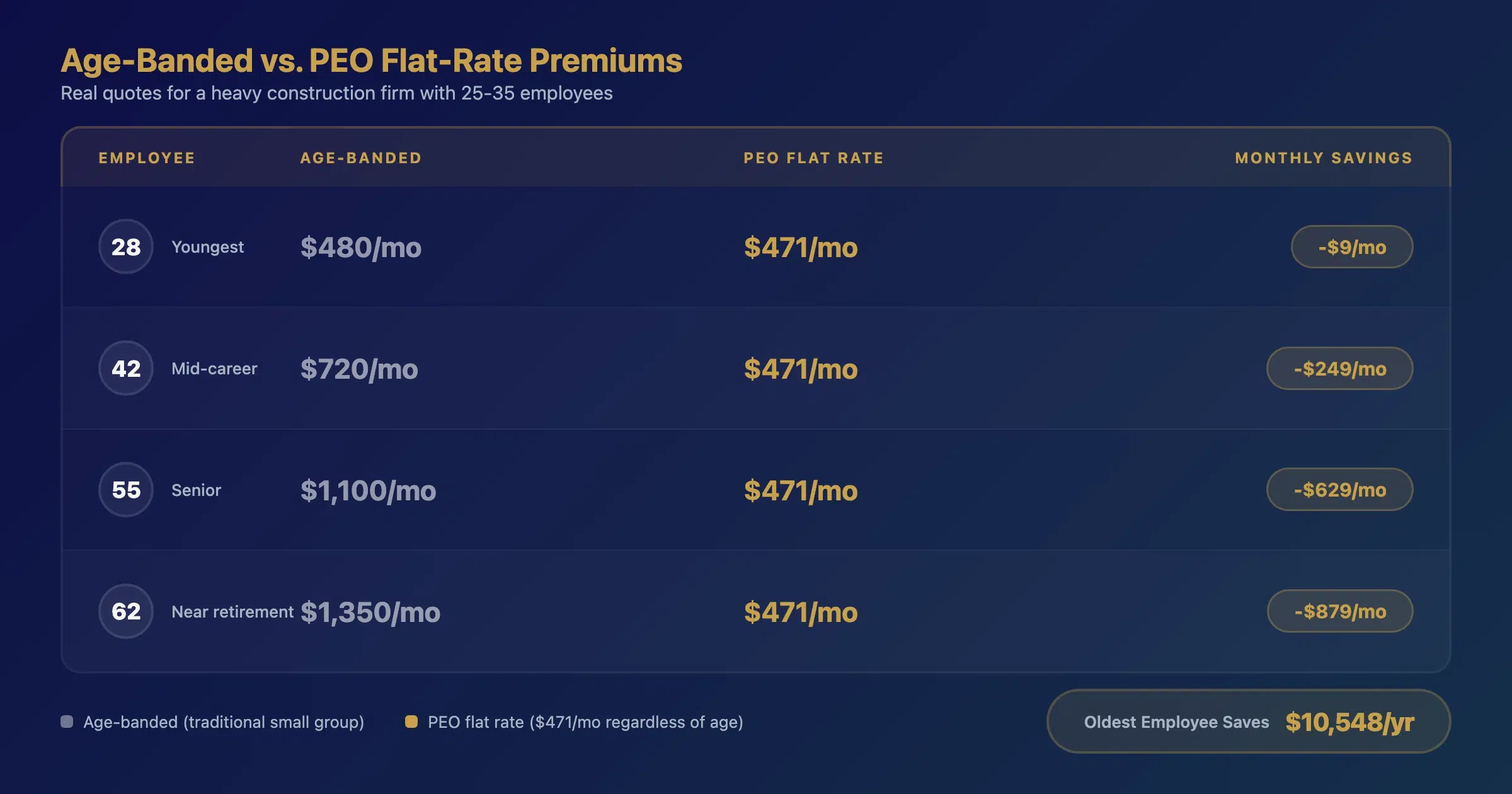
The employees who most need health insurance — experienced, older workers with families — are the ones most priced out by age-banded quotes. A PEO health insurance construction model solves this by pooling your employees into a master policy with community-rated pricing where everyone pays the same base rate.
For the construction firm, this meant their most experienced employees — the ones generating the most revenue and who were hardest to replace — could suddenly afford coverage. Enrollment interest jumped from 30% to over 70% of the workforce.
A PEO (Professional Employer Organization) operates a master health insurance policy covering employees from hundreds of member businesses. Your 30 employees join a risk pool of 20,000+ lives, giving you access to large-group rates that no 30-employee construction company could negotiate independently.
The practical benefits for construction companies:
The lowest-cost PPO option for the construction firm was $471/month per employee — a flat rate regardless of age, gender, or health status. Compare this against their existing quotes where just the 55+ employees were paying $1,100-$1,350/month.
You can model how different premium structures affect your total benefits cost using the Premium Renewal Stress Test to compare age-banded vs. flat-rate scenarios for your specific workforce.
For construction companies, health insurance is only half the benefits equation. Workers' compensation is typically the largest insurance expense, and PEOs offer structural advantages here too.
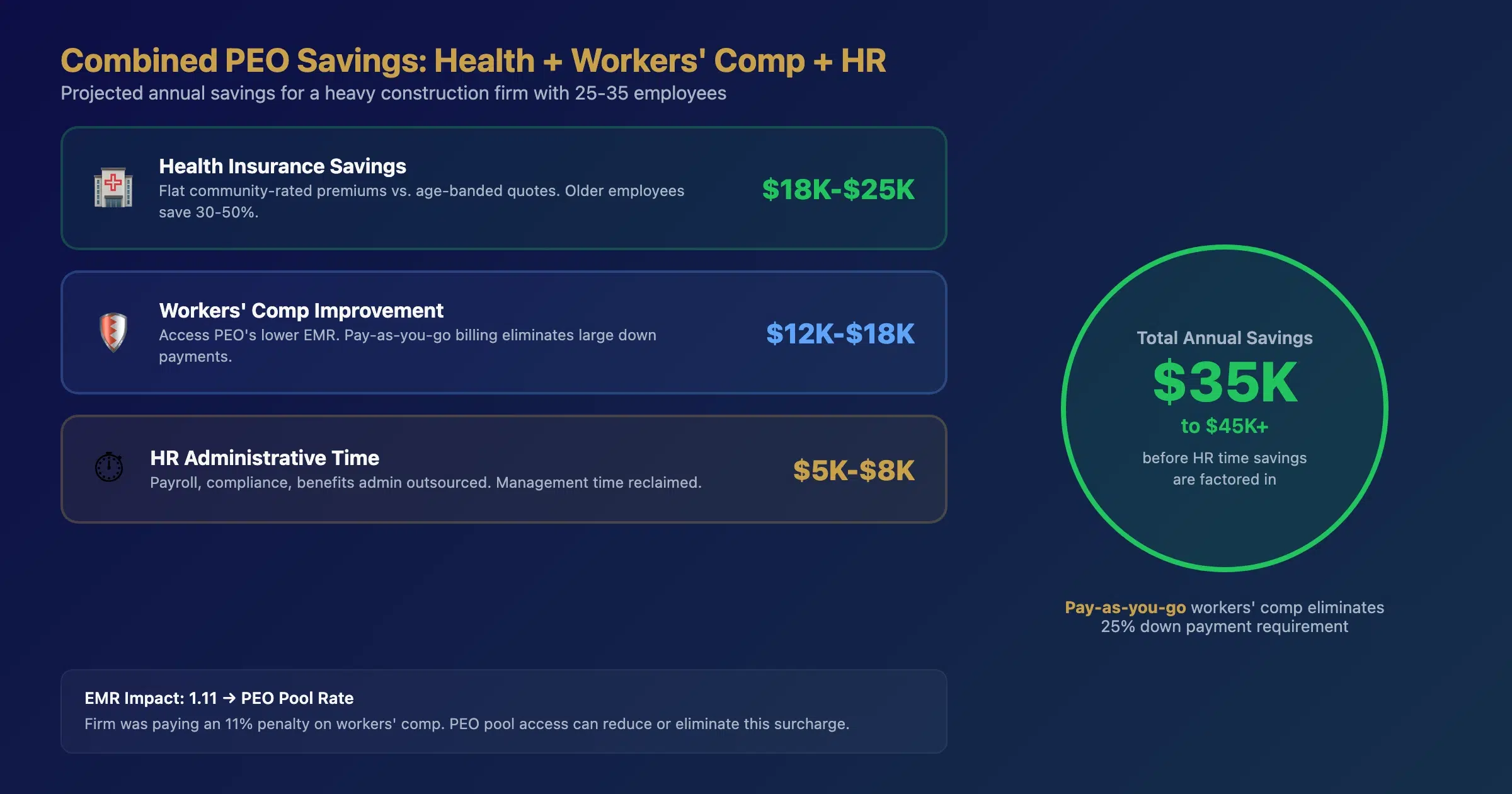
The construction firm had an Experience Modification Rate (EMR) of 1.11 — above the baseline of 1.0, which meant they were paying an 11% penalty on workers' comp premiums due to historical claims. Through a PEO, the firm could potentially access the PEO's lower EMR, reducing their workers' comp rate.
Additional workers' comp advantages through a PEO include:
When we combined health insurance savings and workers' comp improvements for the construction firm, the total projected savings reached $35,000-$45,000 annually — before accounting for the HR administrative time reclaimed by outsourcing to the PEO.
A unique challenge for construction companies is workforce diversity in insurance needs. The firm we worked with had 7-8 employees with foreign insurance that provided superior coverage to any domestic option. These employees wouldn't enroll in a U.S. group plan regardless of price.
This matters because PEOs typically require 30-50% minimum participation among eligible employees. If 25% of your eligible workforce will never enroll, you need near-total participation from the remaining 75% to meet thresholds.
The solution: clearly define eligible employee classes. Employees with documented foreign coverage may be excluded from eligibility calculations — maintaining compliance without forcing enrollment. (Confirm this approach with your compliance counsel, as ACA participation rules vary by plan structure.) This is a nuance most brokers miss, and it's one more reason to work with a PEO experienced in construction workforce dynamics.
For strategies on cutting costs while maintaining quality benefits, understanding participation dynamics is essential.
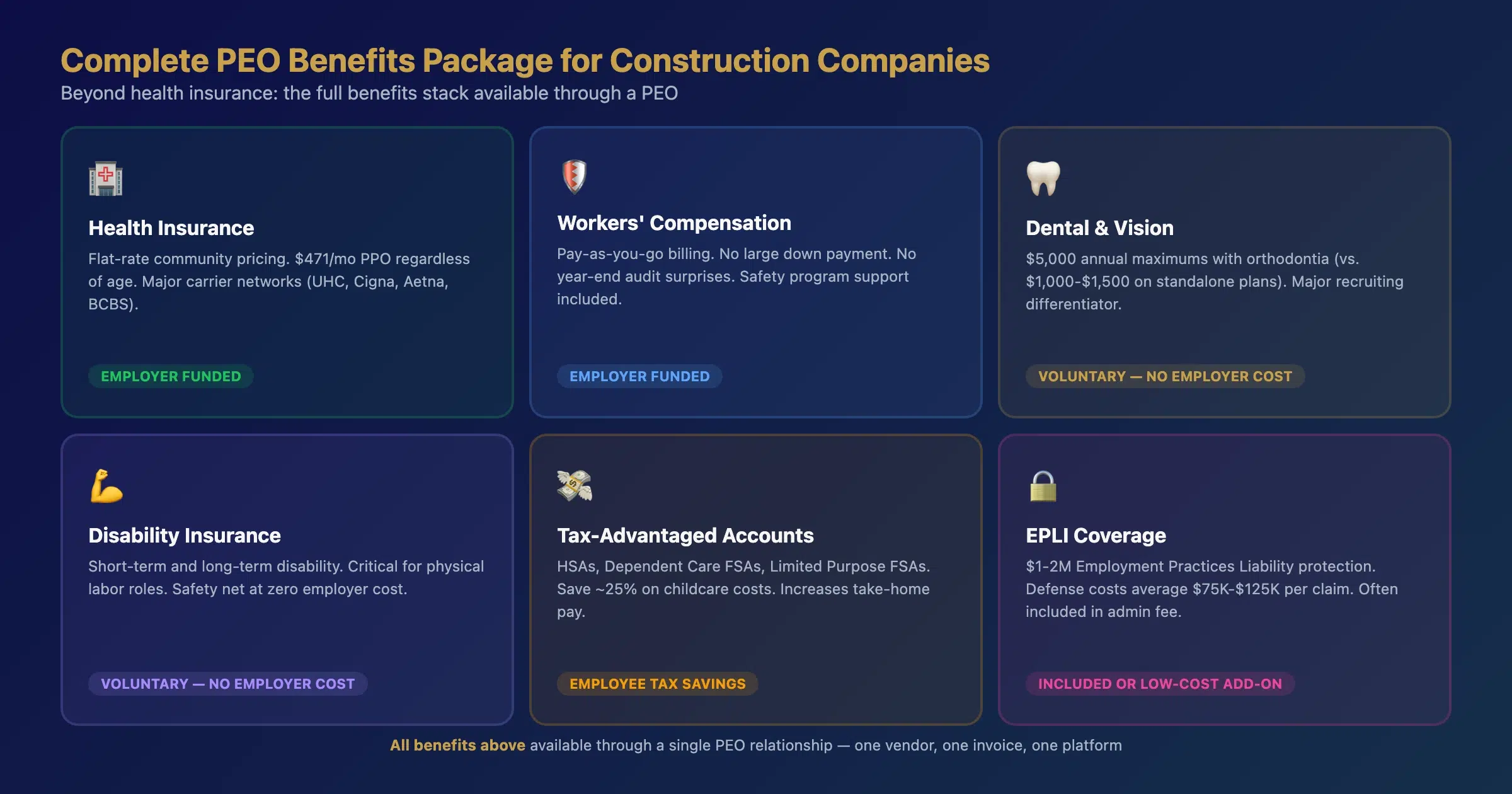
Health insurance gets the most attention, but the PEO model delivers additional benefits that matter specifically to construction companies:
Dental with meaningful maximums: Most standalone small group dental plans cap at $1,000-$1,500 annually. PEO dental plans can offer $5,000 annual maximums with orthodontia — a significant differentiator for recruiting.
Disability insurance: Construction work carries inherent physical risk. Offering short-term and long-term disability as voluntary (employee-paid) benefits provides a safety net at no employer cost.
Dependent Care FSA: For construction employees with young children, pre-tax dependent care spending saves approximately 25% on childcare expenses — an overlooked benefit that increases take-home pay without costing the employer anything.
EPLI coverage: Employment Practices Liability Insurance protects your business from employee lawsuits related to wrongful termination, discrimination, or harassment — with typical coverage of $1-2 million, often included in the PEO admin fee or available as a low-cost add-on.
Learn more about how PEO health insurance works across industries and what to expect from the enrollment process.
Use the Benefits Savings Strategy Builder and Health Funding Projector to model a complete PEO package — including health, workers' comp, and ancillary benefits — for your construction company.
For a detailed ROI analysis of how benefits investments pay for themselves in construction, see our framework for calculating construction employee benefits ROI.
Based on our analyses across multiple construction clients, employers save 20-40% on per-employee health insurance premiums by switching from small group age-banded plans to PEO community-rated pricing. The largest savings accrue to companies with older workforces, where age-banded rates create the greatest disparity.
Yes, most PEOs offer workers' compensation coverage for construction trades, though approval depends on the PEO's risk appetite and your claims history. The PEO evaluates your Experience Modification Rate (EMR), loss runs, and safety protocols during underwriting. Companies with higher EMRs may pay more but can still benefit from the PEO's group rate.
Most PEOs require a minimum of 5-10 employees. For construction companies specifically, the sweet spot is 15-75 employees — large enough to benefit from group buying power but small enough that standalone large-group plans aren't yet accessible.
Yes. PEOs contract with major carrier networks (UHC, Cigna, Aetna, Blue Cross) that include the vast majority of providers. During evaluation, verify that your employees' current providers are in-network by checking the specific carrier and plan type offered through the PEO.
PEO master policies dramatically reduce the impact of high-cost claimants by diluting individual claims across a pool of 20,000+ lives. A $500,000 claim that would spike a 30-employee group's rates by 30-40% has less than a 0.5% impact on a PEO's master policy pool.
If you want to see how PEO flat-rate pricing compares to your current age-banded quotes, the Premium Renewal Stress Test lets you model it yourself with your actual workforce demographics.
About the Author: Sam Newland, CFP®, has spent 13+ years in the employee benefits industry and founded Business Insurance Health and PEO4YOU to bring transparency to an industry that profits from complexity. His approach is simple: show employers the real numbers and let them decide.
April 19, 2026

April 19, 2026
April 20, 2026
April 20, 2026
Recent Posts
April 20, 2026
April 20, 2026

April 19, 2026

April 19, 2026

April 18, 2026

April 18, 2026
Get In Touch— We’re available 24/7
"*" indicates required fields
“We respect your privacy. Your contact information will be used solely for the purpose of responding to your inquiry and will not be shared with third parties.”
Click To Open Modal
Get In Touch— We’re available 24/7
"*" indicates required fields
“We respect your privacy. Your contact information will be used solely for the purpose of responding to your inquiry and will not be shared with third parties.”
Thanks!
We will be in touch soon.
If you're looking to book a consultation now
Affordable health and benefits plans for small businesses, freelancers, and independent contractors.



Copyright © 2026. Peo4you. All rights reserved.