

Your PEO proposal just landed, and the numbers look fantastic. The admin fees are reasonable, the health insurance rates undercut your current plan by 15%, and the rep is already talking about an April 1st start date. Everything feels right.
Until it doesn't. Because what many employers don't realize until year two is that the rates they celebrated were never meant to last. In the benefits industry, we call these PEO honeymoon rates — artificially low first-year pricing designed to win your business, lock you into the platform, and deliver the real cost later.
PEO honeymoon rates are first-year insurance quotes priced below sustainable levels to make a PEO's proposal look dramatically better than alternatives. The strategy is straightforward: offer an irresistible price, get the employer fully onboarded — payroll migrated, benefits enrolled, HR systems integrated — and then deliver the actual market-rate pricing at renewal when switching costs are highest.
When we modeled this scenario for a mid-size law firm evaluating ADP TotalSource against an alternative PEO, the numbers told the story immediately. ADP's proposal included health rates that looked competitive at first glance. But buried in the proposal was a projected 12% renewal increase effective just two months after the start date.
That's not a normal rate adjustment. A legitimate annual increase happens over a 12-month period. A double-digit spike within 60 days signals that the initial rates were never real — they were a door-opener priced below what the carrier would sustain.
The difference between a competitive quote and a honeymoon rate isn't always obvious. Here's what I've learned to look for after reviewing hundreds of PEO proposals across industries:
If a PEO quotes you an April 1 start date but projects a renewal increase in June, the math doesn't work. Legitimate health insurance rates are set for a 12-month policy period. A rate increase within the first quarter means the initial rate was subsidized — and the subsidy is about to end.
What to ask: "Are these rates carrier-approved or PEO-approved?" Carrier-approved rates are underwritten and guaranteed for the full policy period. PEO-approved rates may be internally subsidized and subject to mid-year adjustment.
Many large PEOs charge admin fees as a percentage of payroll — typically 2-12%. This sounds reasonable at first, but the math compounds against you:
| Fee Model | Year 1 (20 employees, $1.5M payroll) | Year 3 (30 employees, $2.5M payroll) |
|---|---|---|
| 3.99% of payroll | $59,850/year | $99,750/year |
| Flat $19.50/week per employee | $20,280/year | $30,420/year |
| Difference | $39,570 | $69,330 |
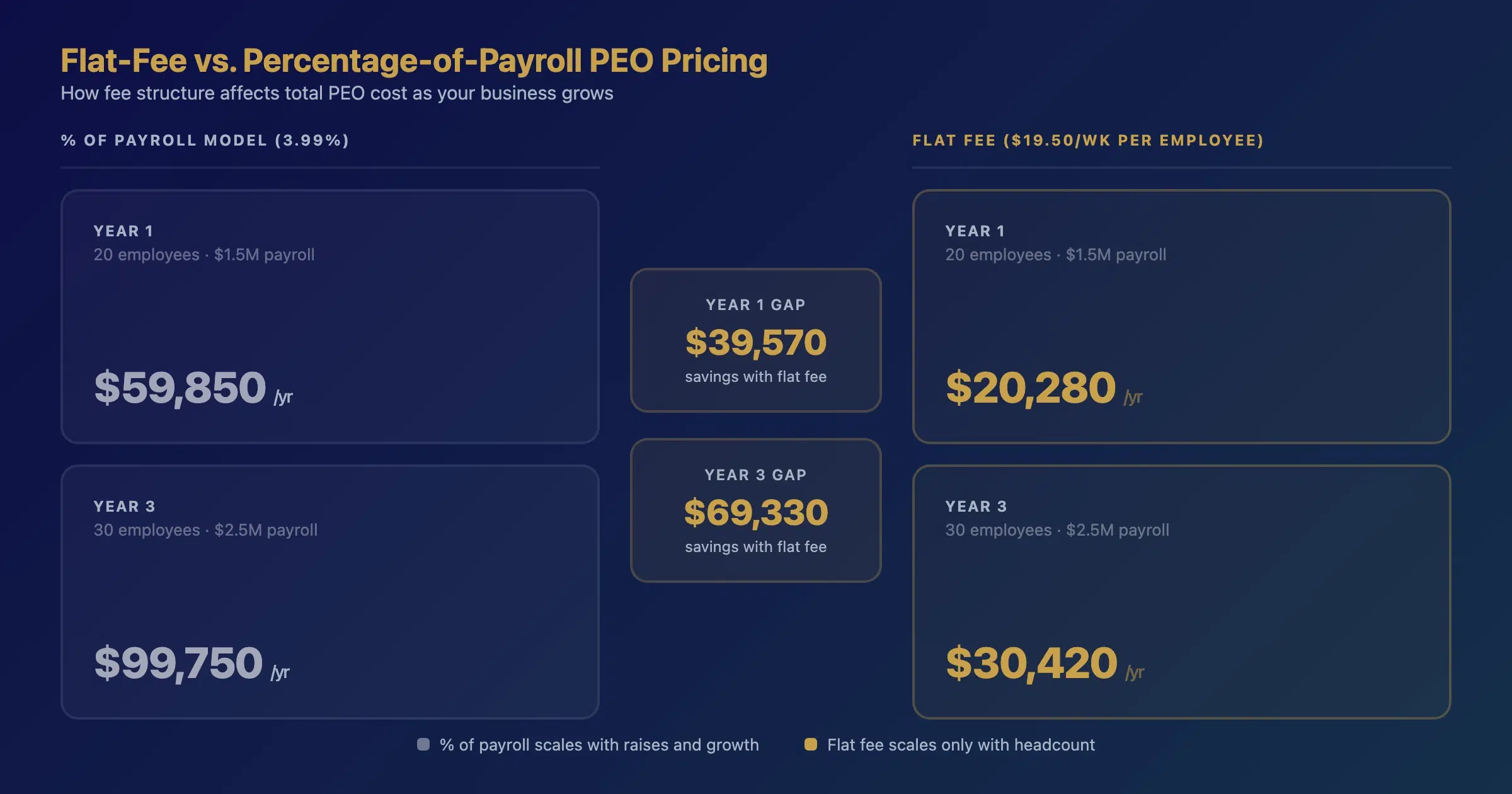
In our analysis of the law firm's proposal, the percentage-of-payroll model would have cost them an additional $22,000-$27,000 annually compared to a flat-fee PEO — and that gap widens every year as payroll grows. You can model your own renewal scenarios across funding strategies using the Premium Renewal Stress Test to see how different fee structures compound over time.
When the health rates, dental maximums, and life insurance limits all outperform the market simultaneously, something is subsidizing the gap. Some PEOs absorb first-year costs through their marketing budget, effectively buying your business with the expectation that you'll stay once switching becomes painful.
The test: Compare the PEO's health plan rates against direct-to-carrier quotes for the same network and plan design. If the PEO rate is more than 10% below the direct rate, ask how the discount is funded and whether it's guaranteed for the full term.
The financial damage from honeymoon pricing isn't just the rate increase itself — it's the compounding effect of being locked in. When we calculated the true cost of PEO health insurance for employers who experienced year-two rate shock, the pattern was consistent:
Over a six-year period, what looked like a winning decision in month one turned into tens of thousands in cumulative excess costs compared to an employer who started with actuarially sound rates and experienced normal annual adjustments. For larger groups (50-100 employees), the compounding effect can reach six figures.
The switching cost compounds the problem. By year two, your payroll, benefits, HR compliance, and 401(k) integrations are all running through the PEO platform. Migrating to a new provider means re-enrolling employees, transferring data, and often paying an early termination fee. That friction is exactly what the honeymoon rate was designed to create.
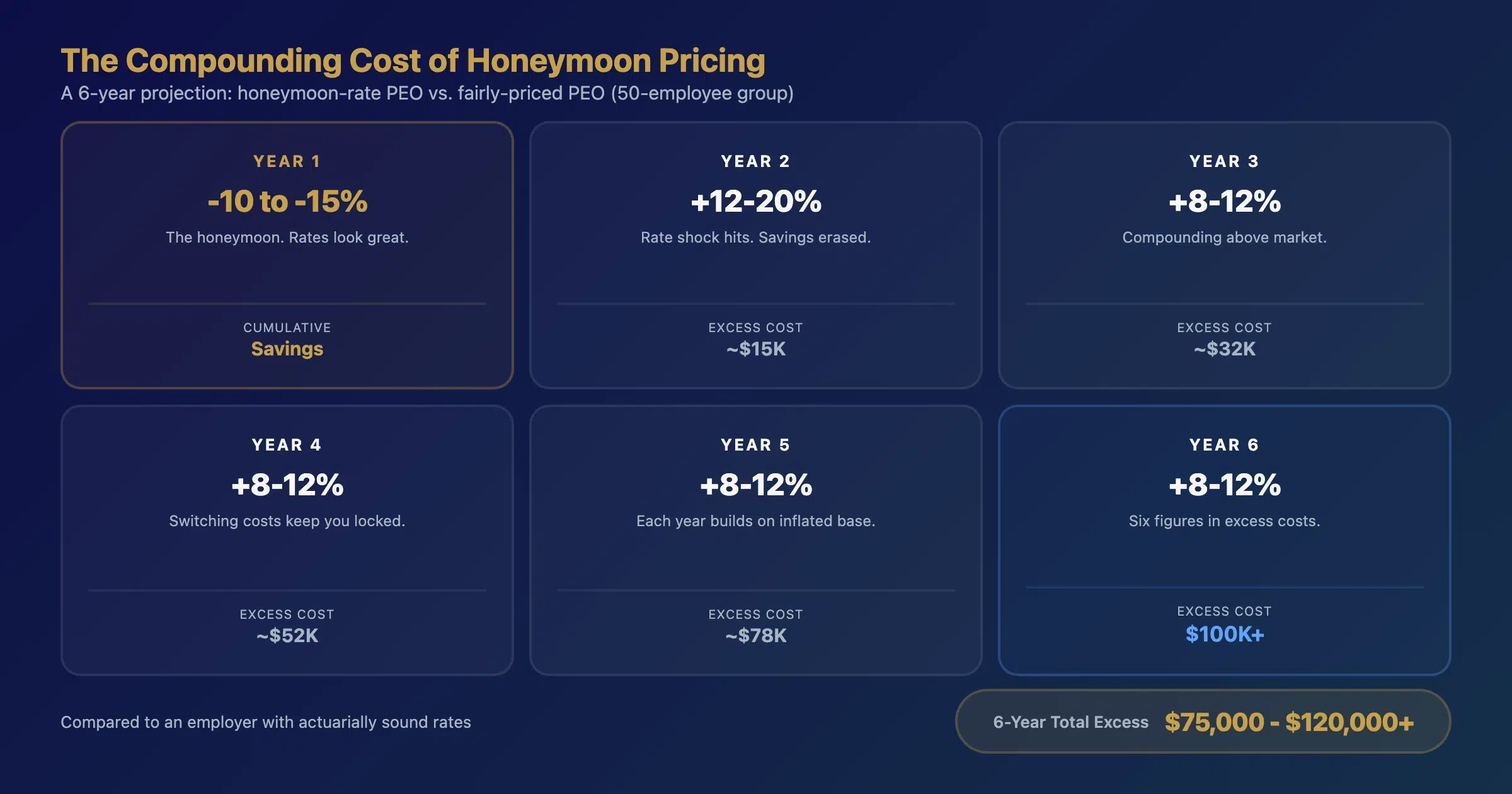
Don't evaluate a PEO on year-one pricing alone. Request a 6-year projection that includes estimated annual increases. If the PEO won't provide one, that's a red flag. You can calculate your benefits ROI across multiple scenarios using the Benefits ROI Calculator to compare how different PEO proposals perform over time.
Request anonymized rate history from 3-5 existing clients in similar industries. What did their rates look like in year one versus year three? A PEO confident in its pricing will share this data. One relying on honeymoon rates won't.
Isolate admin fees from insurance costs. Some PEOs bundle "pass-through" charges (SUTA, FUTA, workers' comp) into their admin percentage, making the true administrative cost harder to identify. Break every line item into its own category and compare.
Ask whether health insurance rates are carrier-underwritten (set by the insurance company based on your group's demographics) or PEO-set (determined by the PEO's internal pricing). Carrier-underwritten rates are inherently more stable because they're based on actuarial data, not marketing strategy.
If you're evaluating a PEO switch and want to understand how your small business health insurance costs compare across models, running the numbers before signing is the single most important step you can take.
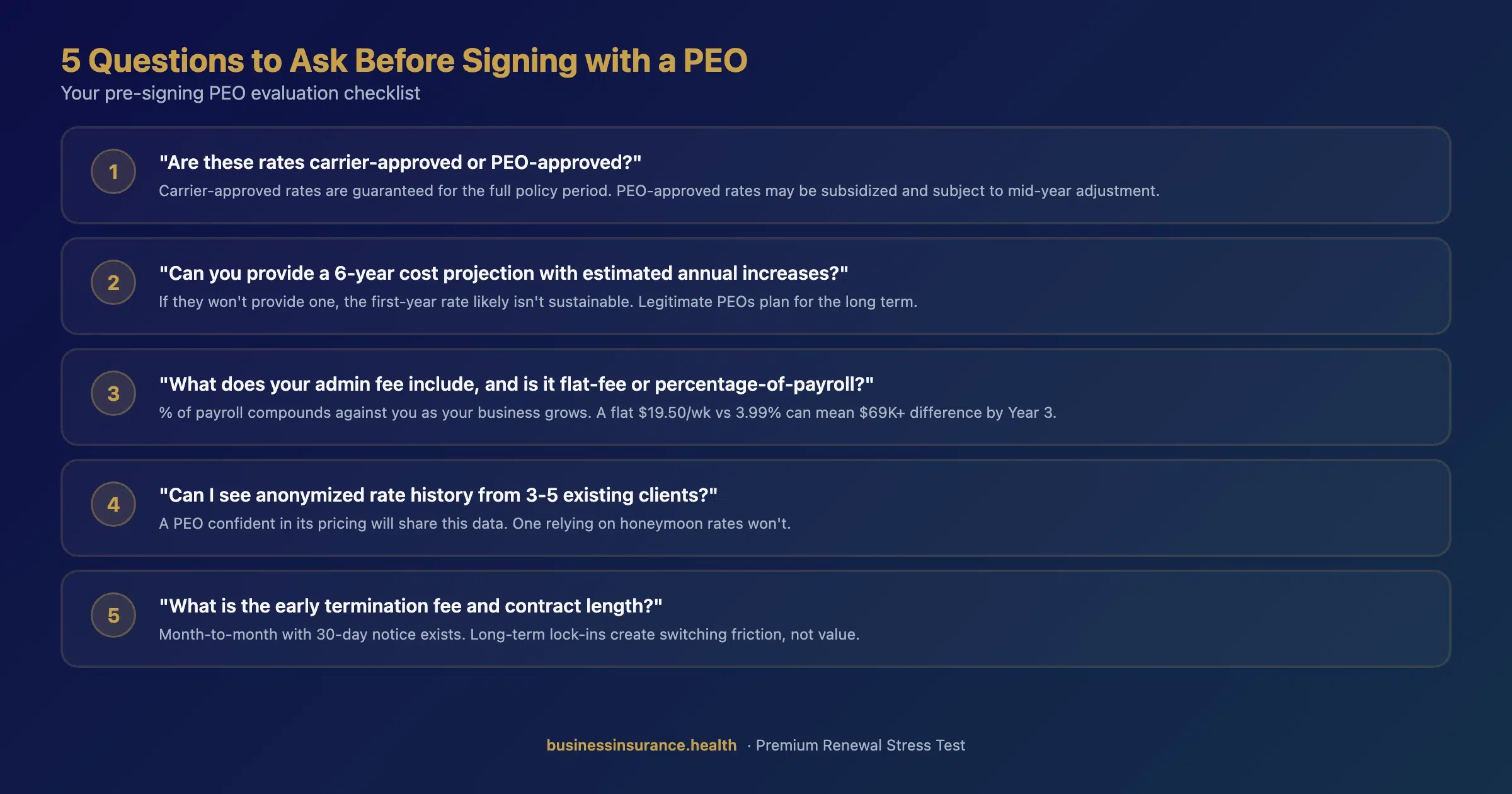
A PEO honeymoon rate is an artificially low first-year insurance or admin fee quote designed to win your business. These rates are typically 10-20% below sustainable levels and increase significantly at renewal — often within the first 6-12 months. The strategy relies on high switching costs to keep employers locked in once real pricing takes effect.
Based on what we've seen across hundreds of proposals, employers who received honeymoon rates experienced increases of 12-20% in year two. By contrast, employers on actuarially sound rates from day one typically see annual increases of 5-10%, which aligns with normal healthcare cost trends (the 2026 market median is running closer to 8-11%).
Yes, but your leverage depends on timing and data. The best time to negotiate is 90-120 days before renewal, armed with competing quotes. PEOs are more willing to negotiate when you can demonstrate you've evaluated alternatives. The Premium Renewal Stress Test can help you model scenarios before entering negotiations.
Flat-fee PEOs charge a fixed dollar amount per employee per week (typically $15-$20). Percentage-of-payroll PEOs charge 2-6% of total payroll (some go as high as 10%). For growing businesses, flat-fee models are almost always more cost-effective long-term because costs scale with headcount, not with raises and promotions. Learn more about when to switch PEO providers if your current fee structure is working against you.
Review your rate history. If your first-year rates were significantly below what you'd been quoted elsewhere, and your second-year renewal came with a double-digit increase, you likely received honeymoon pricing. Also check whether your renewal timeline matches your policy anniversary — mid-year increases are a telltale sign. For PEO solutions designed for construction and trade businesses, rate transparency is especially critical given workers' comp complexity.
If you want to see how honeymoon rate pricing would affect your specific situation over 6 years, the Premium Renewal Stress Test lets you model it yourself — no sales call required.
About the Author: Sam Newland, CFP®, has spent 13+ years in the employee benefits industry and founded Business Insurance Health and PEO4YOU to bring transparency to an industry that profits from complexity. His approach is simple: show employers the real numbers and let them decide.
Recent Posts

March 3, 2026


March 1, 2026

February 25, 2026

February 21, 2026

February 15, 2026

February 8, 2026
Get In Touch— We’re available 24/7
"*" indicates required fields
“We respect your privacy. Your contact information will be used solely for the purpose of responding to your inquiry and will not be shared with third parties.”
Click To Open Modal
Get In Touch— We’re available 24/7
"*" indicates required fields
“We respect your privacy. Your contact information will be used solely for the purpose of responding to your inquiry and will not be shared with third parties.”
Thanks!
We will be in touch soon.
If you're looking to book a consultation now
Affordable health and benefits plans for small businesses, freelancers, and independent contractors.



Copyright © 2026. Peo4you. All rights reserved.