
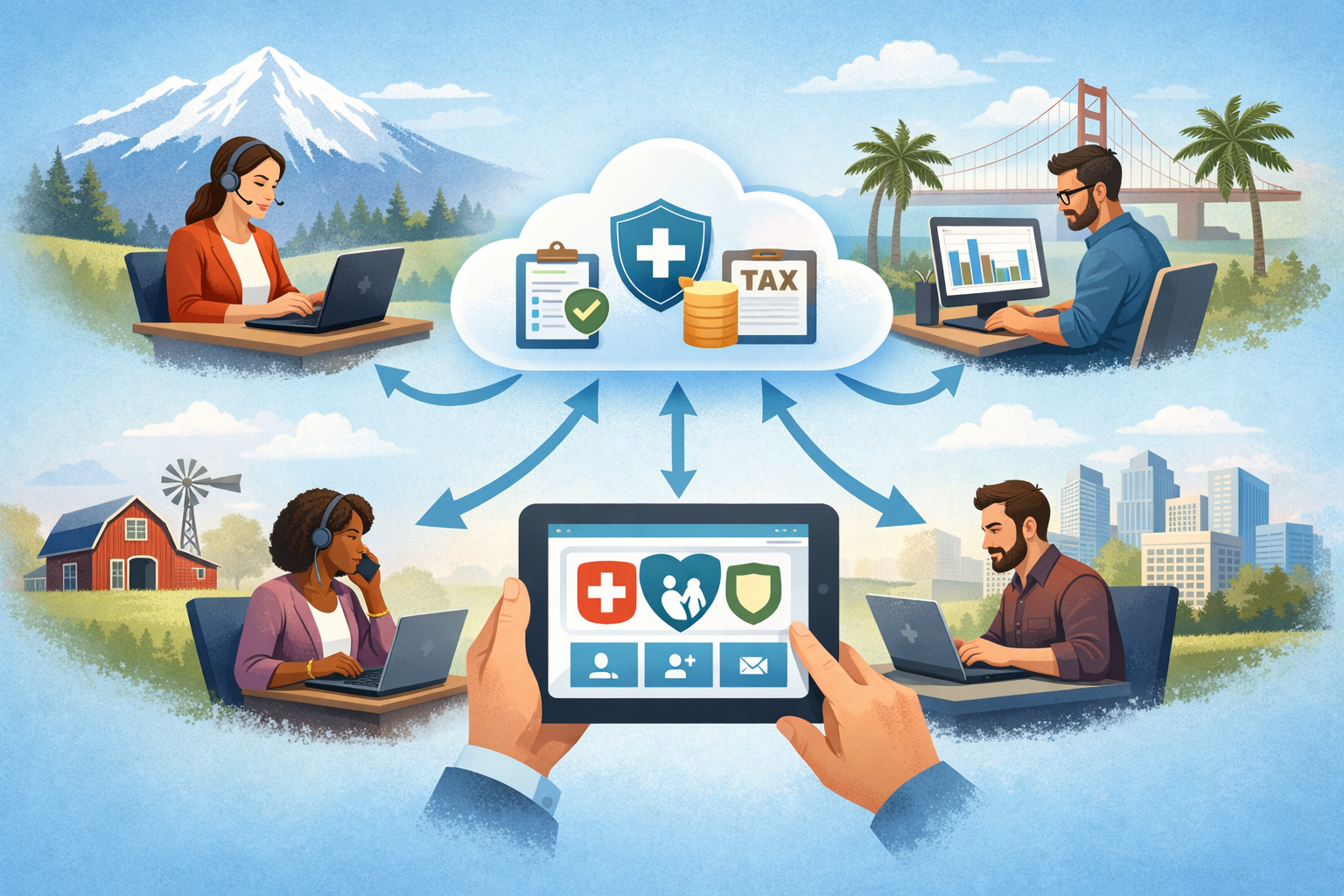
The modern workforce is geographically scattered. A marketing manager works from Colorado, a developer from North Carolina, a finance person from California, and your executive assistant is in Texas. Remote work has become the default for millions of companies, but few realize they've inherited a Byzantine compliance puzzle: managing health benefits across state lines where every state has different rules, different tax treatment, and different regulatory requirements.
When you have remote employees in three states, you're essentially running three separate benefits programs simultaneously. Each state taxes health plan contributions differently. Each state requires different notices and enrollment procedures. If you're self-funding benefits, you're exposed to state-level regulations that conflict with federal ERISA rules. A dependent eligibility decision in Colorado might be handled completely differently in California. An employee moves from Arizona to Florida mid-year, and suddenly their tax treatment, their plan eligibility, and their contribution withholding all change—and if you don't handle it correctly, you expose the company to back taxes, penalties, and employee disputes.
This fragmentation is why remote-first companies hemorrhage money on benefits administration. They either overpay to a consultant who manages each state's compliance separately, or they underpay and expose themselves to massive risk. Meanwhile, remote employees themselves often feel like second-class citizens: they don't have the same plan options as headquarters employees, their coverage is slower to activate, and when they have questions, they're shunted to a generic help line instead of getting personalized support.
This is exactly the problem that Professional Employer Organizations (PEOs) solve. A PEO4YOU or similar provider becomes the co-employer and unifies your entire distributed workforce under a single, national benefits program. One plan. One enrollment process. One point of contact. All compliance handled centrally, in all states, automatically.
Let's walk through what happens when one company tries to manage benefits for a 25-person team across five states without a PEO.
California, New York, and Massachusetts have continuation laws that override federal COBRA in certain circumstances. Illinois mandates specific mental health coverage. Texas allows different waiting periods for pre-existing conditions. Some states require spouse coverage notification within specific timeframes; others don't. When you're offering one national health plan to employees in five states, you're either:
Most companies accidentally choose option two or three, and then discover the problem during a benefits audit.
An employee's health plan premium contribution is treated as pre-tax income in most cases—a significant tax savings. But in some states, certain benefits (like domestic partner coverage) are taxable. Some states require different notice timing for benefit changes. When an employee moves from Colorado (no additional state health tax) to California (which has specific health coverage rules), the tax treatment changes immediately, and if your payroll system doesn't catch it, you've either under-withheld taxes or surprised the employee with an unexpected tax bill at year-end.
Some states require dependent verification (marriage certificate, birth certificate) to be submitted within 30 days of enrollment. Others allow 60 days. Some require third-party verification; others accept self-attestation. If you have a new hire in Texas who submits dependent documents on day 35, they might be rejected in one jurisdiction but accepted in another. You're now managing a patchwork of deadlines and verification rules.
A remote employee in Pennsylvania resigns. Pennsylvania has state continuation laws that differ from federal COBRA. You have 14 days to send a continuation notice—but the 14-day window is calculated differently in Pennsylvania than it is federally. Meanwhile, another employee in California resigns, and California's continuation law overlaps with but doesn't exactly mirror federal COBRA. If you're using a one-size-fits-all continuation process, you're either compliant in some states and violating rules in others.
When an employee in Texas calls HR asking about their out-of-network deductible, your benefits admin needs to know which plan tier they're on, whether that plan has different rules in Texas vs. where the employee might be traveling, and whether any state-specific rules apply. This level of personalized support is impossible to scale, so most companies default to generic scripts: "Check the plan document" or "Call the carrier." Remote employees then feel unsupported and resentful.
| State | Continuation Law | Notice Timing | Special Eligibility Rules |
|---|---|---|---|
| California | Cal-COBRA (state continuation + federal COBRA) | Notice within 30 days of qualifying event; 60-day election period | Domestic partners; different dependent rules |
| New York | NY Continuation Coverage (broader than COBRA) | 30 days for employer notification; 14 days for employee notice | Includes plans under 20-employee threshold |
| Massachusetts | MA Health Care Coverage (mini-COBRA alternative) | 30 days of premium due; 13-week continuation | Applies to all employers; different fee structure |
| Texas | Federal COBRA only | 14 days; standard COBRA timeline | No state continuation law overlay |
| Colorado | Federal COBRA only | 14 days; standard COBRA timeline | No state continuation law overlay |
Looking at this comparison, it's immediately clear: you can't write a single benefits administration process that works across all five states. Each state requires different handling, different notices, and different compliance timelines. Yet most small companies don't have the resources to build and maintain five parallel compliance processes.
Many companies try to manage multi-state remote benefits in-house. Here's what that actually looks like:
You need someone with deep knowledge of multi-state benefits law, or you need to hire a benefits consultant on retainer. That's either $60,000–$120,000 annually for a full-time HR specialist, or $5,000–$15,000 monthly for an external consultant. Add in annual training updates (state law changes), and you're in the $70,000–$150,000 range annually just for expertise.
You need a payroll system that handles multi-state tax withholding, a benefits platform that can apply state-specific eligibility rules, and documentation systems to track compliance by state. Many companies end up running multiple overlapping systems or custom spreadsheets, which creates inconsistency and audit risk. Budget: $2,000–$8,000 annually in software, plus IT time to configure and maintain.
Every enrollment, termination, dependent change, and employee move requires multi-state compliance review. Is this dependent eligible in California? Does this termination trigger state continuation rights? HR staff spend 20–40 hours monthly on multi-state compliance questions. At $50–$75/hour fully loaded cost, that's $12,000–$36,000 annually in HR time.
If you get a state compliance issue wrong (missed notice, wrong tax withholding, ineligible dependent not caught), you're facing back-taxes, penalties, and potential employee lawsuits. Even a small multi-state compliance violation can cost $10,000–$50,000 in corrections and fines1.
Adding it up: DIY multi-state benefits administration costs small companies $85,000–$244,000 annually, plus ongoing risk of penalties and lawsuits.
A PEO becomes your HR co-employer and takes multi-state compliance completely off your table. Here's how it works:
When you partner with a PEO like PEO4YOU, your remote employees all enroll in the same national health plan. But behind the scenes, the PEO's system applies state-specific eligibility rules, notice requirements, and continuation laws automatically. If an employee is in California, the system applies Cal-COBRA rules. If they move to Texas, the system switches to federal COBRA-only rules. You don't manage this—the platform does.
The PEO's payroll system handles all state-specific tax withholding for health benefits automatically. When an employee moves from Colorado to California, the system updates their withholding. When a domestic partner is added to coverage in a state where that's taxable, the system recalculates taxes. You don't manually adjust anything—it's all baked into the platform.
New hires enroll through a single, user-friendly platform regardless of which state they're in. The PEO's system applies the state's dependent verification requirements automatically. If an employee needs to provide documentation, the system prompts them with the right requirements for their state. If documentation is due in 30 days in Texas but 60 days in Massachusetts, the platform tracks that separately. One process; state-specific rules applied behind the scenes.
Every enrollment decision, tax withholding change, and continuation notice is logged with state-specific rules applied. If the DOL or a state agency ever audits, the PEO produces complete documentation showing exactly which rules were applied to each employee in each state. You're never defending DIY spreadsheets or incomplete records—it's all auditable and automated.
Remote employees access a self-service portal to view their benefits, update dependents, and get answers. When they have complex questions, they reach the PEO's support team, which has access to all state-specific rules and can provide accurate, personalized guidance. The employee experience improves dramatically compared to generic HR support.
Benefits are one of the top three reasons employees stay or leave a company2. For remote workers, who often sacrifice in-office perks like free lunch or commute reimbursement, benefits become even more important. According to BLS data, remote employees who report having "excellent" or "very good" benefits communication are 40–50% less likely to leave their current employer3.
When you manage remote benefits through a PEO, the employee experience improves in measurable ways:
This consistency signals that the company values remote workers equally, which has measurable retention impact. Companies that migrate remote benefits to a PEO-managed system often report 8–15% improvements in retention among remote workers in the first year4.
As your remote workforce grows beyond 50–75 people, you may qualify for alternative funding structures that further simplify benefits and reduce costs. Taft-Hartley (multi-employer) health plans pool employees and contributions across multiple related employers, which has several advantages for remote-heavy companies:
Business Insurance Health works with PEOs to design and implement Taft-Hartley structures for companies with 50+ remote employees. Combined with PEO administration, Taft-Hartley funding can reduce remote workforce benefits costs by 20–35% while eliminating most multi-state compliance complexity.
Compare funding strategies for distributed teams — see how PEO pooling, self-funded, and Taft-Hartley options project over 3–5 years. No login required. No email gate. Free.
Scenario: SaaS company, 35 employees, distributed across 7 states (California, New York, Texas, Massachusetts, Colorado, Washington, Florida)
Before PEO: Company managed benefits in-house with a part-time HR manager and an external consultant on retainer ($1,000/month). When a new hire in Massachusetts enrolled, the HR team spent two hours researching dependent verification rules. A California employee's domestic partner was accidentally enrolled in a plan that didn't cover domestic partners (incorrect tax withholding resulted). An employee in New York who was terminated wasn't sent the correct state-specific continuation notice; employee later complained to the state, triggering an audit. Total cost of the audit and corrections: $18,000. HR manager estimates she spends 30 hours monthly on multi-state benefits questions.
After PEO (Year 1): All 35 employees now enroll through a single platform. State-specific rules are applied automatically. A new hire in Massachusetts enrolls in 10 minutes; dependent verification requirements are auto-populated. When the California employee's domestic partner is added to coverage, the system automatically marks the benefit as taxable in California. When the New York employee separates, the system generates the correct NY Continuation Coverage notice automatically. HR manager's multi-state benefits workload drops from 30 hours monthly to 2 hours monthly (just coordinating with the PEO). No compliance violations. No audit findings.
Annual savings: $12,000 (eliminated consultant retainer) + $1,680 (14 hours/month × 12 months × $10/hour HR time savings) + $18,000 (avoided audit costs) = $31,680. PEO benefits administration fee: $8,000–$12,000 annually. Net savings: $19,680–$23,680, plus eliminated compliance risk.
Most major PEOs can serve all 50 states. However, some states (Hawaii, New York) have unique requirements that some PEOs don't handle. Verify that your PEO has active clients in each state where you have remote employees before signing.
A PEO's system updates the employee's location and re-applies state-specific rules automatically. Tax withholding adjusts, continuation law compliance updates, and enrollment requirements reset. The PEO manages all the transitions; you just notify them of the move.
Not necessarily. Many PEO plans are priced identically or lower than small-group plans because PEOs aggregate employees across many clients, creating larger pools and negotiating better rates. You're also eliminating consultant fees and compliance risk, which usually more than offset any small premium difference.
Most PEO plans are fully insured, which shifts claims risk to the carrier. However, some large PEOs offer self-funded or partially self-funded options for companies with 75+ employees. Taft-Hartley plans can be either fully insured or self-funded depending on structure.
PEOs are licensed or registered as employers in all states where they have employees. They handle payroll, tax filings, and compliance in each state through centralized systems. Physical offices are not required; state registration and compliance are the requirement, and all major PEOs handle this.
Sam Newland, CFP® has spent 13+ years in employee benefits consulting, specializing in multi-state compliance, remote workforce benefits, and PEO strategy for distributed companies. Sam is a partner at Business Insurance Health and collaborates with PEO4YOU to help companies simplify benefits administration and improve retention among remote workers.
Disclaimer: This article is educational and does not constitute legal or tax advice. Multi-state benefits requirements vary by jurisdiction, company size, and plan design. Consult your tax advisor, benefits attorney, or qualified PEO specialist before making changes to your remote workforce benefits program.
March 26, 2026

March 27, 2026
March 26, 2026
March 27, 2026
Recent Posts
March 27, 2026

March 27, 2026

March 26, 2026

March 26, 2026

March 25, 2026

March 25, 2026
Get In Touch— We’re available 24/7
"*" indicates required fields
“We respect your privacy. Your contact information will be used solely for the purpose of responding to your inquiry and will not be shared with third parties.”
Click To Open Modal
Get In Touch— We’re available 24/7
"*" indicates required fields
“We respect your privacy. Your contact information will be used solely for the purpose of responding to your inquiry and will not be shared with third parties.”
Thanks!
We will be in touch soon.
If you're looking to book a consultation now
Affordable health and benefits plans for small businesses, freelancers, and independent contractors.


Copyright © 2026. Peo4you. All rights reserved.