Your benefits broker just presented this year's renewal options. The "most affordable" plan has a $6,800 deductible. The one with a $2,000 deductible costs 30% more. And the plan your employees actually want — low copays, reasonable deductible, broad network — does not seem to exist in your price range.
Here is what your broker probably did not tell you: there is a category of high deductible health plan alternatives that delivers a $1,000 deductible, $3,800 out-of-pocket maximum, first-dollar copays, and Blue Cross Blue Shield PPO access — often at a lower total cost than the $6,800 deductible plan you are being quoted.
The reason your broker did not mention it? These plans exist outside the traditional fully insured market.
Key Takeaways
The average deductible for workers at small firms (10-199 employees) reached $2,631 in 2025 — but many employers face $5,000 to $6,800 deductibles on their "affordable" plan options.1
High deductible plans create a paradox: employees avoid using coverage they technically have, leading to worse health outcomes and higher downstream costs.
Multiemployer trust plans (Taft-Hartley) offer $1,000 deductibles with $3,800 out-of-pocket maximums at premiums competitive with — or lower than — high-deductible fully insured plans.
The six-year cost projection shows that a trust plan with under 3% annual renewals saves $180,000 to $350,000 more than a fully insured plan with 7% to 9% renewals for a 35-employee company.
Employer contribution strategy matters: covering 95% of the individual employee premium makes the plan cost roughly $47 per month per employee — competitive with marketplace plans but with dramatically better coverage.
The Deductible Trap: Why "Affordable" Plans Are Anything But
When we analyze health plan renewals at Business Insurance Health and PEO4YOU, we see a pattern we call The Deductible Trap. It works like this:
Employer receives a renewal with a 12% to 19% premium increase.
Broker presents "options" — all of which involve increasing the deductible to offset the premium increase.
Over three to five years, the deductible creeps from $1,500 to $3,000 to $5,000 to $6,800.
Employees now have "coverage" they cannot afford to use. A $6,800 deductible means the average employee pays the full cost of most medical care out of pocket.1
Employees defer care, leading to more expensive emergency visits and chronic condition progression.
The employer pays the same or more in premiums each year, while employees receive progressively less value.
Aon projects employer health care costs will exceed $17,000 per employee in 2026, a 9.5% increase.2 For employers trapped in the fully insured renewal cycle, that cost increase comes with worse plan design, not better.
What a $1,000 Deductible Plan Actually Looks Like
Consider a scenario we encounter regularly: a company with 30 to 40 employees is evaluating its renewal options. The fully insured quotes come back with $6,800 deductibles and limited network options. Then we model the same company on a multiemployer trust plan through PEO4YOU.
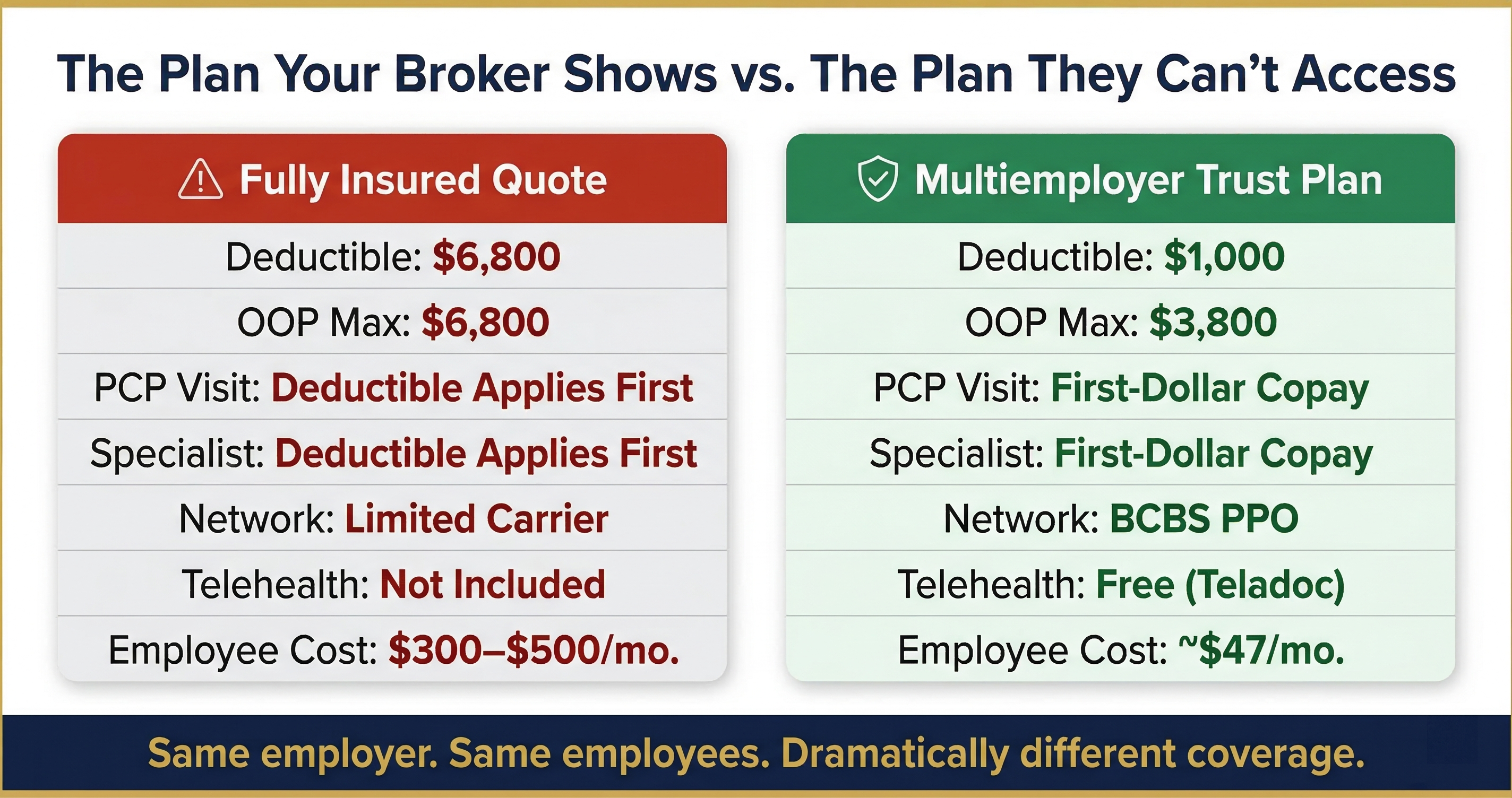
The comparison:
Plan Feature
Fully Insured Quote
Multiemployer Trust Plan
Deductible
$6,800
$1,000
Out-of-Pocket Maximum
$6,800
$3,800
Coinsurance
Varies by plan
20%
PCP Copay
Deductible applies first
First-dollar copay
Specialist Copay
Deductible applies first
First-dollar copay
ER Copay
Deductible applies first
First-dollar copay
Network
Limited carrier network
BCBS PPO
Telehealth
Not included
Free (Teladoc)
Dental Maximum
$1,000/year
$2,000/year
Employee Cost (individual)
$300–$500/month
~$47/month (at 95% employer contribution)
BIH model based on actual plan comparisons for companies with 30-40 employees. Fully insured quotes reflect typical small group market offerings. Trust plan reflects Taft-Hartley multiemployer structure. Employee cost assumes 95% employer contribution to individual premium.
The employee paying $47 per month for a $1,000 deductible BCBS PPO plan is getting dramatically more value than the employee paying $400 per month for a $6,800 deductible plan with limited network access. And the employer's total cost is often lower because the trust plan's pooled risk structure produces more favorable rates than the small group market.
The Six-Year Cost Projection: Where the Real Savings Appear
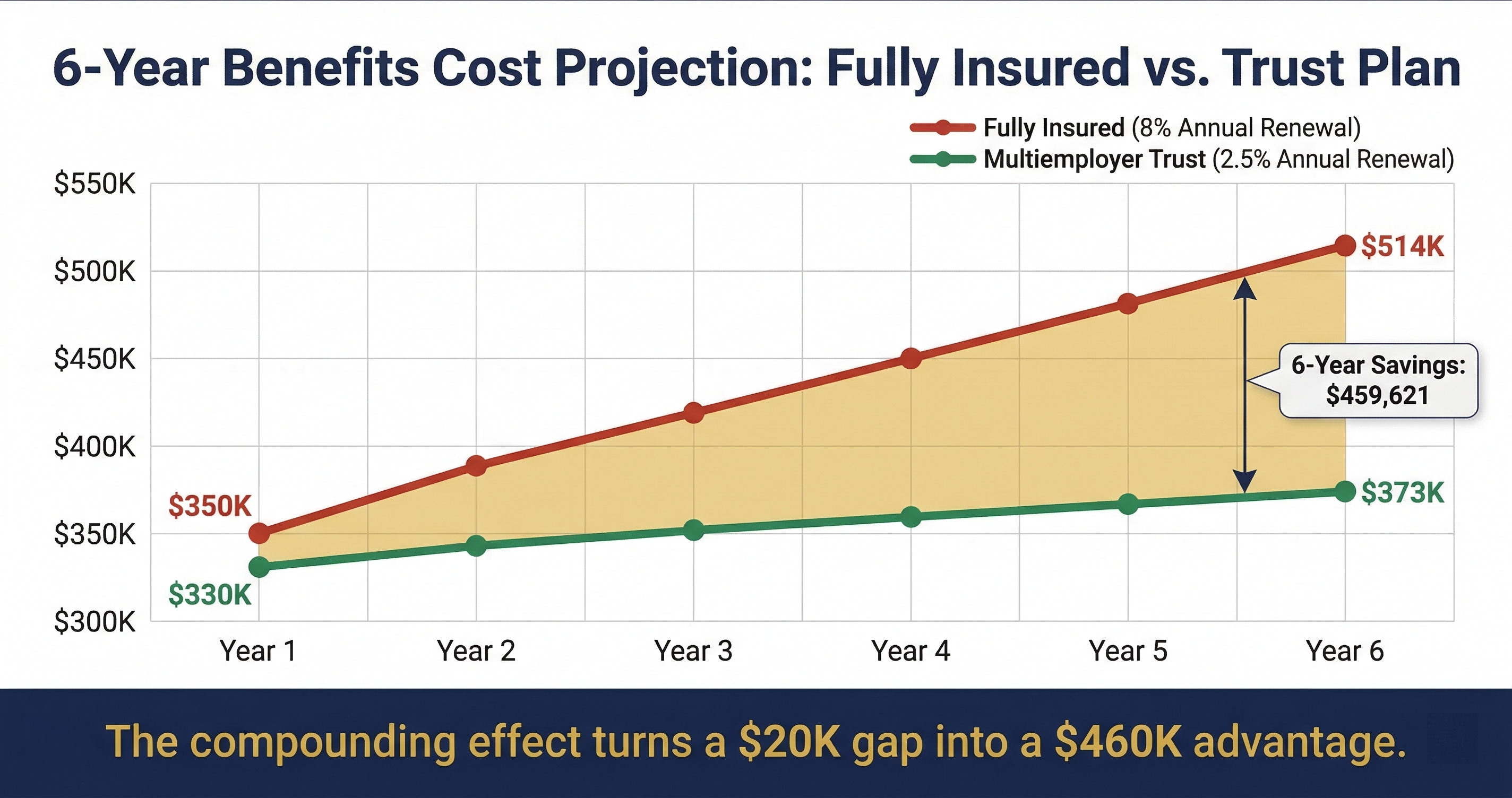
The plan comparison table tells the story at a point in time. The six-year projection tells the story that matters for your business.
Hidden Math: Six-Year Cost Projection for a 35-Employee Company
Model employer: Professional services company, 35 employees, average age 38, current annual premium $350,000
Year
Fully Insured (8% renewal)
Trust Plan (2.5% renewal)
Annual Difference
Year 1
$350,000
$330,000
$20,000
Year 2
$378,000
$338,250
$39,750
Year 3
$408,240
$346,706
$61,534
Year 4
$440,899
$355,374
$85,525
Year 5
$476,171
$364,258
$111,913
Year 6
$514,264
$373,365
$140,900
6-Year Total
$2,567,574
$2,107,953
$459,621
BIH model estimate. Fully insured assumes 8% compound annual renewal (conservative within the 7-9% range for mid-size employers). Trust plan assumes 2.5% compound annual renewal. Starting premiums reflect the trust plan's lower base rate due to pooled purchasing power. Actual savings range: $180,000 to $550,000+ depending on renewal rates and starting premium differential.
Math verification:
Year 2 fully insured: $350,000 × 1.08 = $378,000 ✓
Year 6 fully insured: $350,000 × 1.08⁵ = $514,264 ✓
Year 2 trust: $330,000 × 1.025 = $338,250 ✓
Year 6 trust: $330,000 × 1.025⁵ = $373,365 ✓
6-year totals: Sum of all years ✓
The compounding effect is the key insight. In year one, the difference is $20,000 — meaningful but not transformational. By year six, the annual difference exceeds $140,000. The cumulative six-year savings of $459,621 funds an entire additional department, a facility upgrade, or simply stays on the balance sheet as retained earnings.
And the trust plan employees have a $1,000 deductible the entire time, while the fully insured employees watch their deductible climb toward $8,000 or $9,000.
Why Your Broker Is Not Showing You These Options
Traditional benefits brokers operate within the fully insured market. Their carrier relationships, their quoting systems, and their commission structures are all built around that market. Taft-Hartley multiemployer plans, PEO arrangements, and other alternative funding strategies exist outside that ecosystem.
This is not a criticism of brokers — it is a structural observation. A broker who only has access to fully insured carriers can only show you fully insured options. The PEO health benefits model and Taft-Hartley trust structures require specialized knowledge and carrier relationships that most traditional brokers do not maintain.
That is exactly what Business Insurance Health and PEO4YOU were built to address. We do not replace your broker — we show you the options your broker cannot access.
How the Employer Contribution Strategy Makes It Work
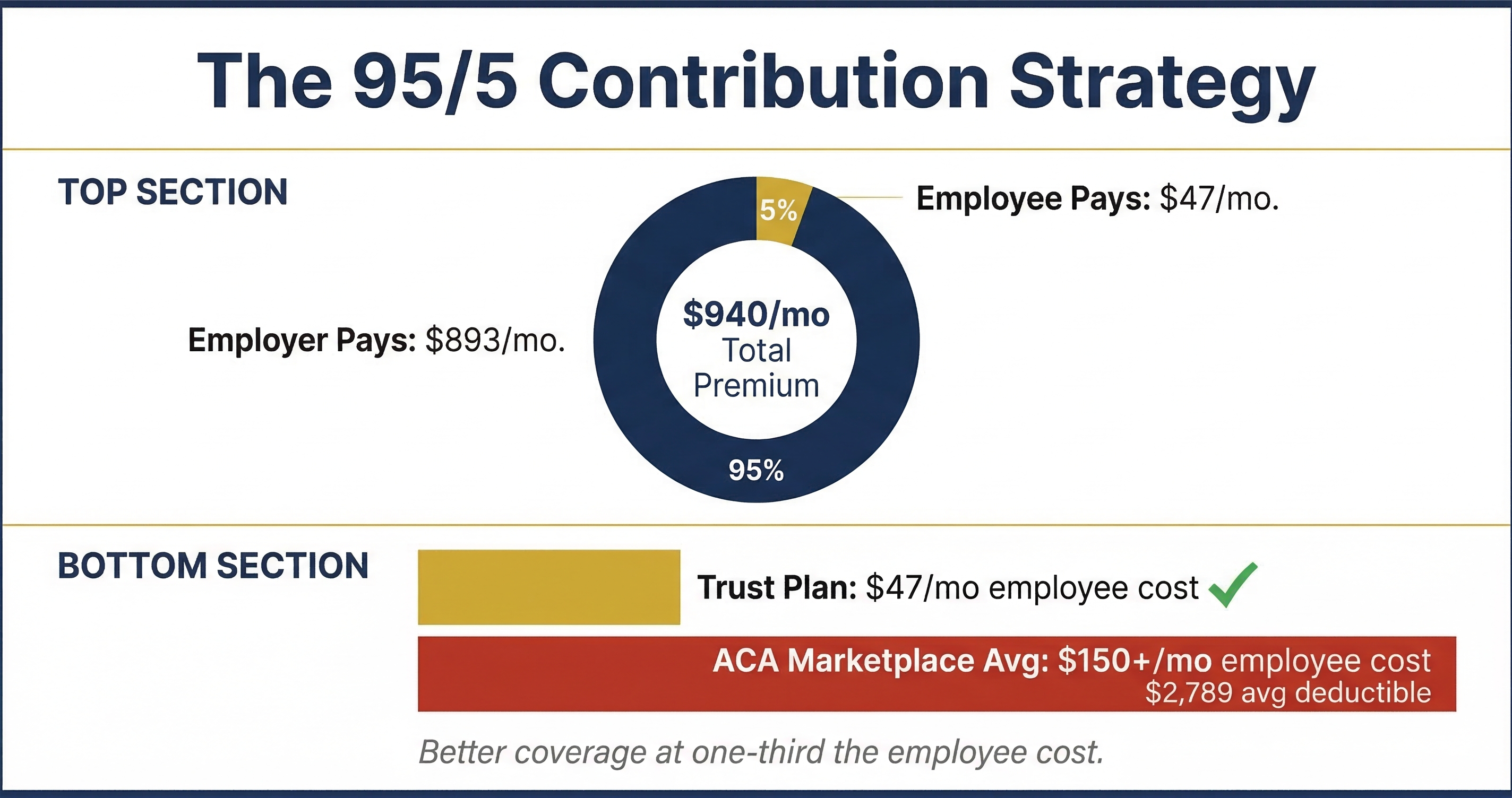
The contribution strategy is as important as the plan selection. Here is how a 95% employer contribution to the individual employee premium changes the math:
If the individual monthly premium is $940 (typical for a BCBS PPO through a multiemployer trust)
Employer pays 95%: $893 per month per employee
Employee pays 5%: approximately $47 per month
At $47 per month, the employee contribution is lower than most ACA Marketplace silver plans — but the coverage is dramatically superior ($1,000 deductible and $3,800 OOP max versus $2,789 average Marketplace deductible).3
This creates a powerful retention tool. An employee would need a significant salary increase at a competitor to offset the value of a $47 per month plan with first-dollar copays and BCBS PPO access. The benefits become a retention moat.
See how your benefits costs project across 6 years under 5 different funding strategies — including Taft-Hartley trust, PEO, level-funded, and captive options.
The 50-Employee Threshold: When This Becomes Critical
Companies approaching 50 employees face a unique inflection point. Under the ACA, companies with 50 or more full-time equivalent employees must offer health coverage or face penalties. This mandate pushes employers into the fully insured market at the exact moment when their renewal leverage is weakest.
The irony: crossing the 50-employee threshold triggers a requirement to offer coverage, but the coverage available in the small-to-midsize fully insured market has deductibles that make the coverage nearly unusable for employees earning $40,000 to $60,000 per year.
A Taft-Hartley multiemployer plan solves both problems simultaneously: it satisfies the ACA mandate with a plan that employees will actually use, at a cost that does not require annual deductible increases to manage renewals.
For companies exploring the ERISA compliance implications of their benefits structure, see our analysis of the new wave of ERISA voluntary benefits lawsuits targeting employers who fail to benchmark their benefits costs.
Frequently Asked Questions
How can a $1,000 deductible plan cost less than a $6,800 deductible plan?
The pricing difference comes from the risk pool, not the plan design. Fully insured small group plans are priced based on your company's demographics and a small risk pool. Multiemployer trust plans pool hundreds or thousands of employees across multiple employers, spreading risk and achieving rates comparable to Fortune 500 companies. The larger pool supports better plan design at lower per-employee cost.
Is a Taft-Hartley multiemployer trust plan legal for non-union companies?
Taft-Hartley plans require a collectively bargained trust structure, which involves a collective bargaining agreement. However, the process is straightforward for companies working with an experienced benefits advisor. PEO4YOU guides employers through the legal setup, which typically takes 30 to 60 days. The trust structure has been validated by decades of ERISA case law and DOL guidance.
What happens if our company has a high-cost claimant on the trust plan?
This is one of the primary advantages of a multiemployer trust. A single high-cost claimant in a 35-person fully insured plan can trigger a 25% to 40% renewal increase. In a trust plan with thousands of pooled members, the same claimant has minimal impact on the overall risk pool. The trust absorbs the volatility that would devastate a small group plan. For more on this dynamic, see PEO health benefits for small businesses.
Can we keep our current doctors and hospitals with a trust plan?
Most trust plans offer BCBS PPO networks, which are among the broadest in the country. In most markets, employees retain access to the same providers they currently use. The network comparison should be part of your evaluation — ask for the specific network and verify provider access before making a decision.
What is the minimum company size for a multiemployer trust plan?
Most trusts require a minimum of 5 benefits-eligible employees. This makes them accessible to companies well below the 50-employee ACA mandate threshold. Companies with 20 to 50 employees often see the most dramatic improvement in plan quality and cost when transitioning from fully insured to a trust structure.
Benchmark your current plan design (deductible, OOP max, copays, network) against institutional data and see how your coverage compares to what is available through alternative funding strategies.
Kaiser Family Foundation. "2025 Employer Health Benefits Survey." October 2025. kff.org. Average single premium $9,325; average deductible for firms with 10-199 workers: $2,631; overall average deductible: $1,886.
Aon plc. "U.S. Employer Health Care Costs Expected to Rise 9.5 Percent in 2026." September 2025. aon.mediaroom.com. Projected costs exceeding $17,000 per employee.
Peterson-KFF Health System Tracker. "How ACA Marketplace Costs Compare to Employer-Sponsored Coverage." November 2025. healthsystemtracker.org. Average ACA individual market deductible: $2,789.
National Association of Professional Employer Organizations (NAPEO). "PEO Industry Research & Data." 2025. napeo.org. PEO users report double median revenue growth and 27.2% average ROI.
Business.com. "Healthcare Employer and Employee Costs in 2026." January 2026. business.com. Aon projection: average employer health cost exceeding $17,000/employee in 2026.
Bureau of Labor Statistics. "Employer Costs for Employee Compensation — September 2025." bls.gov. Benefits account for 29.7% of total compensation.
This analysis is provided for educational purposes and does not constitute financial or legal advice. Plan comparisons are BIH model estimates based on typical market conditions for mid-size employers. Actual costs vary by geography, employee demographics, and claims history. All projections are presented as ranges. Consult your benefits advisor for guidance specific to your situation.
About the Author
Sam Newland, CFP® is the Founder and President of Business Insurance Health and PEO4YOU. With 13+ years in the employee benefits industry and experience as the #1 face-to-face health benefits agent nationally, Sam built BIH on a transparency-first philosophy: "What Most Brokers Can't — or Won't — Show You." Contact: [email protected] | 857-255-9394
March 19, 2026
Your Employees Can't Actually Use a $6,800 Deductible Plan — Here's How to Get Them a $1,000 Deductible for Less
Sam Newland
March 19, 2026
Your Broker's Commission Could Get You Sued — Here's What Employers Need to Know About the New ERISA Lawsuits
Sam Newland
March 18, 2026
How Logistics Companies Cut Benefits Costs Without Losing Their Best Drivers
Sam Newland
March 18, 2026
When Should Your Startup Actually Start Offering Health Benefits?
Sam Newland
March 17, 2026
Health Plans for Small Manufacturers: How to Cut Costs Without Cutting Coverage
“We respect your privacy. Your contact information will be used solely for the purpose of responding to your inquiry and will not be shared with third parties.”
Click To Open Modal
Questions ?
Get In Touch We’re available 24/7
Floating Contact Form
Get In Touch—
We’re available 24/7
"*" indicates required fields
“We respect your privacy. Your contact information will be used solely for the purpose of responding to your inquiry and will not be shared with third parties.”
Question ?
Get In Touch We’re available 24/7
Floating Contact Form
Get In Touch—
We’re available 24/7
"*" indicates required fields
“We respect your privacy. Your contact information will be used solely for the purpose of responding to your inquiry and will not be shared with third parties.”
Thanks! We will be in touch soon. If you're looking to book a consultation now