Your benefits broker just renewed your voluntary benefits package. Disability, life, accident, critical illness — the usual lineup. Your employees signed up, the premiums come out of their paychecks, and you assumed that was the end of your responsibility.
It is not. A new wave of ERISA class action lawsuits is targeting employers — including United Airlines, Allied Universal, and Laboratory Corporation of America — for exactly this scenario. The allegation: employers breached their fiduciary duty by allowing brokers to charge excessive commissions on voluntary benefit programs, and the employees paid the price through inflated premiums.1
If your company has 100 or more employees and offers voluntary benefits, this is a risk you need to understand right now.
Key Takeaways
A new wave of ERISA class action lawsuits (filed late 2025 through early 2026) targets employers over excessive broker commissions on voluntary benefits — even when employees pay 100% of the premium.1
The lawsuits allege fiduciary breach under ERISA Section 404 — employers have a duty to ensure broker fees are reasonable, carriers are competitively selected, and loss ratios are monitored.2
Employers with 100+ employees are the primary targets because their plans are large enough to attract class action attorneys and generate meaningful damages.
The fix is procedural, not expensive — documenting your broker selection process, requiring fee disclosure, and benchmarking premiums against market rates creates a defensible record.
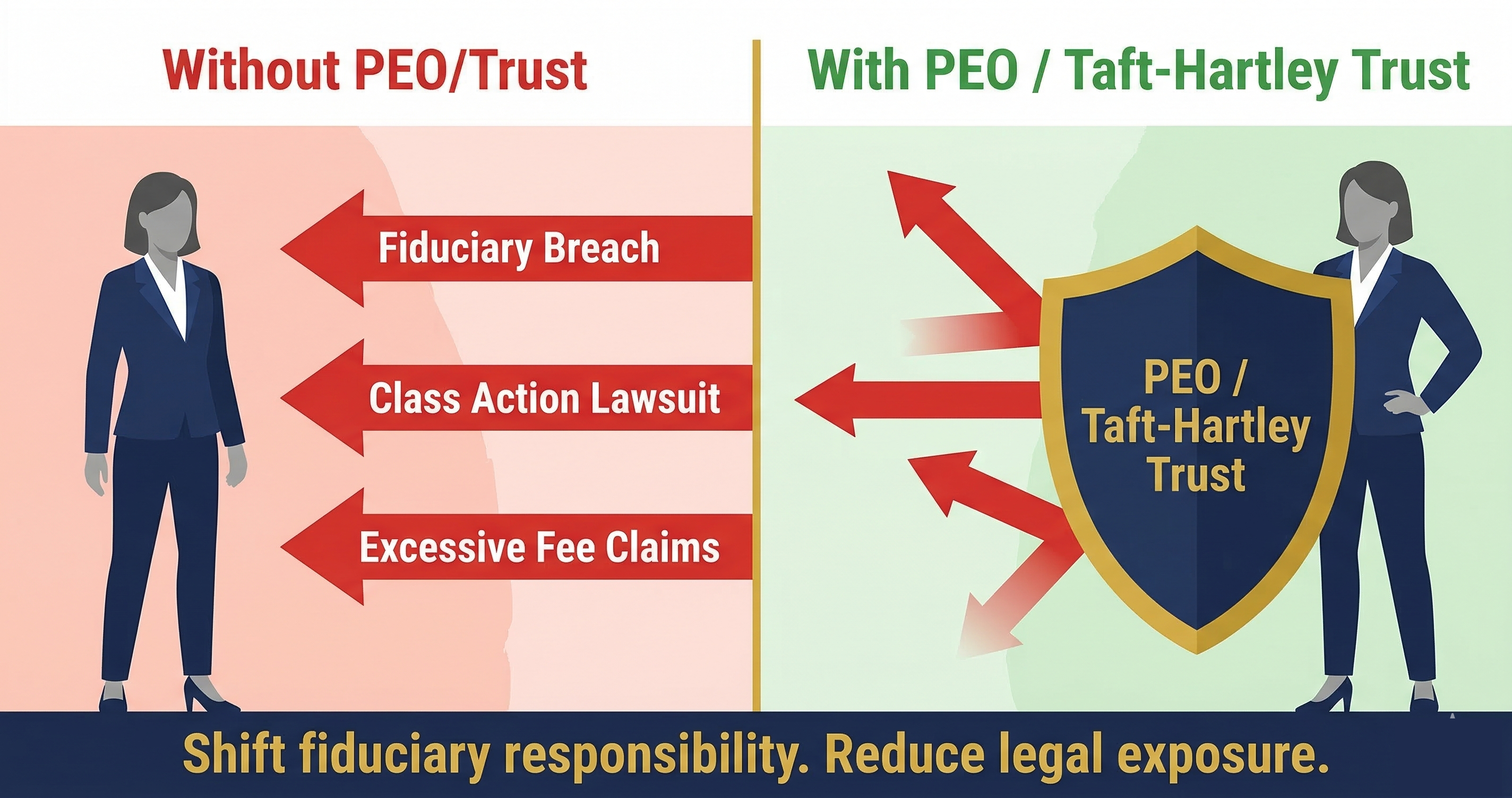
Taft-Hartley multiemployer plans and PEO arrangements can shift fiduciary responsibility off the employer, reducing exposure.
What Are the ERISA Voluntary Benefits Lawsuits About?
The law firm Schlichter Bogard — the same firm behind landmark 401(k) excessive fee litigation — launched this new genre of ERISA lawsuits in late 2025.3 The core theory is straightforward:
Employers integrate voluntary benefits (disability, life, accident, critical illness) into their ERISA welfare plans.
Brokers and consultants recommend specific carriers and negotiate commissions — often 15% to 30% of premiums — that are not disclosed to employees.1
Employers fail to benchmark these commissions against market rates or evaluate whether lower-cost alternatives exist.
Employees pay inflated premiums through payroll deduction, never knowing that a significant portion funds broker compensation rather than actual coverage.
The lawsuits name both the employer (as plan fiduciary) and the broker or consultant (as a "functional fiduciary" who exercises discretion over plan administration).2
What makes this litigation particularly dangerous: the fact that employees pay 100% of the premium does not reduce the employer's fiduciary obligation. Under ERISA, if you sponsor the plan and exercise discretion over provider selection, you have a duty to ensure fees are reasonable — regardless of who pays them.2
The Voluntary Benefits Markup Problem: Why Employers Are Exposed
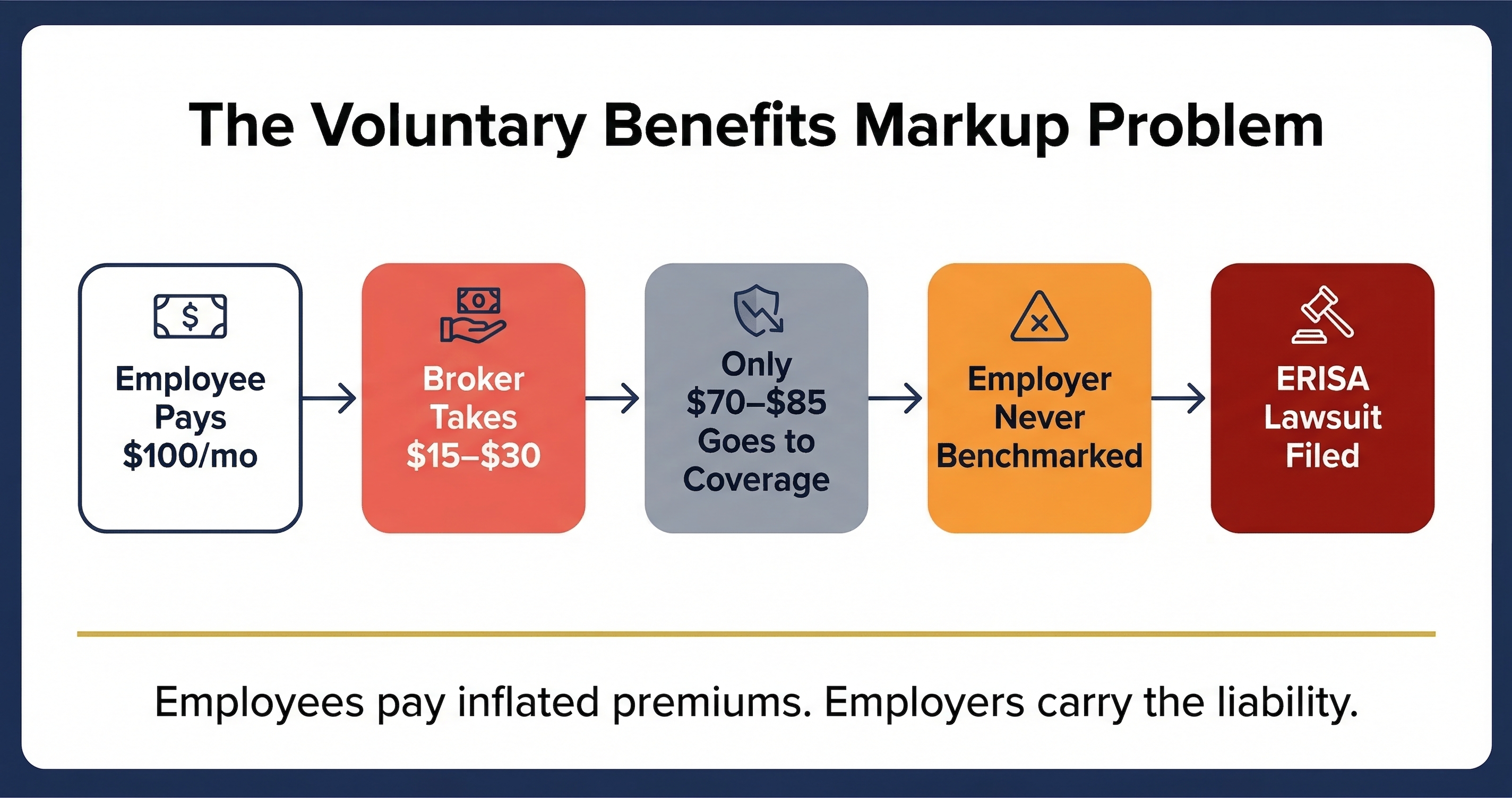
When we analyze voluntary benefits programs at Business Insurance Health and PEO4YOU, we consistently find what we call The Voluntary Benefits Markup Problem. Here is how it works:
A broker recommends a voluntary benefits package from a specific carrier. The premiums seem reasonable on the surface. But hidden inside those premiums is a commission structure that may include:
First-year commissions of 15% to 30% of premium — significantly higher than commissions on medical coverage1
Renewal commissions of 5% to 15% that continue indefinitely
Override bonuses based on total premium volume placed with a carrier
No competitive bidding — the broker recommends one carrier without comparing three or more options
The result: employees pay $100 per month for voluntary disability coverage, but only $70 to $85 of that goes toward actual coverage. The rest is broker compensation that was never disclosed and never benchmarked against market rates.
According to Holland & Knight's analysis of these cases, plaintiffs allege that brokers "exercise discretion in administering voluntary benefit plans by withholding information about lower-cost options to maximize commissions."2 That is the core of ERISA voluntary benefits compliance risk.
Who Is Being Sued — And Who Could Be Next
The initial wave of lawsuits (filed December 2025 through February 2026) targets some of the largest employers in the country:13
Employer
Broker/Consultant Named
Core Allegation
United Airlines
Mercer
Excessive commissions, failure to monitor loss ratios
Allied Universal
Named broker
Failure to benchmark carrier selection and fees
Laboratory Corp. of America
Named broker
Self-dealing, excessive premiums
The pattern is clear: large employers with large voluntary benefits enrollment generate the highest potential damages. But if you have 100 or more employees and offer voluntary benefits through a broker who has not disclosed their commission structure, you carry the same structural risk — just at a smaller scale.
With employer health care costs projected to rise 9.5% in 2026, exceeding $17,000 per employee according to Aon,4 the pressure to contain all benefits costs — including voluntary programs — is intensifying. And where there is financial pressure, class action attorneys see opportunity.
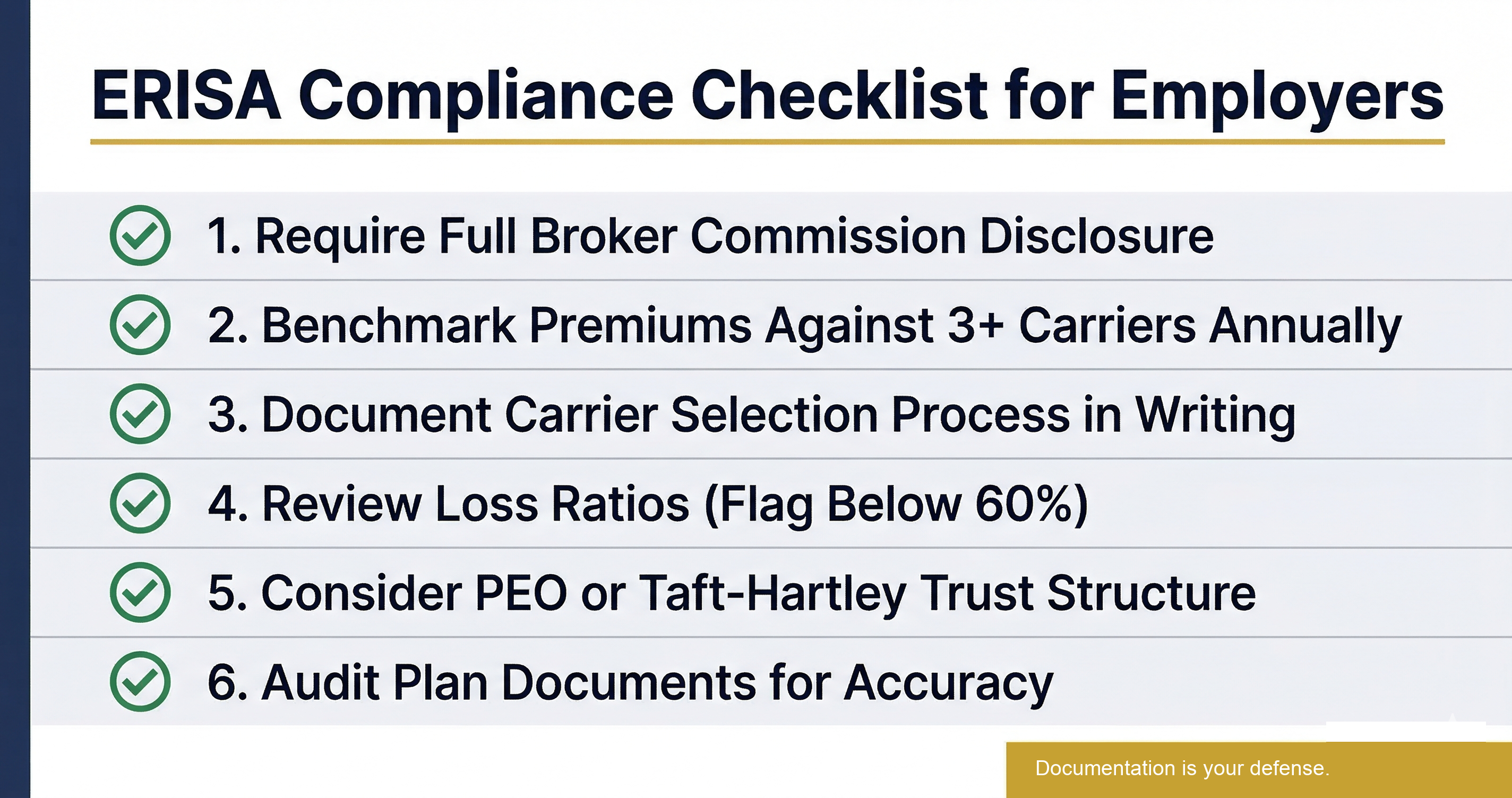
How to Protect Your Company: The ERISA Compliance Checklist
The good news: protecting your company is procedural, not expensive. The lawsuits target employers who did nothing — no benchmarking, no fee disclosure, no documentation. Creating a defensible process costs far less than defending a class action.
Here is what we recommend at Business Insurance Health based on our analysis of these cases:
1. Require Full Commission Disclosure from Your Broker
Ask your broker — in writing — to disclose all compensation they receive from every voluntary benefits carrier they recommend. This includes first-year commissions, renewal commissions, overrides, bonuses, and any indirect compensation. If they refuse, that tells you something.
2. Benchmark Voluntary Benefits Premiums Annually
Compare your voluntary benefits premiums against at least three alternative carriers every year. Document the comparison. Even if you stay with the current carrier, the record shows you exercised fiduciary diligence.
3. Document Your Carrier Selection Process
Create a written record of why you selected each voluntary benefits carrier. Note the factors considered: premium cost, coverage quality, claims payment record, commission levels, and service quality. This documentation is your primary defense if challenged.
4. Review Loss Ratios
Request loss ratio data from your voluntary benefits carriers. If a carrier is paying out less than 60% of collected premiums in claims, that is a signal that the premiums may be excessive — and that broker commissions or carrier margins are absorbing the difference.
5. Consider a PEO or Taft-Hartley Structure
One of the most effective ways to reduce ERISA fiduciary exposure is to shift the plan sponsorship to a Professional Employer Organization or a Taft-Hartley multiemployer trust. Under a PEO arrangement, the PEO becomes the plan sponsor and assumes the fiduciary responsibility for benefits selection and administration. Under a Taft-Hartley trust, the trust's board of trustees (jointly managed by employer and employee representatives) holds fiduciary responsibility.
This is a strategy that PEO4YOU implements specifically for companies concerned about fiduciary exposure. The multiemployer trust structure has an additional advantage: renewal increases consistently under 3%, compared to 7% to 9% for small group fully insured plans.5 You reduce legal risk and cost simultaneously.
6. Audit Your Plan Documents
Ensure your ERISA plan documents accurately describe the voluntary benefits offered, the process for carrier selection, and the fee structure. Outdated or vague plan documents create ambiguity that plaintiffs exploit.
"The employers being sued did not overpay for benefits. They underpaid for documentation. A $2,000 annual benchmarking process would have prevented a $20 million class action."
— BIH analysis of ERISA voluntary benefits litigation patterns
Why This Matters Even If You Have Fewer Than 100 Employees
The current lawsuits target companies with thousands of employees because the damages are larger. But ERISA's fiduciary standards apply to every employer who sponsors an ERISA-covered welfare plan — regardless of size.
The average deductible for workers at firms with 10 to 199 employees is $2,631, compared to $1,670 at larger firms.5 Smaller employers are already asking employees to absorb more cost. If those employees discover that their voluntary benefits premiums also include undisclosed broker markups, the sense of unfairness compounds — and so does the litigation risk as class action firms expand their target list.
For employers exploring alternatives to high-deductible fully insured plans, understanding what 100% employee-paid benefits really means is the first step toward a more transparent structure. And for companies evaluating whether a PEO health benefits model could reduce both costs and fiduciary risk, the comparison is worth running.
The Connection to Your Overall Benefits Strategy
ERISA voluntary benefits compliance does not exist in a vacuum. It connects directly to how you fund and administer your entire benefits program.
Companies that use a transparent, benchmarked approach to their core health benefits — through a PEO, Taft-Hartley trust, or properly structured self-funded plan — tend to apply the same rigor to voluntary benefits. The documentation habits transfer. The fiduciary mindset transfers.
Companies that hand everything to a single broker and never ask questions are the ones getting sued. Not because the broker was necessarily dishonest, but because the employer never verified. Under ERISA, the duty to investigate is non-delegable.2
Can an employer be liable under ERISA for voluntary benefits that employees pay for entirely?
Yes. Under ERISA Section 404, if you sponsor the plan and exercise discretion over provider selection, you have a fiduciary duty to ensure fees are reasonable — regardless of who pays the premiums. The new wave of lawsuits specifically targets this scenario, alleging that employers failed to benchmark broker commissions even though employees bore the full cost.1
What commission level on voluntary benefits is considered "excessive" under ERISA?
There is no specific percentage threshold. The standard is reasonableness in context — have you compared the fees to market rates? Have you documented the comparison? Commissions of 15% to 30% on voluntary benefits are common, but without benchmarking documentation, any commission level could be challenged as excessive. The process matters more than the number.
Does using a PEO eliminate ERISA fiduciary liability for voluntary benefits?
It significantly reduces it. In a PEO co-employment arrangement, the PEO typically becomes the plan sponsor and assumes fiduciary responsibility for benefits selection and administration. However, the employer should confirm in writing that the PEO agreement explicitly transfers fiduciary duties. PEO4YOU structures these arrangements specifically to address fiduciary risk.
How often should employers benchmark their voluntary benefits programs?
At minimum annually, and whenever a broker recommends a new carrier or a significant premium increase. The benchmarking should include at least three carrier alternatives and document the factors considered in the selection decision. This creates the defensible record that the current lawsuits target employers for lacking.
Are these ERISA lawsuits likely to expand to smaller employers?
The current wave targets companies with 1,000+ employees because the damages justify class action economics. However, the legal theory applies equally to any employer sponsoring an ERISA plan with voluntary benefits. As the litigation framework matures and early cases produce settlements, class action firms are expected to lower their size threshold. Employers with 100+ employees should act now; employers with 50+ should be aware.
Benchmark your plan design against market standards — including deductible levels, out-of-pocket maximums, and cost-sharing structures that affect both employee satisfaction and fiduciary compliance.
Frier Levitt, LLC. "Self-Funded Employee Health Benefit Plans and Consultants/Brokers Face String of ERISA Fiduciary Breach Lawsuits for Mismanagement of Voluntary Benefit Programs." February 2026. frierlevitt.com.
Holland & Knight LLP. "Understanding the New Wave of ERISA Litigation Targeting Voluntary Benefit Plans." January 2026. hklaw.com.
NAPA-Net (National Association of Plan Advisors). "Schlichter Bogard Unleashes a New ERISA Suit Genre." December 2025. napa-net.org.
Aon plc. "U.S. Employer Health Care Costs Expected to Rise 9.5 Percent in 2026." September 2025. aon.mediaroom.com. Projected costs exceeding $17,000 per employee.
Kaiser Family Foundation. "2025 Employer Health Benefits Survey." October 2025. kff.org. Average single premium $9,325; average deductible for firms with 10-199 workers: $2,631.
Buchanan Ingersoll & Rooney PC. "New Wave of ERISA Class Action Lawsuits Name Brokers as Defendants." January 2026. bipc.com.
Plan Sponsor Council of America (PSCA). "New Wave of ERISA Litigation Targets Voluntary Benefits." December 2025. psca.org.
National Association of Professional Employer Organizations (NAPEO). "PEO Industry Research & Data." 2025. napeo.org.
This analysis is provided for educational purposes and does not constitute financial or legal advice. The ERISA litigation landscape is evolving rapidly. Consult your ERISA counsel for guidance specific to your plan structure and voluntary benefits program.
About the Author
Sam Newland, CFP® is the Founder and President of Business Insurance Health and PEO4YOU. With 13+ years in the employee benefits industry and experience as the #1 face-to-face health benefits agent nationally, Sam built BIH on a transparency-first philosophy: "What Most Brokers Can't — or Won't — Show You." Contact: [email protected] | 857-255-9394
March 19, 2026
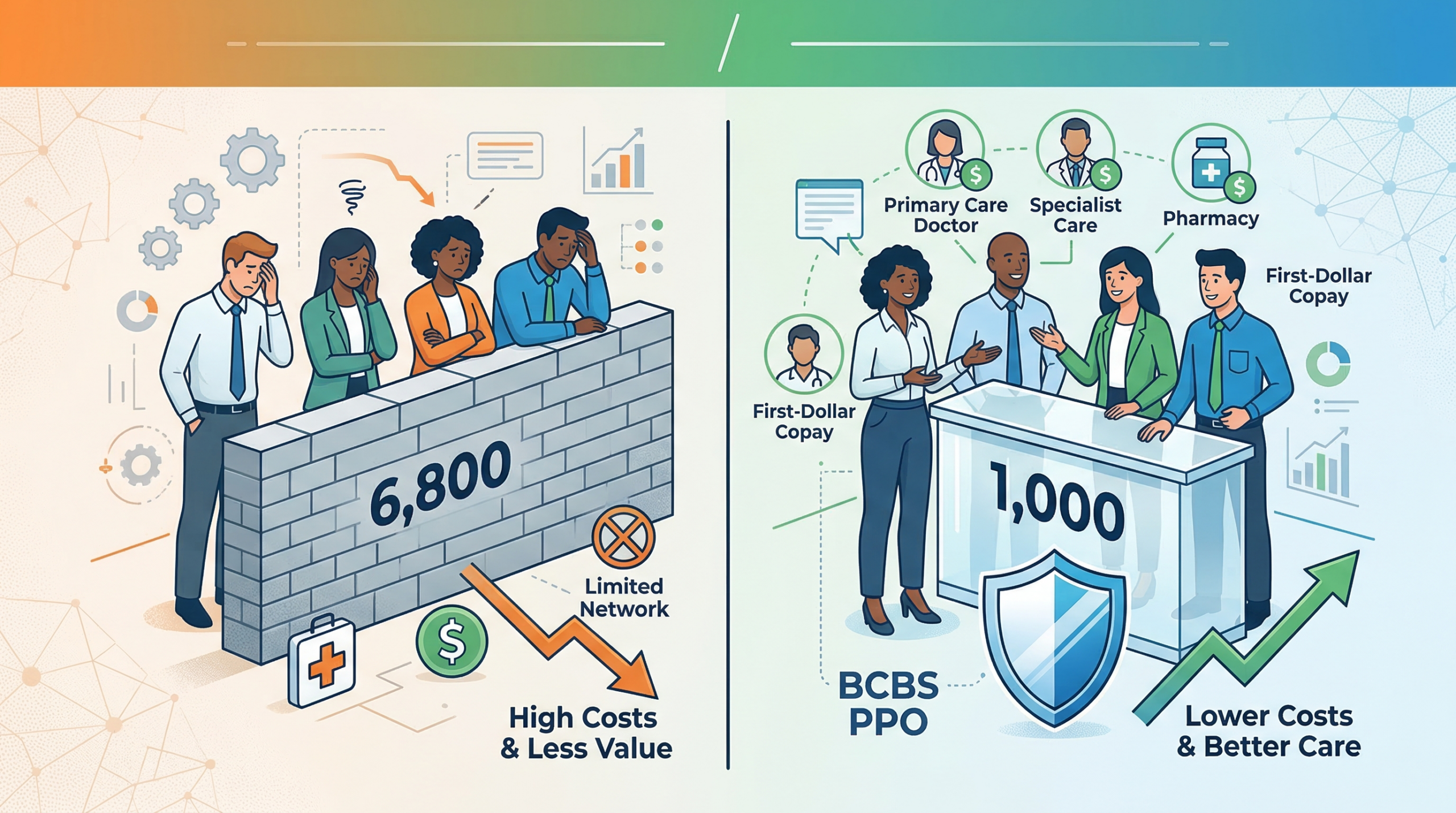
Your Employees Can't Actually Use a $6,800 Deductible Plan — Here's How to Get Them a $1,000 Deductible for Less
Sam Newland
March 19, 2026
Your Broker's Commission Could Get You Sued — Here's What Employers Need to Know About the New ERISA Lawsuits
Sam Newland
March 18, 2026
How Logistics Companies Cut Benefits Costs Without Losing Their Best Drivers
Sam Newland
March 18, 2026
When Should Your Startup Actually Start Offering Health Benefits?
Sam Newland
March 17, 2026
Health Plans for Small Manufacturers: How to Cut Costs Without Cutting Coverage
“We respect your privacy. Your contact information will be used solely for the purpose of responding to your inquiry and will not be shared with third parties.”
Click To Open Modal
Questions ?
Get In Touch We’re available 24/7
Floating Contact Form
Get In Touch—
We’re available 24/7
"*" indicates required fields
“We respect your privacy. Your contact information will be used solely for the purpose of responding to your inquiry and will not be shared with third parties.”
Question ?
Get In Touch We’re available 24/7
Floating Contact Form
Get In Touch—
We’re available 24/7
"*" indicates required fields
“We respect your privacy. Your contact information will be used solely for the purpose of responding to your inquiry and will not be shared with third parties.”
Thanks! We will be in touch soon. If you're looking to book a consultation now